Chapter 1: What the gut microbiome actually is
0:009:10
General

Your Gut Microbiome: Why It Controls Everything

Trillions of organisms in your gut affect immunity, mood, weight, and brain function. Separate science from hype.

Apr 22, 20269 min listen5 chapters
What you'll learn
  • What the microbiome is and how it develops
  • The gut-brain axis and its role in mental health
  • Probiotics, prebiotics, and fermented foods — what works
  • Red flags in gut health marketing vs. real science

Chapter 1: What the gut microbiome actually is

note

Your Gut Microbiome: Why It Controls Everything

Trillions of organisms in your gut affect immunity, mood, weight, and brain function. Separate science from hype.

note

The gut microbiome in plain language

The gut microbiome is the collection of microorganisms living in the digestive tract, especially the colon.

Main residents

  • Bacteria
  • Viruses, including bacteriophages that infect bacteria
  • Fungi
  • Archaea

Why it matters

  • Helps break down fiber
  • Produces short-chain fatty acids
  • Trains the immune system
  • Resists colonization by some pathogens

Development over time

  • Begins at birth
  • Changes rapidly in infancy
  • Becomes more stable by about age 3
  • Still shifts with diet, antibiotics, illness, and aging
diagram
equation
1011 to 1014 microbial cells in the gut, depending on how you count and where you sample10^{11} \text{ to } 10^{14} \text{ microbial cells in the gut, depending on how you count and where you sample}
note

Why fiber matters

Fiber is not just roughage. Many gut bacteria use it as fuel. When they ferment fiber, they make short-chain fatty acids. Those molecules help support the gut lining and influence immune signaling.

A useful analogy: you are not feeding yourself and the microbiome separately. You are feeding an ecosystem, and the ecosystem feeds parts of you back.

Chapter 2: How the gut talks to the brain

note

The gut-brain axis

The gut-brain axis is the two-way communication network between the digestive system and the central nervous system.

Main pathways

  • The vagus nerve
  • Hormones such as cortisol and serotonin-related signaling
  • Immune messengers like cytokines
  • Microbial metabolites such as short-chain fatty acids

What the evidence supports

  • Gut microbes can influence inflammation
  • Stress can change gut function and microbiota composition
  • Some probiotic strains may modestly affect stress or anxiety scores in small studies

What the evidence does not support

  • A single product that fixes mental health for everyone
  • Claims that the microbiome is the sole cause of depression or autism
diagram
chart · line
Evidence strength in gut brain research
Animal studiesObservational human studiesSmall probiotic trialsLarge clinical proof for mental health claims
note

A caution about headlines

When you read that a bacterium "controls mood," ask three questions:

  • Was the study done in mice or humans?
  • Was it one strain or many?
  • Did it measure symptoms, biology, or both?

Those distinctions matter. A mouse result is a clue, not a treatment plan.

Chapter 3: Probiotics, prebiotics, and fermented foods

note

Probiotics vs prebiotics vs fermented foods

Probiotics

Live microorganisms that provide a health benefit when taken in adequate amounts.

Prebiotics

Non-digestible substrates that feed beneficial microbes.

Fermented foods

Foods made using microbial fermentation. Not all are probiotic.

Examples with real-world use

  • Lactobacillus rhamnosus GG for some diarrhea prevention studies
  • Saccharomyces boulardii for some antibiotic-associated diarrhea cases
  • Inulin and galacto-oligosaccharides as prebiotic fibers
  • Yogurt and kefir as fermented foods with potential live cultures
diagram
note

What works best in practice

A useful pattern is this:

  • More plant diversity usually helps
  • Fiber supports microbial fermentation
  • A probiotic may help a narrow problem
  • Fermented foods can add variety, but they are not magic

Common side effects

  • Gas
  • Bloating
  • Temporary stool changes

If symptoms are severe, persistent, or worsening, that is not a probiotic problem. That is a reason to look for a medical cause.

Chapter 4: Gut health myths, marketing, and red flags

note

Red flags in gut health marketing

  • No strain listed
  • No dose listed
  • Claims to treat many unrelated problems
  • Uses words like detox or cleanse without defining them
  • Cites only testimonials
  • Confuses association with causation

Better questions to ask

  • What was studied?
  • In whom?
  • For how long?
  • Was the effect clinically meaningful?
  • Does the product match the study?
diagram
chart · bar
How to judge a microbiome claim
Strain namedDose namedOutcome studiedHuman trialMarketing promise
note

A practical skepticism rule

If a claim sounds like it should work for everyone, it usually works for no one in particular. Real biology is narrower, slower, and more specific than ads.

Chapter 5: What to do with the science

note

Evidence-based gut health habits

  • Eat a wide range of plant foods
  • Increase fiber gradually
  • Include fermented foods if you tolerate them
  • Use antibiotics only when needed
  • Sleep consistently
  • Move your body regularly

When to get medical advice

  • Blood in stool
  • Unexplained weight loss
  • Persistent diarrhea or constipation
  • Fever with gut symptoms
  • Severe abdominal pain
  • Symptoms that wake you from sleep
illustration
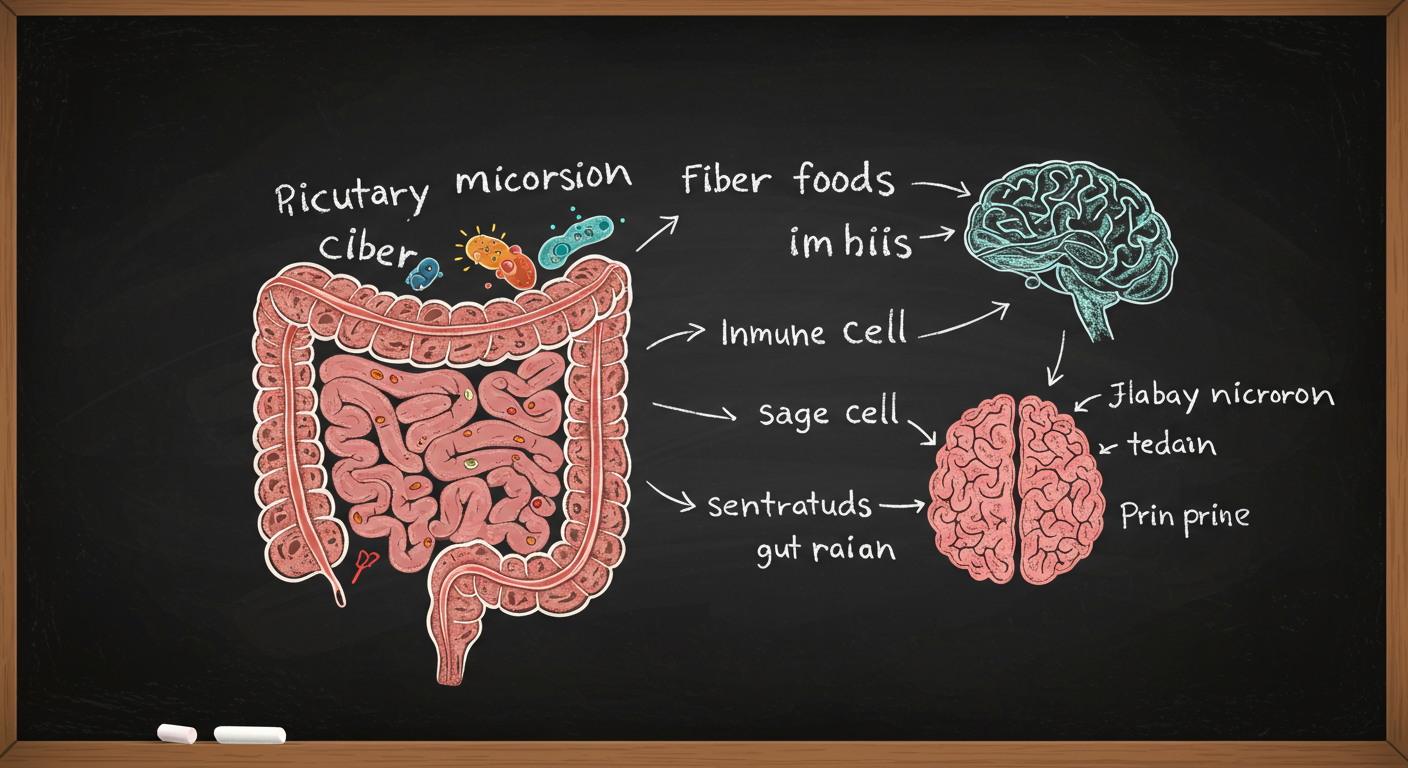
A cross section of the human digestive tract showing the colon filled with diverse gut microbes, fiber foods entering from one side, immune cells near the gut lining, and signals traveling to the brain
diagram
note

Bottom line

The microbiome influences immunity, digestion, and parts of the gut-brain axis. It can help or hurt depending on context. Your best tools are ordinary ones: food, sleep, movement, and caution with bold claims.

Transcript

Welcome to Slate. Today we're looking at Your Gut Microbiome: Why It Controls Everything. We'll cover What the microbiome is and how it develops, The gut-brain axis and its role in mental health, Probiotics, prebiotics, and fermented foods — what works, and Red flags in gut health marketing vs. real science. Let's get into it.

Your gut microbiome is the community of microbes living in your digestive tract. Most of them are bacteria, but there are also viruses, fungi, and archaea. One gram of colon content can hold around 10 to 100 billion microbial cells. That is more than the number of human cells in some tissues, but not more than your whole body by an order of magnitude. The modern estimate is that microbes and human cells are in the same ballpark, not that microbes outnumber you ten to one. Here is the key idea. Think of the gut like a crowded city. Different neighborhoods support different jobs. The small intestine is relatively sparse. The colon is the dense downtown district. There, microbes help break down fibers that your own enzymes cannot digest. In the process, they make short-chain fatty acids such as acetate, propionate, and butyrate. Butyrate is especially important because colon cells use it as fuel. The microbiome starts forming at birth and changes fast in the first three years of life. Delivery mode matters. Vaginal birth exposes infants to microbes from the mother’s vaginal and gut flora. Cesarean delivery shifts early colonization toward skin-associated microbes. Breastfeeding also shapes the community through human milk oligosaccharides, which are food for beneficial bacteria like Bifidobacterium. By age three, the microbiome begins to look more adult-like, but it still changes with diet, illness, antibiotics, sleep, and travel. Antibiotics can reduce diversity quickly. Sometimes the community recovers in weeks. Sometimes it takes months. That is why the microbiome is not a fixed fingerprint. It is more like a garden that responds to weather, soil, and what you plant in it.

The gut and the brain communicate through nerves, hormones, immune signals, and microbial chemicals. Scientists call this the gut-brain axis. The vagus nerve is one fast route. Immune molecules provide another. So do metabolites made by gut microbes. Here is the clean version of the science. The microbiome does not read your thoughts. It does not directly control mood like a remote control. But it can influence systems that affect mood, stress response, and inflammation. That is why the gut-brain axis is real, while many social-media claims are exaggerated. Stress can change gut function, and gut changes can feed back into stress. The relationship runs in both directions. In animal studies, transplanting microbiota from anxious or depressed animals can alter behavior. In humans, the evidence is more modest. We have associations, some small trials, and a few promising signals. We do not have proof that one probiotic cures anxiety or depression. The strongest clinical evidence in this area is still for general health habits. Diets rich in diverse plant fibers tend to support a more diverse microbiome. That often correlates with lower inflammation. Exercise also appears to help microbial diversity. Sleep loss and chronic stress can push the system in the opposite direction. Think of the gut-brain axis like a group chat with several channels. The brain sends messages. The gut sends messages back. If one channel is noisy, the whole conversation changes. But noise is not the same thing as control.

These three words get mixed up constantly, so the definitions matter. Probiotics are live microorganisms that, when given in adequate amounts, provide a health benefit. That definition comes from a 2014 expert consensus led by the International Scientific Association for Probiotics and Prebiotics. Prebiotics are substrates, usually fibers, that are selectively used by host microbes and confer a health benefit. Fermented foods are foods made with microbial fermentation, but they are not automatically probiotic. Here is the practical difference. A probiotic is a product with a specific strain and a studied dose. A prebiotic is food for your existing microbes. Fermented food is a food category, not a medical claim. For probiotics, strain matters. Lactobacillus rhamnosus GG is one of the best-studied strains. Bifidobacterium infantis 35624 has been studied for some IBS symptoms. Saccharomyces boulardii is a yeast used in certain cases of antibiotic-associated diarrhea. But effects are narrow. A strain that helps diarrhea may do nothing for bloating or anxiety. Prebiotics with evidence include inulin, fructo-oligosaccharides, and galacto-oligosaccharides. They can increase beneficial bacteria, but they can also cause gas and discomfort, especially in people with irritable bowel syndrome. Fermented foods can be useful, especially yogurt and kefir. But sauerkraut, kimchi, and kombucha vary widely. Some are pasteurized. Some are high in sugar or sodium. Some contain live microbes; some do not. The label matters more than the hype. A good rule is simple. Use food first when possible. Use a probiotic for a specific reason, with a specific strain, and a realistic expectation.

The microbiome has become a magnet for overselling. The most common trick is to take a real scientific idea and stretch it far beyond the evidence. For example, a company may point to a study on one strain in a small group of adults and then imply the entire product fixes immunity, weight, skin, and mood. That is not science. That is category inflation. Here is how to spot the red flags. First, vague labels. If a supplement only says Lactobacillus or Bifidobacterium without a strain code, you cannot tell whether the evidence applies. Second, huge promises. No probiotic should claim to cure depression, reverse obesity, or detox the body. Third, proprietary blends with no dose listed. If you do not know the dose, you cannot compare it to a study. Regulation also matters. In the United States, probiotics sold as supplements do not need pre-approval for efficacy the way drugs do. That means quality can vary. A 2023 analysis in Frontiers in Microbiology found that some commercial products did not contain the organisms listed on the label, or contained different amounts than advertised. That does not mean all products are bad. It means labels deserve skepticism. Another red flag is blaming the microbiome for everything. Yes, it matters in obesity, inflammatory bowel disease, and some infections. But weight change is still driven mainly by energy balance, behavior, hormones, medications, sleep, and genetics. The microbiome is one factor, not the whole story. The best marketing test is simple. Ask: what exact strain, what exact dose, what exact outcome, and in what kind of study? If the ad cannot answer those questions, the claim is probably ahead of the evidence.

The most evidence-based way to support your microbiome is not to chase miracle products. It is to build conditions that favor a resilient ecosystem. That usually means eating more diverse plant foods, getting enough fiber, using antibiotics only when medically needed, sleeping regularly, and managing chronic stress as best you can. A simple target is helpful. Many adults in the United States get far less fiber than recommended. The National Academy of Medicine sets adequate intake at 25 grams per day for adult women and 38 grams per day for adult men, or about 14 grams per 1,000 calories. Most people fall short of that. Increasing fiber slowly can reduce bloating and make the change easier to tolerate. If you want a food-first plan, think in categories. Beans, lentils, oats, barley, nuts, seeds, vegetables, fruits, and whole grains all help feed a broader microbial community. Fermented foods can add variety. Yogurt with live cultures is a practical option. So is kefir if you tolerate dairy. If you have IBS, inflammatory bowel disease, or recurrent infections, talk with a clinician before starting supplements or major diet changes. One final point. The microbiome is powerful, but it is not destiny. It changes with what you eat, what medicines you take, how you sleep, and how stressed you are. That is good news, because it means the system is responsive. Small, consistent habits usually beat dramatic claims. Here is the takeaway. Support the ecosystem, not the hype. Feed the microbes that help you. Question products that promise too much. And remember that good microbiome science is specific, testable, and modest about what it can prove.

XLinkedInWhatsApp

Keep going with Slate

Pick up where this left off in your own voice session.

Built with Slate