1. The mental shortcuts behind overspending
0:007:24
Business

Why You Overspend (And How to Stop)

Anchoring, loss aversion, and the tricks retailers use — the psychology behind your worst financial decisions.

Apr 22, 20267 min listen5 chapters
What you'll learn
  • Anchoring, loss aversion, and the endowment effect
  • How retailers engineer your purchasing decisions
  • The emotional spending cycle and how to break it
  • Evidence-based strategies to regain financial control

1. The mental shortcuts behind overspending

note

Why You Overspend (And How to Stop)

Anchoring, loss aversion, and the tricks retailers use — the psychology behind your worst financial decisions.

note

Anchoring, loss aversion, and the endowment effect

Anchoring is the pull of the first number you see.

Loss aversion is the fact that losing $100 hurts more than gaining $100 feels good.

The endowment effect is the tendency to value something more once you imagine it as yours.

These are not flaws in intelligence. They are features of human decision-making.

Why they matter in stores

A sale price does not exist in isolation. It sits next to a higher original price, a countdown timer, or a “only 2 left” message. That framing changes what your brain feels.

Real research

  • Daniel Kahneman and Amos Tversky published Prospect Theory in 1979.
  • Richard Thaler described the endowment effect in 1980.
  • In many studies, losses loom roughly twice as large as gains.

Simple rule

If a purchase feels urgent, ask: “What number am I anchored to, and who put it there?”

diagram
equation
Vperceived=VitemλL+Aλ>1 captures loss aversion, and A is the anchor effect.V_{perceived} = V_{item} - \lambda L + A \lambda > 1 \text{ captures loss aversion, and } A \text{ is the anchor effect.}
note

A quick example

A blender is listed at $199, then discounted to $129.

Your brain does not ask only, “Is $129 a good price for a blender?” It also asks, “Am I saving $70?”

That second question is the trap. The savings feel like money gained, even though you still spend $129.

A better comparison is this: would you still buy the blender if you never saw the $199 tag?

2. How retailers shape the choice before you choose

note

Retail design that steers spending

Retailers do not need to force a decision. They only need to shape the choice set.

Common tactics

  • Eye-level placement for high-margin items
  • End-cap displays at the ends of aisles
  • Bundles that make one option look like the smart default
  • Online preselected shipping or subscription options
  • “Bestseller” labels that reduce comparison effort

Why it works

Humans use context. We judge by contrast, not by absolute value.

Real evidence

Sheena Iyengar and Mark Lepper’s 2000 jam experiment found that a large display drew attention, but a smaller display led to more purchases.

Key idea

A store is not a neutral room. It is a decision environment.

diagram
chart · bar
Choice overload example
6 jam options24 jam optionsEye level itemBottom shelf item
note

Why defaults are powerful

A default option works like the path of least resistance. If the shipping box is already checked, many people leave it alone.

That is not laziness. It is cognitive economy.

The practical lesson is simple: when a choice is preselected, pause and reset it yourself.

3. The emotional spending cycle

note

The emotional spending loop

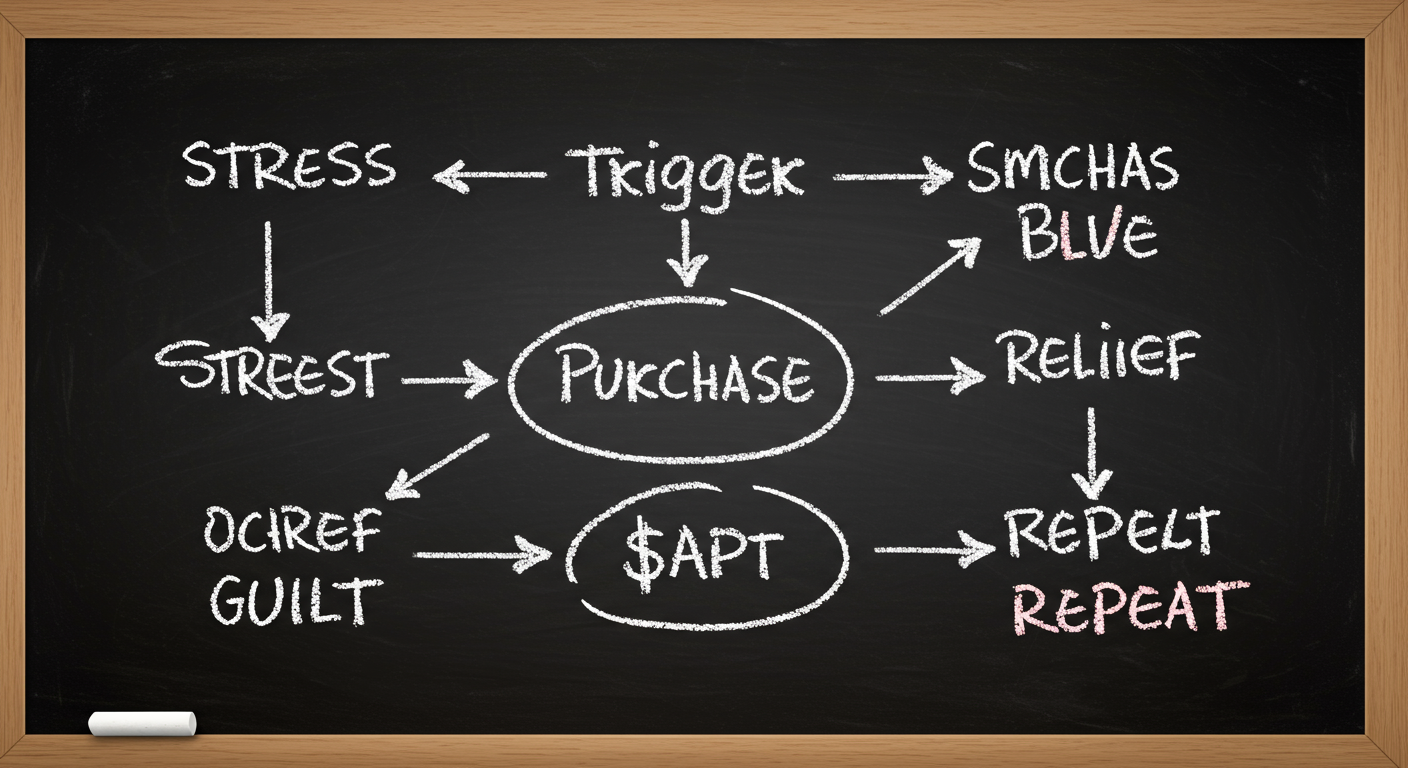
Overspending often follows a repeatable pattern:

  1. A feeling shows up.
  2. A trigger makes shopping feel comforting.
  3. Buying creates short-term relief.
  4. Guilt or debt creates a new stressor.
  5. The cycle starts again.

Common triggers

  • Stress after work
  • Boredom and scrolling
  • Loneliness
  • Celebration and reward
  • Social comparison

Why this is hard to resist

Present bias makes immediate relief feel more valuable than future cost.

Important distinction

The problem is not desire itself. The problem is using spending as the main tool for emotional relief.
diagram
illustration
A simple loop diagram showing stress, trigger, purchase, relief, guilt, and repeat with arrows

4. Evidence-based ways to stop overspending

note

Practical anti-overspending strategies

1. Use a cooling-off rule

Wait 24 hours for small nonessential purchases and 72 hours or longer for bigger ones.

2. Add friction

Remove saved cards, turn off one-click checkout, and avoid buy-now-pay-later unless you have a strict repayment plan.

3. Budget by category

Separate spending into categories such as food, transport, fun, and gifts.

4. Precommit

Use a one-in, one-out rule for clothes, gadgets, or home items.

5. Replace the ritual

If shopping is emotional relief, build a different relief ritual before you shop.

Why these work

They interrupt the moment when emotion is strongest and logic is weakest.

diagram
equation
Impulse cost=price+future regret+interest if unpaid\text{Impulse cost} = \text{price} + \text{future regret} + \text{interest if unpaid}
note

A useful rule of thumb

If a purchase only feels good while you are scrolling, it is probably satisfying the feeling, not the need.

5. A personal system that holds up in real life

note

Build a spending system that survives stress

Step 1: Identify your top trigger

Write down the last 10 impulse purchases and label the emotion behind each one.

Step 2: Add one barrier

Examples: delete saved cards, unsubscribe from promo emails, or remove shopping apps from the home screen.

Step 3: Add one replacement

Examples: a walk, a text to a friend, a snack, or a 10-minute reset.

Step 4: Review weekly

Look at your bank app once a week, not once a month, so small problems stay small.

What success looks like

Not zero spending. Better timing, better reasons, and fewer regrets.

diagram
chart · line
Impulse spending over time
Week 1Week 2Week 3Week 4Week 5
note

Final takeaway

Overspending is usually the result of a system, not a single bad choice.

Change the anchors. Slow the decision. Reduce friction. Replace the emotional payoff.

That is how spending starts to match your real priorities.

Transcript

Welcome to Slate. Today we're looking at Why You Overspend (And How to Stop). We'll cover Anchoring, loss aversion, and the endowment effect, How retailers engineer your purchasing decisions, The emotional spending cycle and how to break it, and Evidence-based strategies to regain financial control. Let's get into it.

Your brain does not shop like a spreadsheet. It uses shortcuts. That is efficient, but it also makes you easy to steer. Two of the biggest shortcuts are anchoring and loss aversion. Anchoring means the first number you see becomes a reference point. If a jacket is marked down from 300 dollars to 180, your mind compares 180 to 300, not to other jackets that cost 120. Loss aversion means losses hurt more than equal gains feel good. In a classic 1979 paper, Daniel Kahneman and Amos Tversky showed that people weigh losses about twice as strongly as gains. That is why a “limited-time” discount feels urgent. The store is not only offering a price. It is threatening you with a missed opportunity. Here’s the pattern on the screen: first number, then comparison, then emotional pressure. That pressure can make a mediocre deal feel like a rescue. The endowment effect adds another layer. Once you imagine an item as yours, you value it more. Richard Thaler’s 1980 mug experiments showed that people asked for much more money to give up a mug than they were willing to pay to get it. Ownership changes value in your head, the way a house feels bigger after you move in. Retailers know this. They make you picture possession early, before your rational brain has finished comparing alternatives.

Most shopping decisions are designed long before you feel like you are deciding. Stores arrange the path, the lighting, the shelf height, the timing, and the comparison set. That matters because people do not evaluate every option from scratch. We compare what is in front of us. Supermarkets put essentials like milk and eggs deep inside the store so you pass displays on the way. Eye-level shelves get more attention because we scan with effort, not with perfect logic. Online, the same idea shows up in a different costume. A “recommended” item, a preselected shipping option, or a bundle with one item highlighted changes the reference point. The diagram on the screen shows the funnel: attention first, then comparison, then emotion, then purchase. That is not an accident. It is architecture. Even the number of choices matters. Barry Schwartz popularized the “paradox of choice,” and experiments like Sheena Iyengar and Mark Lepper’s 2000 jam study showed that too many options can reduce purchases. When people saw 24 jams instead of 6, they were more likely to stop and look, but less likely to buy. More choice can create more doubt. Retailers often solve that doubt by nudging you toward the default or the bestseller. The result feels like freedom, but the menu was written to guide your hand.

Overspending is rarely just about the item. It is often about the feeling before the item and the feeling after. The cycle usually starts with stress, boredom, loneliness, or reward-seeking. Then comes a trigger. Maybe it is a difficult workday, a social media ad, or seeing someone else’s purchase. Then you get a burst of relief from imagining the item. That relief is powerful because it arrives before the bill. The purchase itself gives a short dopamine-linked reward, especially when the item is novel or tied to identity. Then comes the aftershock: guilt, clutter, and sometimes more stress. That can restart the cycle. Here’s the visual loop: feeling, trigger, buy, relief, regret, repeat. The loop matters because it means spending is often emotion regulation, not just consumption. In behavioral economics, present bias helps explain this. We heavily discount future costs compared with immediate comfort. That is why a $40 impulse buy can feel easier than skipping it, even if you know the credit card bill is coming. The goal is not to become emotionless. The goal is to interrupt the loop earlier, before the purchase becomes the fastest path to relief. Once you can name the feeling, you can choose a different response.

Stopping overspending is easier when you build friction into the moment of purchase. That is because willpower is unreliable under stress, but systems can hold. Start with a cooling-off rule. For any nonessential purchase over a set amount, wait 24 hours. For bigger items, wait 72 hours or a full week. This helps the emotional peak fade. Next, remove frictionless payment. If one-click checkout, saved cards, or buy-now-pay-later makes spending too easy, delete the saved card and require manual entry. Research on defaults and friction shows that tiny barriers change behavior more than people expect. Use category budgets, not just one big monthly number. A grocery budget and a fun-money budget are easier to follow than one vague limit. Then precommit. Decide in advance that if you want a new item, you must sell or donate one old item first. That weakens the endowment effect because ownership becomes visible and comparable. Another strong tactic is replacement, not deprivation. If shopping relieves stress, replace the ritual with a walk, a call, or a ten-minute reset. The diagram shows the sequence: trigger, pause, check the budget, compare alternatives, then buy only if it still fits. This is not about never spending. It is about making the default path the thoughtful path.

The best money system is one you can follow on a tired Tuesday, not just on a motivated Sunday. Start by tracking the last ten nonessential purchases and writing the trigger beside each one. You are looking for patterns, not shame. Maybe stress drives food delivery. Maybe boredom drives small online orders. Maybe social comparison drives clothing purchases. Once you know the trigger, choose one barrier and one replacement. For example, if late-night scrolling causes spending, set a phone cutoff and move shopping apps off the home screen. If restaurant spending is the problem, plan two default meals for busy nights. Small systems beat dramatic promises because habits live in repetition. A good check is this: if a purchase would still make sense after a good night’s sleep, a clear budget, and a look at your bank balance, it is probably a real choice. If it only makes sense in the heat of the moment, it is probably a mood purchase. The final screen shows the whole lesson together: retailers shape the choice, psychology shapes the feeling, and your system shapes the outcome. You do not need perfect self-control. You need fewer high-pressure moments and more time between wanting and buying. That gap is where better decisions live.

XLinkedInWhatsApp

Keep going with Slate

Pick up where this left off in your own voice session.

Built with Slate