1. Why nuclear energy fell out of favor
0:007:13
Science

Why Nuclear Energy Is Making a Comeback

Small modular reactors, AI energy demands, and the safety record — why nuclear went from feared to funded in 2026.

Apr 22, 20267 min listen5 chapters
What you'll learn
  • How modern reactors differ from Chernobyl-era designs
  • Small modular reactors and why they change the game
  • The safety debate with updated data
  • Why tech companies are investing in nuclear

1. Why nuclear energy fell out of favor

note

Why Nuclear Energy Is Making a Comeback

Small modular reactors, AI energy demands, and the safety record — why nuclear went from feared to funded in 2026.

note

Why nuclear lost public trust

Nuclear power became associated with rare but unforgettable accidents.

Three Mile Island in 1979 damaged confidence in the United States. Chernobyl in 1986 showed how a flawed reactor design and unsafe operations can turn a test into catastrophe. Fukushima Daiichi in 2011 showed that even a modern plant can be overwhelmed by extreme natural events.

The core problem was not that nuclear power always fails. The problem was that when it fails, the consequences can be dramatic, long-lived, and politically devastating.

The economics also changed

From the 1980s through the 2000s, cheap natural gas and long construction timelines made new reactors hard to finance. A plant that takes 10 to 15 years to build ties up capital for a very long time. That is hard for utilities, and even harder for investors.

Key idea

Nuclear energy did not disappear because it became technically impossible. It lost momentum because safety fears, regulation, and financing all became harder at once.

diagram
chart · line
U S nuclear share of electricity over time
19701985200020102023

2. What makes modern reactors different

note

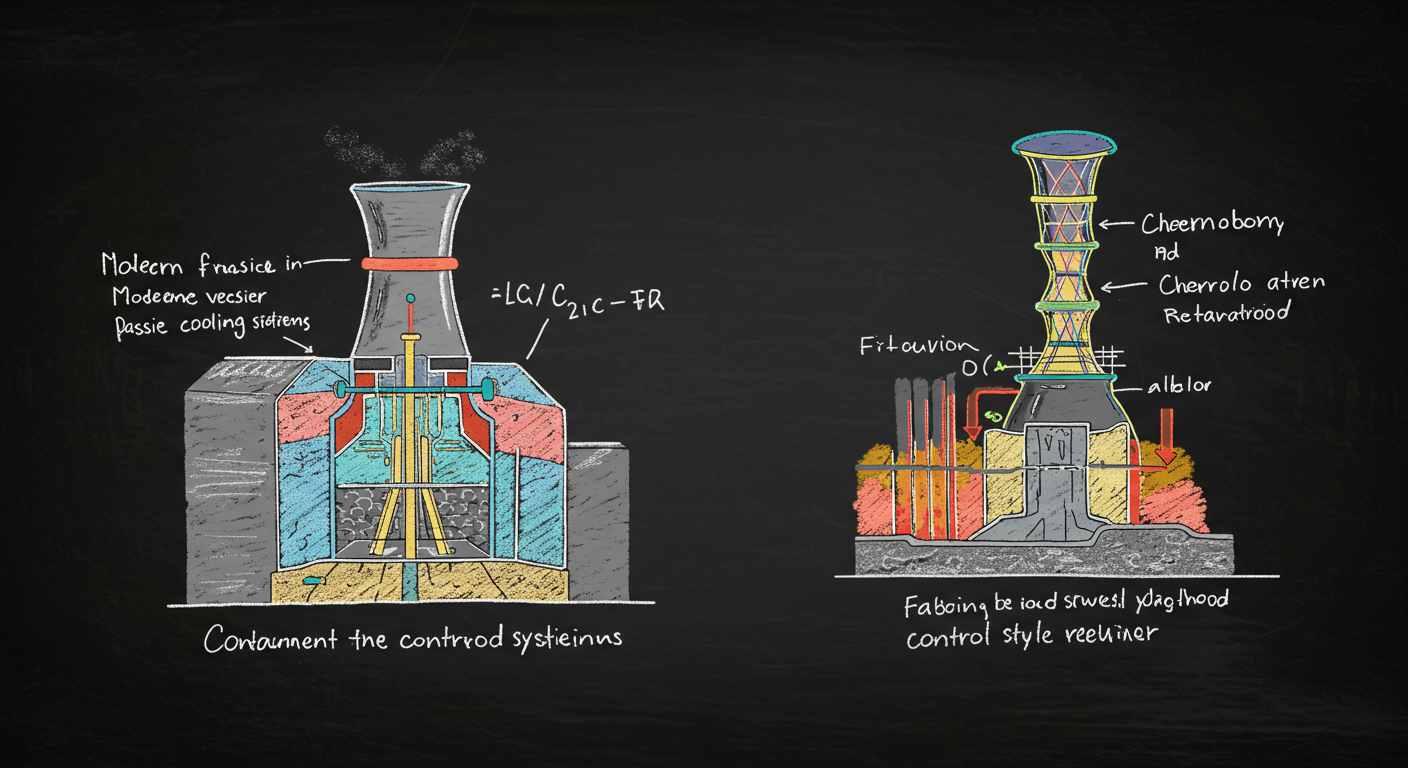
Modern reactor design versus Chernobyl-era design

Chernobyl used an RBMK reactor. That design had two major weaknesses: a positive void coefficient and poor containment.

A positive void coefficient means that as water turns to steam, the reactor can become more reactive instead of less reactive. That is the opposite of what you want in an emergency.

Modern light-water reactors are designed so rising temperature and changing water density tend to reduce reactivity. That creates a natural brake.

Passive safety

Passive safety uses gravity, natural circulation, and heat conduction. If power is lost, the reactor can still shed heat without a human operator pressing the right button at the right second.

Why this matters

The safest system is not the one that assumes perfect operators. It is the one that stays stable when people are tired, delayed, or wrong.
diagram
illustration
cross section of a modern nuclear reactor showing containment vessel passive cooling systems control rods and heat flow compared with a Chernobyl style reactor

3. Small modular reactors and why they matter

note

What an SMR is

A small modular reactor is a nuclear reactor designed to be built in smaller units and assembled from standardized modules.

The U.S. Department of Energy commonly uses 300 megawatts of electricity per module as an upper reference point. That is far below the output of a large reactor, which can exceed 1,000 megawatts.

Why modular construction matters

Traditional nuclear plants are custom megaprojects. Custom projects are slow, expensive, and vulnerable to delays.

Modular construction aims to move more work into factories. That can improve quality control and shorten construction time.

Real-world caution

NuScale’s design was certified by the U.S. Nuclear Regulatory Commission in 2020. But the Utah Associated Municipal Power Systems project was canceled in 2023 after projected costs increased.

That is why the SMR story is about economics as much as technology.

diagram
python
# Simple comparison of build-time risk for large plants vs SMRs
large_plant_years = 10
smr_years = 4
financing_cost_per_year = 0.08

large_risk = large_plant_years * financing_cost_per_year
smr_risk = smr_years * financing_cost_per_year

print('Large plant financing burden:', round(large_risk, 2))
print('SMR financing burden:', round(smr_risk, 2))
print('Relative reduction:', round((large_risk - smr_risk) / large_risk * 100, 1), '%')

4. Is nuclear actually safe

note

Safety record in context

Per unit of electricity, nuclear has one of the lowest death rates among major energy sources.

A widely cited estimate from Our World in Data is about 0.03 deaths per terawatt-hour for nuclear. For coal, the estimate is about 24.6 deaths per terawatt-hour.

That difference is enormous.

But accidents still matter

Fukushima did not produce confirmed radiation deaths in the first year, but it triggered mass evacuation and long-term disruption. Safety is not only about fatalities. It is also about displacement, cleanup, and public trust.

The real comparison

The useful comparison is not nuclear versus perfection. It is nuclear versus the full cost of fossil fuels, blackouts, and climate damage.

equation
Deaths per TWhcoal24.6,Deaths per TWhnuclear0.03,24.60.03820\text{Deaths per TWh}_{\text{coal}} \approx 24.6, \quad \text{Deaths per TWh}_{\text{nuclear}} \approx 0.03, \quad \frac{24.6}{0.03} \approx 820
chart · bar
Deaths per terawatt hour by energy source
CoalOilNatural gasSolarNuclear

5. Why tech companies are funding nuclear now

note

Why big tech cares

Data centers need electricity every hour of every day. AI training and inference increase that demand. A cloud company cannot tell users to wait for sunset.

Nuclear fits the use case

Nuclear provides firm power. That means steady output, day and night. It also has very low lifecycle carbon emissions, about 12 grams of carbon dioxide equivalent per kilowatt-hour according to the International Energy Agency.

Why the money is moving

Companies are not buying nuclear because it is trendy. They are buying it because they need predictable power prices, low-carbon electricity, and enough capacity to support AI growth.

diagram
chart · pie
Why tech firms want nuclear
24 7 powerLow carbonPrice stabilityScale

Transcript

Welcome to Slate. Today we're looking at Why Nuclear Energy Is Making a Comeback. We'll cover How modern reactors differ from Chernobyl-era designs, Small modular reactors and why they change the game, The safety debate with updated data, and Why tech companies are investing in nuclear. Let's get into it.

Nuclear power’s reputation was shaped by three disasters, not by the full record. Three Mile Island happened in 1979 in Pennsylvania. Chernobyl exploded in 1986 in Ukraine. Fukushima Daiichi was hit by a tsunami in 2011. Each one was different, but together they taught the public to fear one thing above all: loss of control. That fear stuck because nuclear plants are invisible once they are built. You do not see fuel trucks arriving every hour. You do not see carbon coming out of a smokestack. You mostly see the risk, not the benefit. Here’s the useful comparison: a coal plant is like a campfire you can watch, while a reactor is like a pressure cooker sealed inside a locked box. If the box is badly designed, the pressure matters more than the fire. In the 1980s and 1990s, nuclear also lost ground because natural gas got cheap, construction costs climbed, and projects took too long. In the United States, the average nuclear plant construction time was often measured in a decade or more. That made financing brutal. The lesson is simple. Nuclear did not fail because physics stopped working. It struggled because public trust, regulation, and economics all moved against it at the same time.

The old stereotype is a reactor waiting to overheat. Modern designs attack that problem at the source. Many new reactors use passive safety, which means they rely on physics instead of pumps and human timing. Gravity, natural circulation, and heat conduction do the work. That matters because a system that cools itself for hours without electricity is much harder to push into disaster. Think of the difference between a car that needs a driver to keep it from rolling downhill and a car with a built-in parking brake. The parking brake is simpler, and in an emergency it is more reliable. Modern reactors also use stronger containment structures and improved fuel designs. Some are designed to shut down automatically if temperature rises too high. Others use low-enriched uranium fuel in forms that are less likely to overheat than the fuel used at Chernobyl. Chernobyl’s RBMK design had a dangerous positive void coefficient and no robust containment. That combination helped make the accident so severe. Most modern commercial reactors in the West are pressurized water reactors or boiling water reactors with very different safety features. The big shift is this: the newest designs try to make a serious accident physically harder, not just procedurally forbidden.

Small modular reactors, or S-M-Rs, are changing the conversation because they change the factory model. A traditional gigawatt-scale reactor is a one-off megaproject. An S-M-R is meant to be built in modules, shipped to site, and assembled more like industrial equipment. That can cut schedule risk. It can also reduce the financial cliff that comes with betting billions on a single giant build. The U.S. Department of Energy has described S-M-Rs as reactors that typically produce up to 300 megawatts of electricity per module. That is much smaller than a large conventional plant, but size is not the only point. Smaller reactors can be sited for industrial heat, remote grids, or data centers where a full-size plant would be overkill. The tradeoff is straightforward. Smaller units may be easier to finance and standardize, but they must still prove they can be built cheaply enough to compete. NuScale’s design became the first S-M-R to receive U.S. Nuclear Regulatory Commission design certification in 2020, but its planned Idaho project was later canceled in 2023 after costs rose. That is the real lesson. S-M-Rs are promising because they reduce complexity. They are not magic. Their success depends on repeatable manufacturing, not just clever engineering on paper.

Safety is the question people ask when they are being honest. The answer has to be honest too. Nuclear power has caused far fewer deaths per unit of electricity than coal, oil, or even biomass. A major analysis by Our World in Data, using studies from the Intergovernmental Panel on Climate Change and others, estimates around 0.03 deaths per terawatt-hour for nuclear, compared with about 24.6 for coal. That is a huge gap. But averages can hide real suffering. Chernobyl caused immediate deaths and long-term contamination. Fukushima caused no radiation deaths confirmed in the first year, but it displaced more than 100,000 people and created enormous social harm. So the safety debate has two layers. First, the statistical risk of death from nuclear electricity is low. Second, the societal cost of a major accident is high, especially when evacuation and distrust spread far beyond the plant fence. Modern designs try to shrink both risks. They reduce the chance of core damage and make emergency cooling more robust. They also use smaller fuel inventories in some designs, which can limit worst-case releases. The right question is not whether nuclear is perfectly safe. Nothing in energy is. The real question is whether it is safer than the alternatives at the scale we need.

The new demand signal is electricity. Artificial intelligence data centers need huge amounts of round-the-clock power. A single large data center campus can draw hundreds of megawatts. Some of the biggest AI training clusters are pushing toward gigawatt-scale demand when you include cooling and surrounding infrastructure. That kind of load is hard to serve with solar alone, because the sun sets. It is hard to serve with gas alone if companies want lower carbon emissions and price stability. Nuclear offers something rare: firm power with very low operational carbon emissions. The International Energy Agency has estimated nuclear lifecycle emissions at about 12 grams of carbon dioxide equivalent per kilowatt-hour, similar to wind and much lower than gas or coal. That is why companies like Microsoft, Google, Amazon, and Meta have all explored nuclear-linked deals, from power purchase agreements to advanced reactor partnerships. The logic is not sentimental. It is arithmetic. Tech firms want power that is clean, constant, and available at scale. Nuclear still has hurdles: licensing, construction risk, and waste management. But in 2026, the equation changed because the demand for always-on electricity got bigger, and the climate target got tighter. Nuclear is back not because fear disappeared, but because the grid now needs what nuclear does well.

XLinkedInWhatsApp

Keep going with Slate

Pick up where this left off in your own voice session.

Built with Slate