Why Is English So Weird? A History of the Language
Silent letters, irregular verbs, and 'ough' — how Vikings, monks, and the French broke English and made it global.
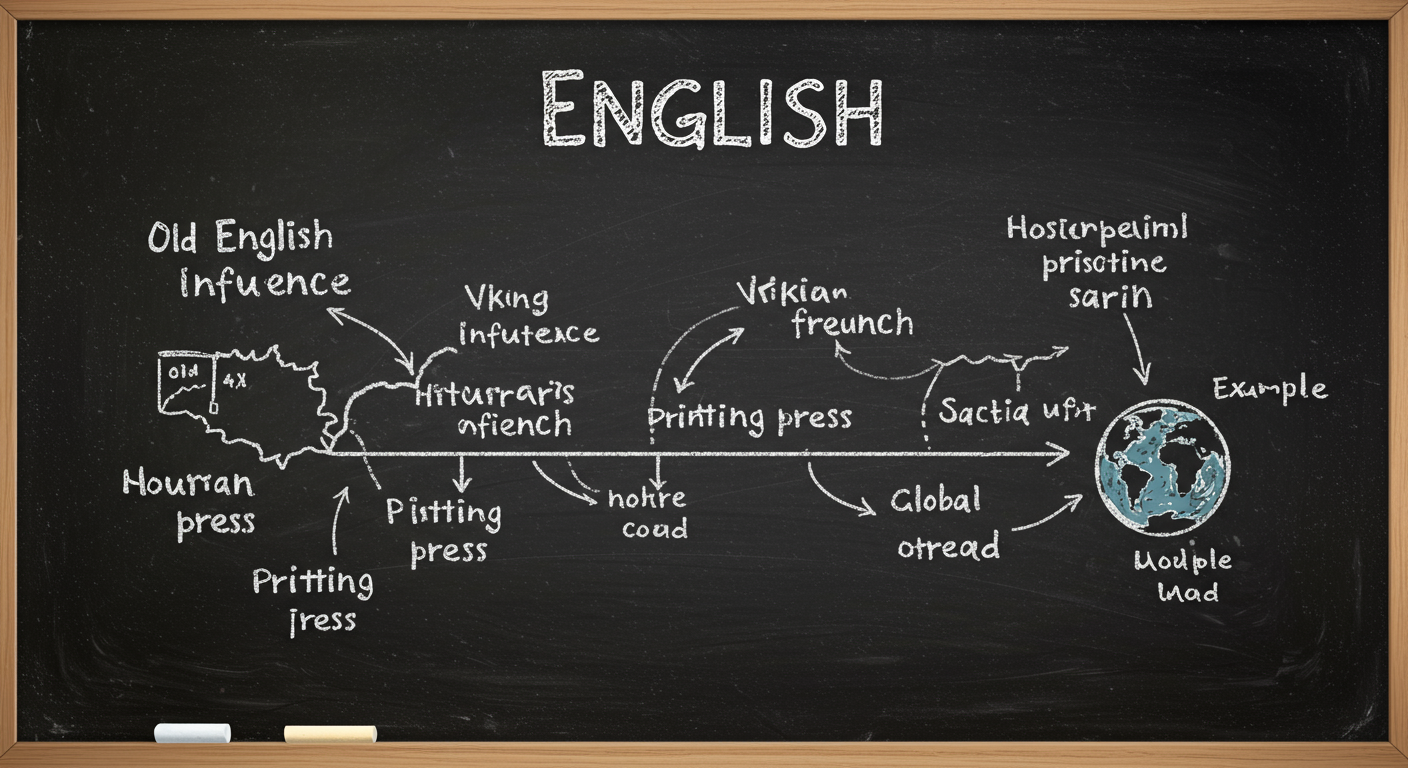
- Old English, Middle English, Modern English — the three eras
- How Norse, Latin, and French invasions layered onto English
- Why English spelling is so inconsistent (blame the printing press)
- How English became the global lingua franca
Three Englishes in One Language
Why Is English So Weird? A History of the Language
Silent letters, irregular verbs, and 'ough' — how Vikings, monks, and the French broke English and made it global.
The Three Eras of English
Old English c. 450 to 1100
- Germanic roots from Anglo Saxon settlers
- Heavy grammar with noun cases and grammatical gender
- Vocabulary mostly native Germanic words
Middle English c. 1100 to 1500
- Norman French after 1066 adds prestige vocabulary
- Grammar simplifies as endings erode
- Regional spelling varies widely
Modern English c. 1500 to present
- Printing helps standardize spelling
- Latin and Greek words flood in through scholarship
- English expands worldwide through trade, empire, and migration
Core pattern
English grammar became simpler, while English vocabulary became larger and more mixed.
Why the language feels mixed
Native words usually cover everyday life: mother, bread, water, hand.
French and Latin words often sound formal, legal, or academic: liberty, justice, information, university.
That split is a clue to history, not a flaw. It reflects who had power, who wrote, and who taught.
How Vikings, Monks, and the French Changed English
Vocabulary layers from contact
Old Norse
- sky
- take
- get
- they, them, their
Latin
- altar
- scripture
- minister
- school
French
- court
- justice
- government
- beauty
Useful contrast
- ask versus question
- house versus mansion
- sheep versus mutton
The native word is often shorter and plainer. The borrowed word often sounds more formal or specialized.
Why mutual understanding mattered
Old Norse and Old English were close enough that speakers could borrow grammar habits as well as words. That helped simplify English endings. When adults learn each other’s language in daily life, they often drop hard-to-master inflections first.
Why English Spelling Looks Broken
Why spelling and sound drift apart
Three main reasons
- Printing fixed many spellings before pronunciation finished changing
- The Great Vowel Shift changed long vowels between about 1400 and 1700
- Scholars sometimes added letters to show Latin roots
Examples
- through, though, rough
- knight, write, know
- debt, doubt, island
Key point
English spelling often tells you where a word came from, not exactly how it sounds today.
Why ough is the famous nightmare
The letters o-u-g-h represent several different historical pronunciations:
- through once had a sound like the German ch in Bach
- though kept a different vowel and lost the final fricative
- rough kept a rougher fricative sound
One spelling, many histories. That is English in a nutshell.
Irregular Verbs and the Grammar That Survived
Why some verbs stay irregular
High-frequency verbs resist change
- go → went
- be → am, is, are, was, were
- have → has
- do → did
Why this happens
People use these verbs constantly. Frequent use keeps old forms alive.
English grammar today
- fewer endings than Old English
- fixed word order does more of the work
- phrasal verbs remain very common
The grammar tradeoff
English lost many endings, which made it easier in one sense. But it also had to rely more on word order and helper words. So the language became simpler in morphology and more dependent on syntax.
How English Became Global
How English went global
Major forces
- British Empire from the seventeenth through twentieth centuries
- United States power after 1945
- International trade, science, aviation, and the internet
What lingua franca means
A shared language used by speakers with different native languages.
Real-world scale
- About 1.5 billion total users in Ethnologue 2024 estimates
- Roughly 380 million native speakers
- Many more speak it as a second or additional language
Why English keeps changing
When a language is used by millions of second-language speakers, it does not stay still. New pronunciations, new slang, and new local forms appear. That is why global English is many Englishes, not one frozen standard.
The bottom line
English looks weird because it is old, borrowed, standardized late, and spread widely. Its spelling preserves history. Its vocabulary records conquest and scholarship. Its global role reflects power and networks.
Keep going with Slate
Pick up where this left off in your own voice session.