Why Did the Roman Empire Fall?
Explore the Roman Empire's collapse through the lens of cascading system failures in money, military, and legitimacy.
- Identify the three core pillars of imperial stability
- Understand how feedback loops accelerate system collapse
- Analyze the trade-offs between immediate military needs and long-term fiscal health
- Recognize how political fragmentation and external pressure amplify internal weakness
The Core System: Money, Military, and Legitimacy
Cause vs. feedback loop
- Cause: the initial push that weakens the system.
- Feedback loop: the weakening then makes itself worse.
Example:
- High taxes can be a cause of unrest.
- Unrest then reduces tax collection, which creates more fiscal stress.
So a feedback loop is a cause that keeps amplifying its own effect.
The Fiscal Pressure Trap
Question
If you were the emperor and tax revenue gets less reliable, what happens first:
- pay the army less
- borrow more
- squeeze more out of taxpayers?
Money side: the key answer
When revenue gets unreliable, the emperor is pushed into bad tradeoffs:
- Pay the army less → risk revolt or weak loyalty
- Borrow more → worsens long-term financial strain
- Squeeze taxpayers → creates unrest and reduces trust
So the deeper problem is not just “less money.” It is a pressure trap where every response creates another problem.
Money side: question, answer, feedback loop
Question: If tax revenue becomes less reliable, what does the state do?
Answer: It may try to pay the army less, borrow more, or squeeze more out of taxpayers.
Feedback loop:
- paying the army less can cause revolt or weak loyalty
- borrowing more increases long-term debt stress
- squeezing taxpayers creates unrest
- unrest and instability reduce tax collection
- lower tax collection makes the fiscal problem worse
Military Strain and Legitimacy Loss
Military side: question, answer, feedback loop
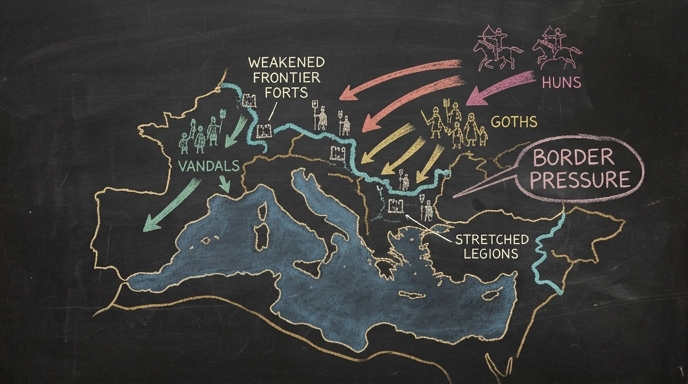
Question: What happens when the empire does not have enough manpower to defend its borders?
Answer: Defenses get thinner, enemies exploit the weakness, and the empire struggles to hold territory.
Feedback loop:
- weak defense invites more attacks
- attacks consume soldiers and resources
- losses reduce manpower and morale
- lower morale and fewer troops make defense even weaker
Legitimacy side: question, answer, feedback loop
Question: If the public stops trusting the state, what breaks first?
Answer: Obedience usually breaks first. After that, people start questioning governance, and eventually succession becomes unstable too.
Feedback loop:
- lower trust reduces obedience
- weaker obedience makes governance harder
- the state responds with force or propaganda
- that response can lower trust further
- over time, succession becomes contested or unstable
Fragmentation and External Pressure
Political fragmentation: question, answer, feedback loop
Question: What happens when power stops being centralized?
Answer: Local generals, governors, or elites begin acting on their own instead of following one coordinated center.
Example: A regional commander may be more loyal to his own troops or province than to Rome.
Feedback loop:
- divided power makes coordination harder
- the emperor loses control over taxes, armies, and policy
- local actors gain more independence
- that weakens central authority even further
The Cascading Failure Summary
Final notes
- Roman collapse was not one cause; it was cascading failure.
- The three core buckets were money, military, and legitimacy.
- Political fragmentation and the East-West split weakened coordination.
- Inflation, corruption, and overextension mostly acted as amplifiers.
- The useful lesson: institutions often fall when several feedback loops reinforce each other at once.
Keep going with Slate
Pick up where this left off in your own voice session.