1. Loneliness is a health risk, not a mood
0:007:07
Humanities

Why Are We So Lonely? The Connection Crisis

Loneliness is as deadly as smoking 15 cigarettes a day. Why community collapsed and how people are rebuilding it.

Apr 22, 20267 min listen5 chapters
What you'll learn
  • The health impact of loneliness — comparable to smoking 15 cigarettes a day
  • Why third places are disappearing and why it matters
  • Run clubs, co-living, and the new community movements
  • Evidence-based strategies for building meaningful connections

1. Loneliness is a health risk, not a mood

note

Why Are We So Lonely? The Connection Crisis

Loneliness is as deadly as smoking 15 cigarettes a day. Why community collapsed and how people are rebuilding it.

note

Loneliness and health: what the evidence shows

Loneliness is the subjective feeling of being socially disconnected. Social isolation is the objective state of having few contacts. They overlap, but they are not the same.

A major 2010 meta-analysis by Julianne Holt-Lunstad, Timothy Smith, and J. Bradley Layton found that stronger social relationships were associated with a 50% higher likelihood of survival. Later work in 2015 by Holt-Lunstad and colleagues estimated that social isolation and loneliness carry health risks comparable in magnitude to well-known medical risks such as obesity and smoking.

Why this matters:

  • Loneliness increases chronic stress
  • Chronic stress raises cortisol and blood pressure
  • Over time, that can affect sleep, immunity, and cardiovascular health

A useful analogy: loneliness is like running a house with the alarm system stuck on. The alarm is meant for short emergencies. If it never shuts off, the wiring starts to suffer.

diagram
chart · bar
Social risk factors and survival impact
Strong relationshipsWeak relationshipsLonelinessSocial isolation

2. How we lost the places that used to hold us together

note

Third places: the social infrastructure of everyday life

Ray Oldenburg coined the term third place in 1989. His point was simple: people need settings outside home and work where they can meet regularly without a formal agenda.

Classic third places include:

  • cafés and diners
  • libraries
  • parks
  • barbershops and salons
  • faith communities
  • union halls and community centers

Why they matter:

  • they create repeated contact
  • they lower the cost of showing up
  • they make weak ties possible
  • they turn strangers into familiar faces

When third places decline, connection becomes more effortful. That is a big deal, because friendships usually start with repetition, not intensity.
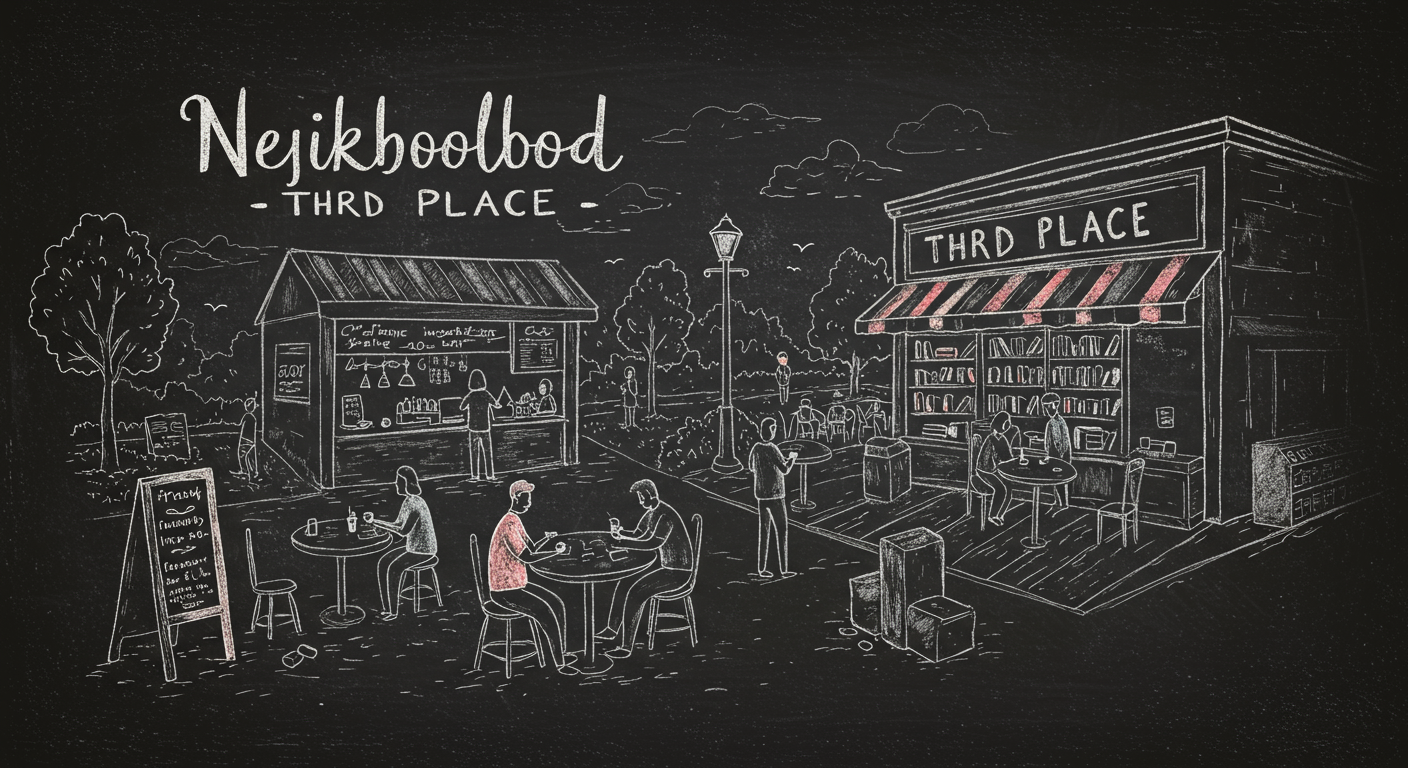
diagram
illustration
A neighborhood third place with people talking at tables, a barista serving coffee, a library corner, and a park bench nearby

3. Why modern life makes connection harder

note

Why connection got harder

Several forces push in the same direction:

  • suburban design increases distance between people
  • car dependence reduces walk-by encounters
  • remote and hybrid work reduce repeated face-to-face contact
  • digital entertainment fills small gaps that used to be social
  • rising costs make some community spaces less accessible

The key tradeoff is efficiency versus overlap. Friendship usually grows in the overlap: the repeated, low-stakes moments where people become recognizable to each other.

diagram
chart · line
A simple model of contact frequency
1990200020102020Today

4. What people are rebuilding now

note

New community movements

Examples of modern connection-building models:

  • run clubs
  • co-living houses
  • volunteer networks
  • hobby meetups
  • faith-adjacent and values-based groups
  • coworking communities with social rituals

Why they work:

  • they are activity-first, so conversation has a natural starting point
  • they reward repetition, which helps trust develop
  • they reduce the pressure to “perform” socially

Analogy: friendship is less like a job interview and more like becoming a regular at a neighborhood café. Familiarity does most of the work.

diagram
python
def connection_score(repetition, ease, shared_activity):
    # Simple teaching model, not a clinical tool
    return 0.4 * repetition + 0.3 * ease + 0.3 * shared_activity

examples = {
    'one_off_party': connection_score(1, 2, 1),
    'weekly_run_club': connection_score(8, 7, 9),
    'volunteer_shift': connection_score(6, 6, 8)
}

print(examples)

5. How to build meaningful connection on purpose

note

Evidence-based strategies for stronger relationships

Try these four moves:

  • schedule recurring contact
  • join activity-based groups
  • make invitations specific
  • invest in a few dependable ties

Useful evidence:

  • repeated exposure increases familiarity
  • shared tasks lower social pressure
  • small, regular interactions are easier to sustain than rare big events

Practical rule: weekly, local, repeated, low-pressure.

That is how community becomes a habit instead of a wish.

equation
Connection qualityrepetition+shared activity+reliability3\text{Connection quality} \approx \frac{\text{repetition} + \text{shared activity} + \text{reliability}}{3}
chart · pie
What builds lasting connection
RepetitionShared activityReliabilityWarmth

Transcript

Welcome to Slate. Today we're looking at Why Are We So Lonely? The Connection Crisis. We'll cover The health impact of loneliness — comparable to smoking 15 cigarettes a day, Why third places are disappearing and why it matters, Run clubs, co-living, and the new community movements, and Evidence-based strategies for building meaningful connections. Let's get into it.

Loneliness is not just feeling sad on a Friday night. It is a mismatch between the connection you need and the connection you actually have. The U.S. Surgeon General, Vivek Murthy, put it bluntly in 2023: social disconnection is a public health issue. The risk shows up in the body. In a 2010 meta-analysis by Julianne Holt-Lunstad and colleagues, weak social relationships were linked with about a 50 percent higher risk of early death. That is the kind of number that changes how we think about loneliness. The famous line about smoking 15 cigarettes a day comes from comparisons used in public health reporting. It is not a perfect medical equivalence, but it gives you the scale. Here’s the key idea: isolation raises stress, and chronic stress wears down sleep, immunity, and heart health. Think of social connection like a support beam in a house. You do not notice it every day, but remove it, and the structure starts to strain. The diagram shows this chain clearly: fewer relationships, more stress, worse health, more withdrawal, and then even less contact. That feedback loop is why loneliness can become self-reinforcing. It is also why simply telling people to “put themselves out there” misses the point. If the environment is built to keep people apart, individual effort has a ceiling.

For most of human history, people met in ordinary shared places. The barber shop, the church basement, the union hall, the corner diner, the park bench. Sociologist Ray Oldenburg called these “third places” in his 1989 book The Great Good Place. They are neither home nor work. They are the social middle where weak ties become familiar, and familiar ties become real support. The problem is that many of these places have thinned out. American time-use data and local surveys show fewer spontaneous in-person gatherings than previous decades. Car-centered suburbs make every errand a trip. Online shopping removes the need to bump into neighbors. Remote work helps many people, but it also deletes the daily repetition that used to create casual friendship. The result is not one single collapse. It is a thousand tiny losses. A closed café. A church that no longer functions as a community hub. A street designed for driving past instead of lingering. Here’s the pattern to notice: community does not disappear all at once. It erodes when the places that made low-effort contact possible become harder to reach, more expensive, or socially fragmented. If connection is a muscle, third places are the gym where the repetitions happen.

The loneliness crisis is not just about personality. It is also about design. When cities spread out, people drive alone. When schedules get tighter, friendships have to fight for calendar space. When phones become the default portal to the world, the easiest social behavior is also the most passive one. That does not mean technology is evil. It means convenience often replaces friction, and friction is how many relationships begin. Think of friendship like making bread. You need time, warmth, and repeated kneading. One burst of effort does not do it. The same pattern shows up in the data on social contact. People may have many online interactions, but fewer deep ties and fewer repeated in-person routines. Work also changed. In the United States, the share of workers who are remote full-time has stayed well above pre-2020 levels, and hybrid schedules can reduce the casual overlap that used to happen in offices. That overlap mattered. It produced the “Hey, how was your weekend?” moments that slowly build trust. The new loneliness is often a byproduct of efficiency. We optimized for speed, privacy, and individual choice. We got more convenience. We also got fewer shared moments that ask nothing of us except presence.

People are not waiting for institutions to fix everything. They are building connection in smaller, practical ways. Run clubs are one example. They work because they combine movement, repetition, and low pressure. You do not need to be especially witty or impressive. You just need to show up and run the same route with the same people. Co-living is another model. It is not just shared rent. In the best versions, it is a deliberate attempt to make daily contact easier through shared kitchens, chores, and common spaces. Then there are hobby-based communities: climbing gyms, book clubs, sewing circles, board game nights, and volunteer groups. These succeed because they give people a reason to return. Repetition matters more than charisma. A one-time mixer often feels awkward. A weekly group feels like a story that is still being written. The strongest new communities usually do three things well: they lower the barrier to entry, they create a clear shared activity, and they make repeat attendance normal. That is why these movements feel so alive. They are not trying to manufacture instant intimacy. They are building the conditions where familiarity can grow into care.

If loneliness is partly structural, the answer has to be practical. Start with frequency. One deep conversation is good. A weekly touchpoint is better. Aim for recurring contact with the same people. That is how trust compounds. Next, choose settings with a shared task. A meal, a walk, a class, a cleanup, a game. Shared activity removes the burden of inventing conversation from scratch. Then make the invitation specific. “Want to join the Tuesday walk at 7?” works better than “We should hang out sometime.” Specificity reduces decision fatigue. Also, do not confuse breadth with depth. Ten acquaintances can be useful, but one or two dependable relationships matter more when life gets hard. Research by Robin Dunbar suggests humans can maintain roughly 150 stable social relationships, but only a much smaller inner circle gets the deepest attention. The practical lesson is not to chase more people. It is to build a few reliable loops. If you want a starting rule, use this: weekly, local, repeated, and low-pressure. That combination gives connection a place to land. The goal is not to become endlessly social. The goal is to create a life where being known is normal.

XLinkedInWhatsApp

Keep going with Slate

Pick up where this left off in your own voice session.

Built with Slate