1. The two forces behind every market
0:007:24
Business

What Is Supply and Demand? Economics Made Simple

The most powerful idea in economics — how prices, wages, and markets are shaped by two simple forces.

Apr 22, 20267 min listen5 chapters
What you'll learn
  • Supply and demand curves and how equilibrium price forms
  • Price elasticity: why gas prices spike but Netflix doesn't
  • Minimum wage, rent control, and what happens when you override the market
  • Real examples: housing, healthcare, concert tickets, surge pricing

1. The two forces behind every market

note

What Is Supply and Demand? Economics Made Simple

The most powerful idea in economics — how prices, wages, and markets are shaped by two simple forces.

note

Supply and demand basics

Demand is the quantity buyers want at each price.

Supply is the quantity sellers offer at each price.

Equilibrium price is the price where quantity demanded equals quantity supplied.

The core rule

  • Lower price → more quantity demanded
  • Lower price → less quantity supplied
  • Higher price → less quantity demanded
  • Higher price → more quantity supplied

Why this matters

Markets use prices to coordinate millions of choices. When price changes, both sides react.
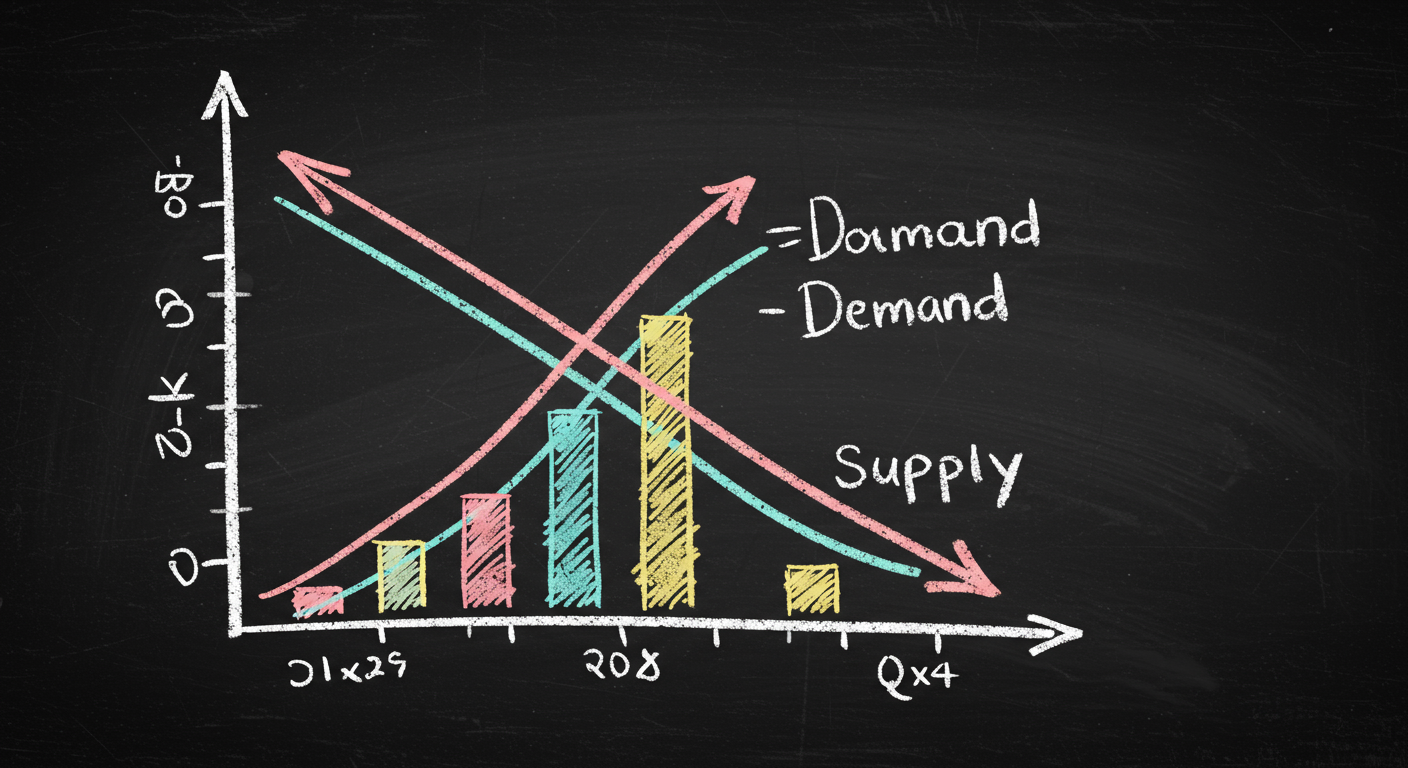
diagram
illustration
supply and demand graph with a downward sloping demand curve and upward sloping supply curve crossing at equilibrium price and equilibrium quantity
note

A simple example

If a movie ticket costs $5, more people want to go. If it costs $50, fewer people buy. At the same time, the theater has a limited number of seats. That is supply. The market price has to work for both sides.

2. How equilibrium works in real markets

note

Shortage and surplus

When price is too low, quantity demanded is greater than quantity supplied. That is a shortage.

When price is too high, quantity supplied is greater than quantity demanded. That is a surplus.

Market adjustment

  • Shortage puts upward pressure on price
  • Surplus puts downward pressure on price
  • The market tends to move toward equilibrium
note

{"type":"line","title":"Price and quantity in a market","data":[{"x":"$2","y":90},{"x":"$3","y":70},{"x":"$4","y":50},{"x":"$5","y":35},{"x":"$6","y":20}]}

diagram
note

Real-world shifts

Demand can rise because of population growth, higher incomes, or a trend.

Supply can fall because of bad weather, higher fuel costs, or factory shutdowns.

A curve shift changes the market price even if no one changes their mind about the product itself.

3. Elasticity: why some prices move fast and others barely move

equation
Ed=%ΔQd%ΔPE_d = \frac{\%\,\Delta Q_d}{\%\,\Delta P}
note

Elastic vs. inelastic demand

Elastic demand: buyers change behavior a lot when price changes.

Inelastic demand: buyers change behavior only a little.

Examples

  • Gasoline in the short run: usually inelastic
  • Netflix: often more elastic than gas, because subscriptions are easy to cancel
  • Insulin: very inelastic for many patients, because it is medically necessary
diagram
note

Why elasticity changes the burden

A tax on a product with few substitutes is harder to avoid. A tax on a product with many substitutes is easier to dodge. That is why economists care about elasticity before they judge a policy.

4. When policy overrides the market

note

Price ceilings and price floors

A price ceiling is a legal maximum price.

A price floor is a legal minimum price.

Common examples

  • Rent control: price ceiling on housing rents
  • Minimum wage: price floor on labor
  • Ticket caps: ceiling on event prices

Main tradeoff

Lower prices can help some people now, but they can also create shortages later.

diagram
note

Minimum wage in plain language

If a worker’s productivity is worth less than the legal wage, firms may hire fewer workers. If productivity is higher, firms may absorb the higher wage more easily. That is why economists study local conditions instead of treating every market the same.

note

Rent control in plain language

Rent control can protect current tenants, but it can also reduce new construction and maintenance. The long-run housing shortage is the hidden cost many cities face.

5. Putting it all together in the world you live in

note

Real examples of supply and demand

Housing

More people, fewer homes, or slower construction pushes prices up.

Healthcare

Demand is often inelastic because treatment is necessary.

Concert tickets

Supply is fixed by venue seats, so prices can jump fast.

Surge pricing

Higher prices can pull in more drivers during busy times.

diagram
chart · bar
How markets differ
HousingHealthcareConcertsRide sharing
note

The three questions to ask

  1. How sensitive are buyers to price?
  2. How quickly can sellers increase supply?
  3. Is the market price free to move?

If you know those three things, you can explain most price changes.

Transcript

Welcome to Slate. Today we're looking at What Is Supply and Demand? Economics Made Simple. We'll cover Supply and demand curves and how equilibrium price forms, Price elasticity: why gas prices spike but Netflix doesn't, Minimum wage, rent control, and what happens when you override the market, and Real examples: housing, healthcare, concert tickets, surge pricing. Let's get into it.

Prices are not random. They come from a meeting point between buyers and sellers. Demand is how much people want to buy at each price. Supply is how much sellers are willing to sell at each price. Here is the key pattern: when a price falls, buyers usually want more, while sellers usually want to offer less. That is the basic push and pull. Think of it like two teams pulling a rope. The rope stops moving when the pull is balanced. In economics, that balance is called equilibrium. At equilibrium, the quantity people want to buy equals the quantity sellers want to sell. The diagram on screen shows the demand curve sloping down and the supply curve sloping up. Their crossing point gives the market price. If the price is above that point, stores have extra goods left over. If the price is below it, buyers line up and shortages appear. Adam Smith described this kind of coordination in 1776 in The Wealth of Nations. He did not draw the modern graph, but he understood the same logic: prices help millions of separate decisions fit together without a central planner. That is why supply and demand is the first tool economists reach for. It explains why bread, wages, rent, and concert tickets all move the way they do.

Equilibrium is not a magical number. It is a result of pressure from both sides. Suppose a coffee shop charges $2 for a latte, but the balance point is $4. At $2, customers want more lattes than the shop can make. That is a shortage. People may wait in line, or the shop may raise prices. Now flip it. If the shop charges $6 when customers only want a few drinks, the shop has a surplus. Coffee sits unsold, so the price may fall. That back-and-forth is the market’s adjustment process. The table on screen shows how quantity demanded falls as price rises, while quantity supplied rises. This is why economists talk about curves, not single numbers. A curve shows the whole relationship, one price at a time. Real markets also shift. If more people move into a city, demand for apartments rises. If a drought cuts crop yields, supply falls. Then the equilibrium changes. In 2023, U.S. residential rent inflation slowed from the highs of 2022, partly because supply was finally catching up in some cities. The graph of prices moved because the underlying curves moved. That is the important lesson: prices are the outcome, not the starting point.

Not all demand is equally sensitive. Elasticity measures how strongly buyers react when price changes. If a small price increase causes a big drop in sales, demand is elastic. If price jumps and people still buy almost the same amount, demand is inelastic. Gasoline is a classic inelastic good in the short run. Most people still need to drive to work, so they cannot cut usage quickly. Netflix is different. A few extra dollars a month may not change demand much, because the service is a small part of many budgets and there are substitutes. The formula on screen shows price elasticity of demand as the percentage change in quantity demanded divided by the percentage change in price. Economists usually report it as a negative number, because price and quantity move in opposite directions. A value near zero means inelastic. A value with a larger absolute size means elastic. Why does this matter? Because it predicts who feels the burden of a tax or price increase. If demand is inelastic, consumers pay more of it. If supply is inelastic, sellers bear more. That is why a gasoline tax or a short-term hotel tax can be passed through to buyers more easily than a tax on products with many substitutes. Elasticity is the difference between a small wobble and a dramatic swing.

Governments sometimes set prices instead of letting supply and demand do the work. Minimum wage is one example. If the legal wage is above the market wage for some workers, firms may hire fewer workers than before, because labor now costs more. That does not mean every minimum wage increase causes job loss. The size of the effect depends on the local labor market, the level of the wage floor, and how much firms can raise prices or improve productivity. The U.S. federal minimum wage has been $7.25 an hour since July 24, 2009. Rent control works in a similar way. If a city caps rent below the market level, current tenants may benefit, but landlords have less incentive to build or maintain units. Over time, shortages can get worse. The chart on screen shows the basic pattern: a price ceiling below equilibrium creates excess demand; a price floor above equilibrium creates excess supply. Concert ticket caps can also backfire. If tickets are priced too low, fans may face long lines, bots, or lottery systems instead of normal price competition. Price controls do not erase scarcity. They just change how scarcity shows up. Sometimes the result is waiting, rationing, or hidden fees instead of a clear price.

Now connect the idea to real life. Housing prices rise when demand grows faster than new homes are built. Healthcare prices are affected by insurance, regulation, market power, and inelastic demand, because people cannot simply skip treatment. Concert tickets can sell out in minutes when demand is high and supply is fixed by the number of seats. Surge pricing in ride-hailing works because it raises price when demand spikes, which attracts more drivers and reduces wait times. That is supply and demand in motion, not just on paper. The diagram shows the same logic across different markets. In each case, the key questions are simple: how much can buyers change their behavior, how fast can sellers respond, and what happens if the price is blocked from moving? If you can answer those three questions, you can predict a lot about a market. Think of supply and demand as a map. It does not tell you every street, but it tells you where the hills, rivers, and bridges are. That is why economists use it for wages, rent, taxes, tickets, and even medicine. Once you see the pattern, prices stop looking mysterious. They start looking like messages sent by a market trying to coordinate scarcity.

XLinkedInWhatsApp

Keep going with Slate

Pick up where this left off in your own voice session.

Built with Slate