What Is Dark Matter (And Why Can't We Find It)?
95% of the universe is invisible. Dark matter and dark energy — what they are, why we know they exist, and the hunt to detect them.
- The evidence: galaxy rotation curves and gravitational lensing
- Dark matter vs. dark energy — two different mysteries
- The leading candidates: WIMPs, axions, and modified gravity
- Why 95% of the universe remains completely unknown
1. The missing mass problem
What Is Dark Matter (And Why Can't We Find It)?
95% of the universe is invisible. Dark matter and dark energy — what they are, why we know they exist, and the hunt to detect them.
Dark matter: the missing mass in galaxies
Dark matter is matter inferred from gravity, not from light.
The classic clue is the galaxy rotation curve. If most mass were in the bright central region, orbital speed should fall with distance, like planets farther from the Sun move more slowly. Instead, many spiral galaxies show nearly constant speeds far from the center.
That means there is more mass than we can see. Astronomers estimate that ordinary atoms make up only about 5% of the universe. Dark matter is about 27%. Dark energy is about 68%.
Key historical milestones:
- 1933: Fritz Zwicky studies the Coma Cluster
- 1970s: Vera Rubin and Kent Ford measure flat rotation curves
- Today: the same mass gap appears in clusters, lensing, and the cosmic microwave background
Why flat rotation curves matter
A rotation curve is a speed map versus distance from a galaxy center. Flat means the outer parts are moving too quickly for the visible mass alone.
Think of it like a city map at night. If you can only see a few lit streets, you might miss the rest of the road network. The lights are not the road. Light traces some mass, but not all of it.
This is not a single odd galaxy. It shows up across many spirals, which is why astronomers take the result seriously.
2. Seeing the invisible with gravity
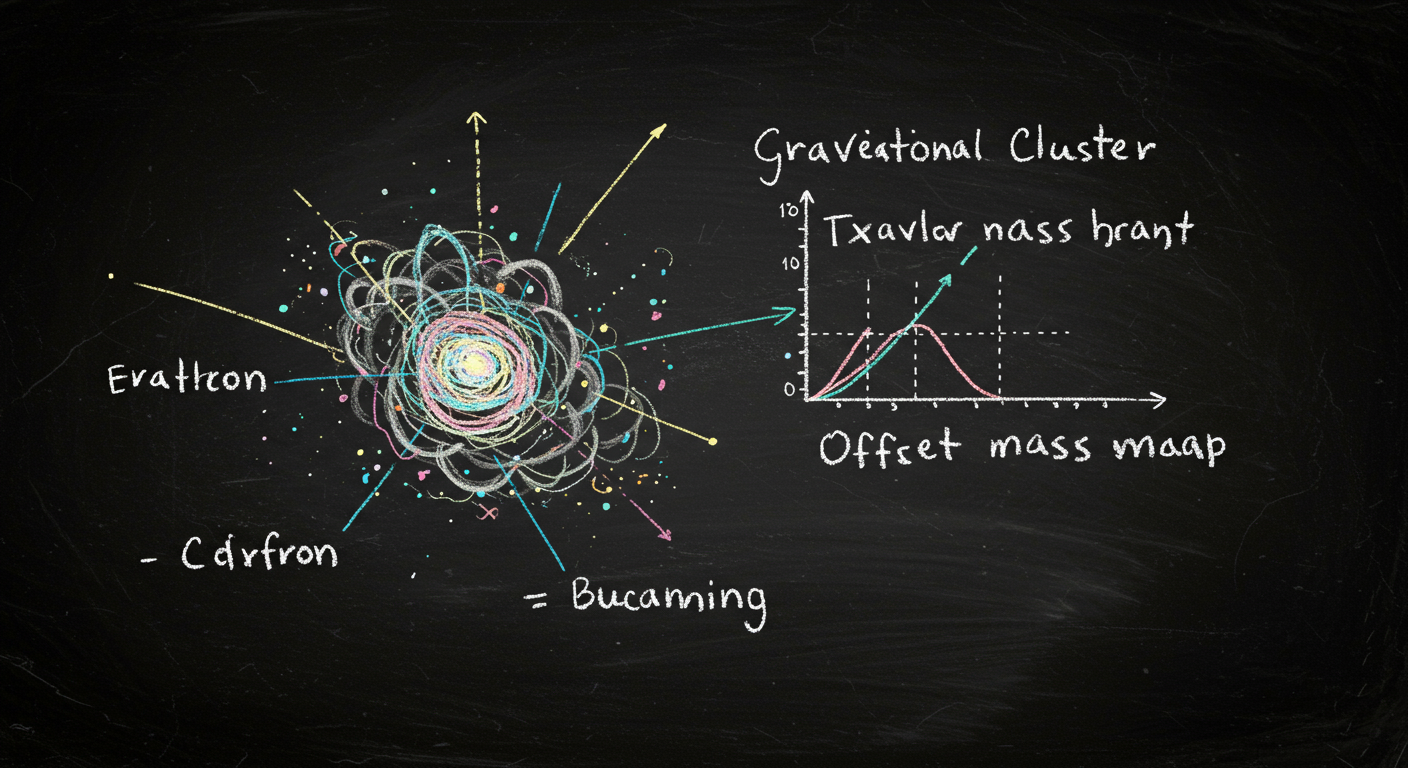
Gravitational lensing: mass bends light
Albert Einstein predicted gravitational lensing in 1915. Mass curves spacetime, and light follows that curvature.
Lensing gives astronomers a mass map. If the light from stars and gas is not where the lensing mass sits, something unseen must be present.
The Bullet Cluster, 1E 0657−56, became famous because the lensing mass does not line up with the hot X-ray gas. That is one of the strongest visual arguments for dark matter.
Analogy: lensing is like seeing the shadow of a hidden object in fog. You may not see the object directly, but the distortion tells you where it is.
Why clusters are so persuasive
A galaxy cluster can contain thousands of galaxies and huge amounts of hot gas. In a cluster, the missing mass problem is large enough to measure in more than one way.
When several methods agree, the case gets stronger. That is why dark matter is treated as a physical component, not a bookkeeping trick.
3. Dark matter is not dark energy
Dark matter vs dark energy
They are different unknowns.
Dark matter:
- attracts through gravity
- clumps around galaxies and clusters
- helps galaxies hold together
- behaves like extra mass
Dark energy:
- drives accelerated cosmic expansion
- is smooth on large scales
- does not clump like matter
- behaves like a property of space itself
Current best estimates from the Planck 2018 results and other cosmological data give roughly 5% ordinary matter, 27% dark matter, and 68% dark energy.
Why the percentages matter
If 95% of the universe is not ordinary matter, then most of cosmology is about invisible ingredients.
That does not mean science is guessing wildly. It means we have measured the gravitational effects very precisely, even while the underlying substances remain unknown.
4. What could dark matter be?
Leading dark matter candidates
WIMPs: heavy particles with weak interactions. They were attractive because a thermal relic WIMP can naturally end up near the observed dark matter density. Many experiments have searched for them, including XENON1T, LUX-ZEPLIN, and PandaX.
Axions: very light particles introduced to solve the strong CP problem. They are searched for with resonant cavities, magnetic fields, and precision instruments.
Modified gravity: instead of adding unseen matter, change the law of gravity on galaxy scales. This can match some observations, but it is harder to make one theory fit galaxies, clusters, lensing, and the cosmic microwave background at once.
import math

# Simple circular-orbit estimate
# v^2 = G M / r
# Rearranged: M = v^2 r / G

G = 6.674e-11
v = 2.0e5      # 200 km/s in m/s
r = 5.0e20     # about 50,000 light-years in meters

M = v**2 * r / G
print(f"Estimated enclosed mass: {M:.3e} kg")What the calculation shows
If a galaxy keeps stars moving at about 200 kilometers per second far from the center, the enclosed mass must be huge.
The point of the calculation is not the exact number. The point is that measured speeds imply much more mass than the visible stars and gas account for.
Analogy: you can estimate the weight of a sealed box by how hard it is to lift, even if you cannot see inside.
5. Why we still have not found it
Why direct detection is difficult
A dark matter particle would pass through ordinary matter almost all the time.
That means detectors need:
- very low background noise
- very large target masses
- long observation times
- careful shielding from cosmic rays and radioactivity
Examples of searches include underground xenon detectors, axion haloscopes, and collider experiments at the Large Hadron Collider.
The big takeaway
We infer dark matter because gravity keeps telling the same story in many places.
We have not detected it directly because the interaction is extraordinarily faint.
That is why 95% of the universe is still mysterious: 27% is dark matter, 68% is dark energy, and both are known mainly through their effects, not their faces.
Keep going with Slate
Pick up where this left off in your own voice session.