Deterministic chaos: simple rules, wild outcomes
0:007:02
Math

What Is Chaos Theory? The Butterfly Effect Explained

Why tiny changes create massive, unpredictable outcomes — from weather systems to stock markets to your daily life.

Apr 22, 20267 min listen5 chapters
What you'll learn
  • What deterministic chaos actually means
  • The butterfly effect: sensitive dependence on initial conditions
  • Strange attractors and why weather is fundamentally unpredictable
  • Chaos in biology, economics, and everyday decisions

Deterministic chaos: simple rules, wild outcomes

note

What Is Chaos Theory? The Butterfly Effect Explained

Why tiny changes create massive, unpredictable outcomes — from weather systems to stock markets to your daily life.

note

Deterministic chaos

A chaotic system is not ruleless. It is governed by precise equations, but those equations amplify tiny differences in starting conditions.

Core idea

  • Deterministic: the same starting point gives the same result
  • Chaotic: nearby starting points separate very fast
  • Random: outcomes are not fixed by a rule at all

Why this matters

A chaotic system can be fully known in principle and still be unpredictable in practice, because measurement is never perfect.

equation
xn+1=rxn(1xn)x_{n+1} = r x_n (1 - x_n)
diagram
note

Logistic map example

When r is around 4, the logistic map can produce highly irregular behavior. That does not mean the rule changed. It means the system is extremely sensitive to the starting value.

Edward Lorenz's 1963 weather model showed the same principle in a real scientific setting. He discovered that small rounding differences could destroy a long-term forecast.

The butterfly effect and sensitive dependence

note

Sensitive dependence on initial conditions

Sensitive dependence means nearby starting states separate exponentially over time.

A useful intuition

A small measurement error at the start is like a tiny crack in glass. At first it is invisible. Under stress, it can spread across the whole pane.

In weather

Meteorologists do not try to predict one exact future forever. They estimate a range of likely futures, because the system amplifies uncertainty.
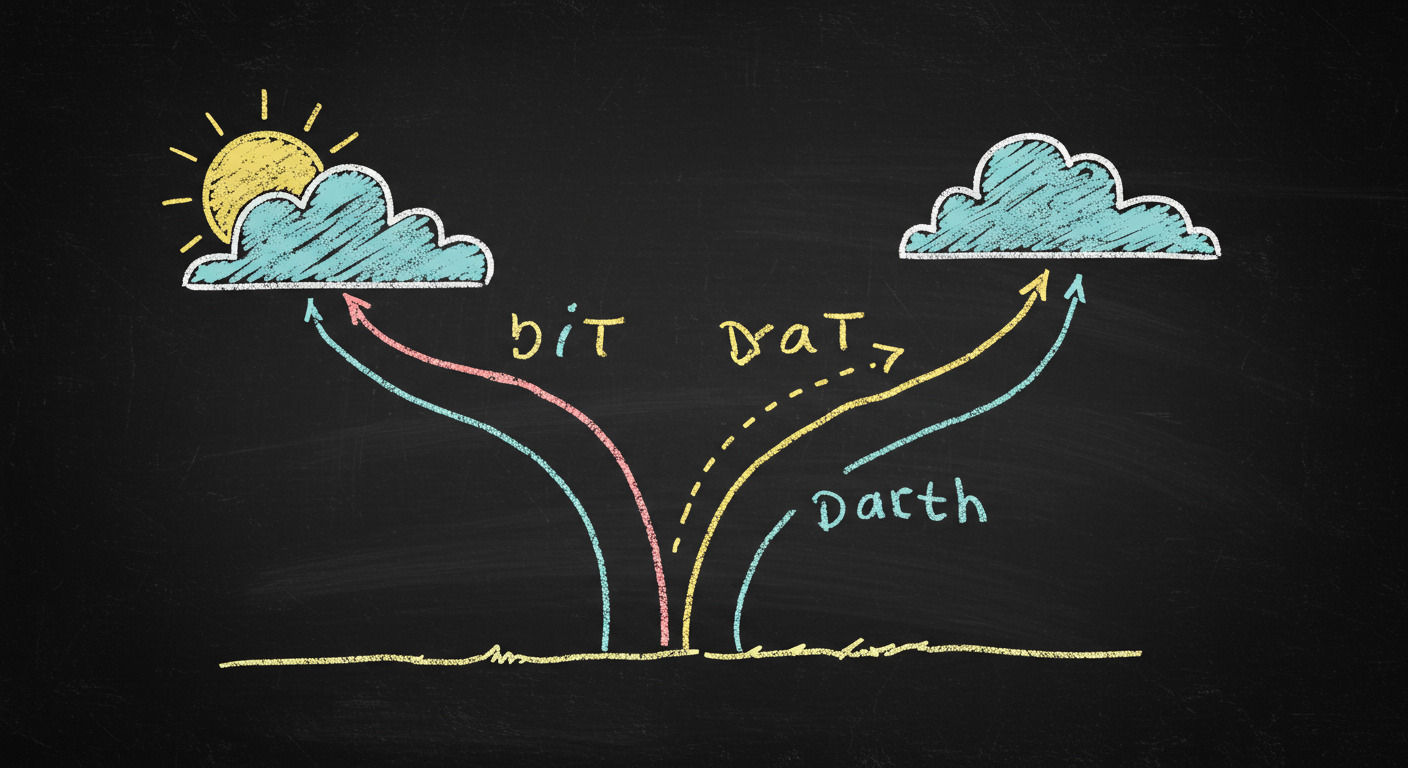
diagram
illustration
Two nearly identical weather paths diverging from the same starting point, with one path splitting into many possible futures
note

The butterfly effect is about amplification

The butterfly is a metaphor for a small cause in a sensitive system. The effect is not magic. It is error growth.

chart · line
Forecast error grows over time
Hour 0Hour 12Hour 24Hour 48Hour 72Hour 96

Strange attractors and the shape of chaos

note

Strange attractor

A strange attractor is the geometric footprint of a chaotic system over time.

What it tells us

  • The system stays bounded
  • The motion does not repeat exactly
  • The pattern has structure, often fractal-like

Why it matters

You may not predict the exact next point, but you can study the region the system occupies and the kinds of motion it prefers.

diagram
note

Lorenz attractor

Edward Lorenz published the model in 1963. The famous butterfly shape is a visual summary of repeated stretching and folding.

equation
λ>0    small differences grow roughly like eλt\lambda > 0 \; \Rightarrow \; \text{small differences grow roughly like } e^{\lambda t}
note

Stretching and folding

This is the same basic mechanism behind many chaotic systems. Stretching separates nearby states. Folding keeps the system inside a finite region.

Chaos beyond weather: biology, economics, and daily life

note

Chaos in the real world

Chaotic dynamics appear in systems with feedback, delay, and nonlinear interaction.

Examples

  • Biology: heartbeat variability, population cycles
  • Economics: market reactions, price swings
  • Everyday life: traffic, schedules, cooking temperatures

Why prediction fails

If a system reacts to its own output, tiny changes can feed back into larger changes. That makes exact long-range prediction fragile.

diagram
chart · pie
Where chaos appears
WeatherBiologyEconomicsDaily life
note

What chaos theory teaches

When a system is nonlinear, cause and effect are not proportional. A small push can have a huge effect, or almost none, depending on timing and state. That is the heart of chaos.

How scientists work with chaos

note

Working with chaos

Scientists do not give up on chaotic systems. They change the kind of prediction they make.

Tools

  • Short-term forecasting
  • Ensemble simulations
  • Statistical patterns
  • Stability measures such as Lyapunov exponents

Big takeaway

Chaos means exact long-range prediction can fail even when the underlying rules are known.

equation
λ=limt1tln(δ(t)δ0)\lambda = \lim_{t\to\infty} \frac{1}{t} \ln\left(\frac{\delta(t)}{\delta_0}\right)
diagram
note

Final takeaway

Chaos theory explains how simple rules can produce complex behavior. The future is not always unknowable. But in chaotic systems, precision has a time limit.

Transcript

Welcome to Slate. Today we're looking at What Is Chaos Theory? The Butterfly Effect Explained. We'll cover What deterministic chaos actually means, The butterfly effect: sensitive dependence on initial conditions, Strange attractors and why weather is fundamentally unpredictable, and Chaos in biology, economics, and everyday decisions. Let's get into it.

Chaos theory starts with a surprising idea. A system can follow exact rules and still become impossible to predict for long. That is deterministic chaos. The word deterministic means the rules are fixed. The word chaotic means the results can look random. The famous classroom example is the logistic map, x next equals r times x times one minus x. With r near 4, tiny differences in the starting value spread fast. Two values that begin almost identical can drift apart until their paths look unrelated. The rule is simple. The behavior is not. That is the key. Think of it like two marbles rolling on nearly the same bumpy table. At first they stay close. Then one hits a ridge a fraction earlier and the paths separate. The table has not changed. The starting point did. This is why chaos is not the same as noise. Noise is random input. Chaos is generated by a rule. Mathematicians first saw this clearly in the 1960s and 1970s, especially through Edward Lorenz, who studied weather equations and found that rounding a number from 0.506127 to 0.506 made a later forecast diverge completely. That tiny rounding difference became a classic lesson in sensitivity to initial conditions.

The butterfly effect is a vivid name for sensitive dependence on initial conditions. The image is not that a butterfly causes a tornado by itself. The point is subtler. In a nonlinear system, a tiny nudge can grow through many interactions until the final result looks completely different. Edward Lorenz popularized the phrase in a 1972 talk titled Does the Flap of a Butterfly’s Wings in Brazil Set Off a Tornado in Texas? The answer is not literal yes. It is a warning about amplification. Weather is a good example because air, heat, moisture, and pressure all interact nonlinearly. A small change in one place can alter cloud formation, which changes heating, which changes wind, which changes later cloud formation. The system is like a game of pinball with millions of bumpers. One tiny change at the launch point can send the ball down a different lane. That is why meteorologists use ensembles. They run many forecasts with slightly different starting conditions. If the runs cluster together, confidence is higher. If they spread apart, predictability is low. The practical limit is not just weak computers. It is the atmosphere itself. Lorenz showed that after a few days, forecast error tends to grow so much that precise long-range weather prediction becomes impossible.

Chaotic systems are unpredictable in detail, but not shapeless. Their long-run behavior often lives inside a geometric pattern called an attractor. An attractor is the set of states the system tends to visit over time. In a pendulum with friction, the attractor is simple: the pendulum settles to rest. In a chaotic system, the attractor can be strange. That means it has a folded, intricate shape and the motion never repeats exactly, yet it stays within a bounded region. The Lorenz attractor is the classic example. Lorenz derived it from simplified convection equations in 1963. When plotted, the path loops around two lobes, switching back and forth in a pattern that looks like butterfly wings. Here is the important idea: chaos is not wandering everywhere. It is constrained unpredictability. Think of a marble trapped in a curved bowl with many ridges. It never flies off to infinity, but it also never settles into one neat circle. Strange attractors help scientists see the hidden order inside apparent disorder. They also explain why a system can be stable in the broad sense while still being impossible to forecast exactly. The shape is predictable. The next exact point is not.

Chaos shows up anywhere many parts interact nonlinearly. In biology, the heart is a good example. Healthy hearts do not beat like a metronome. Their timing varies slightly from beat to beat, and that variability carries useful information. Too much regularity can be a warning sign. In ecology, predator and prey populations can oscillate in complicated ways when growth, food supply, and competition feed back on one another. In economics, markets mix feedback, expectations, delayed reactions, and crowd behavior. A single news item can move prices sharply because traders respond not only to the news itself, but to what they think everyone else will do next. That is a nonlinear loop. Even in daily life, chaos appears in traffic jams, kitchen ovens, and your calendar. Leave home five minutes later, and a different traffic light cycle, bus delay, or parking spot can change the rest of the morning. The lesson is not that everything is random. It is that some systems are so sensitive that long-range precision is unrealistic. That changes how we think. We stop asking for one exact future and start asking for probabilities, patterns, and warnings. Chaos theory gives us better questions, not perfect control.

Chaos does not make science impossible. It changes the goal. Instead of hunting for exact long-term prediction, scientists study short-term forecasts, statistical patterns, and invariant structures such as attractors and Lyapunov exponents. The Lyapunov exponent measures how fast nearby trajectories separate. If it is positive, the system has sensitive dependence. That is a quantitative test, not a slogan. In practice, this matters a lot. Weather services use ensembles because a single forecast is only one possible future. Economists use models that estimate risk rather than certainty. Biologists track rhythms and variability rather than expecting perfect repetition. The same idea helps in engineering too. A bridge, aircraft, or power grid may be designed to avoid unstable feedback. So chaos theory is not a story about helplessness. It is a story about limits, structure, and better prediction. The world can be lawful and still resist certainty. That is the deep lesson. The butterfly effect is not about one butterfly controlling the sky. It is about how a tiny difference, inside a nonlinear system, can grow until the future branches into many possibilities. Once you see that, weather maps, markets, and even your morning commute start to look different.

XLinkedInWhatsApp

Keep going with Slate

Pick up where this left off in your own voice session.

Built with Slate