1. What makes a language hard to learn
0:006:42
Languages

What Are the Hardest Languages to Learn (And Why)?

Mandarin tones, Arabic script, Hungarian grammar — what makes some languages harder than others (it depends where you start).

Apr 22, 20267 min listen5 chapters
What you'll learn
  • FSI language difficulty rankings and what drives them
  • Why 'hard' depends entirely on your native language
  • Tonal languages, logographic scripts, and case systems
  • Strategies for tackling languages in the 'super-hard' category

1. What makes a language hard to learn

note

What Are the Hardest Languages to Learn (And Why)?

Mandarin tones, Arabic script, Hungarian grammar — what makes some languages harder than others (it depends where you start).

note

What makes a language hard?

Language difficulty is not a single score. It is a mix of four different jobs your brain has to do:

  • Hear and produce new sounds
  • Read a new writing system
  • Master grammar and sentence order
  • Build a large vocabulary from scratch

For an English speaker, languages that are structurally close to English usually take less time. Languages that differ in many of those jobs usually take more time.

The Foreign Service Institute estimates are based on classroom hours needed for English speakers to reach professional working proficiency. They are often summarized like this:

  • Category I: about 600 to 750 hours
  • Category II: about 900 hours
  • Category III: about 1,100 hours
  • Category IV: about 2,200 hours
  • Category V: about 2,200 hours and beyond, with some languages harder still

That is not a measure of intelligence. It is a measure of distance from English and of how much practice is needed.

diagram
chart · bar
FSI classroom hours by broad category
Category ICategory IICategory IIICategory IVCategory V

2. Why the hardest language depends on your native language

note

Hard is relative

A language is not universally hard. It is hard relative to the language you already speak.

Examples:

  • English speakers usually find Spanish easier than Mandarin because Spanish shares the Latin alphabet and many cognates.
  • Arabic can feel easier for a speaker of another Semitic language, such as Hebrew, than for an English speaker.
  • Japanese speakers often learn Chinese characters faster than English speakers because the writing system is less alien.

This is why the phrase “hardest language” is incomplete. The better question is: hardest for whom?

A useful analogy is hiking. A trail that feels steep to a beginner may feel flat to someone who trains on mountains every week. The trail did not change. The starting point did.

diagram
chart · scatter
Relative difficulty depends on your starting point

3. Mandarin tones and logographic writing

note

Mandarin: tones plus characters

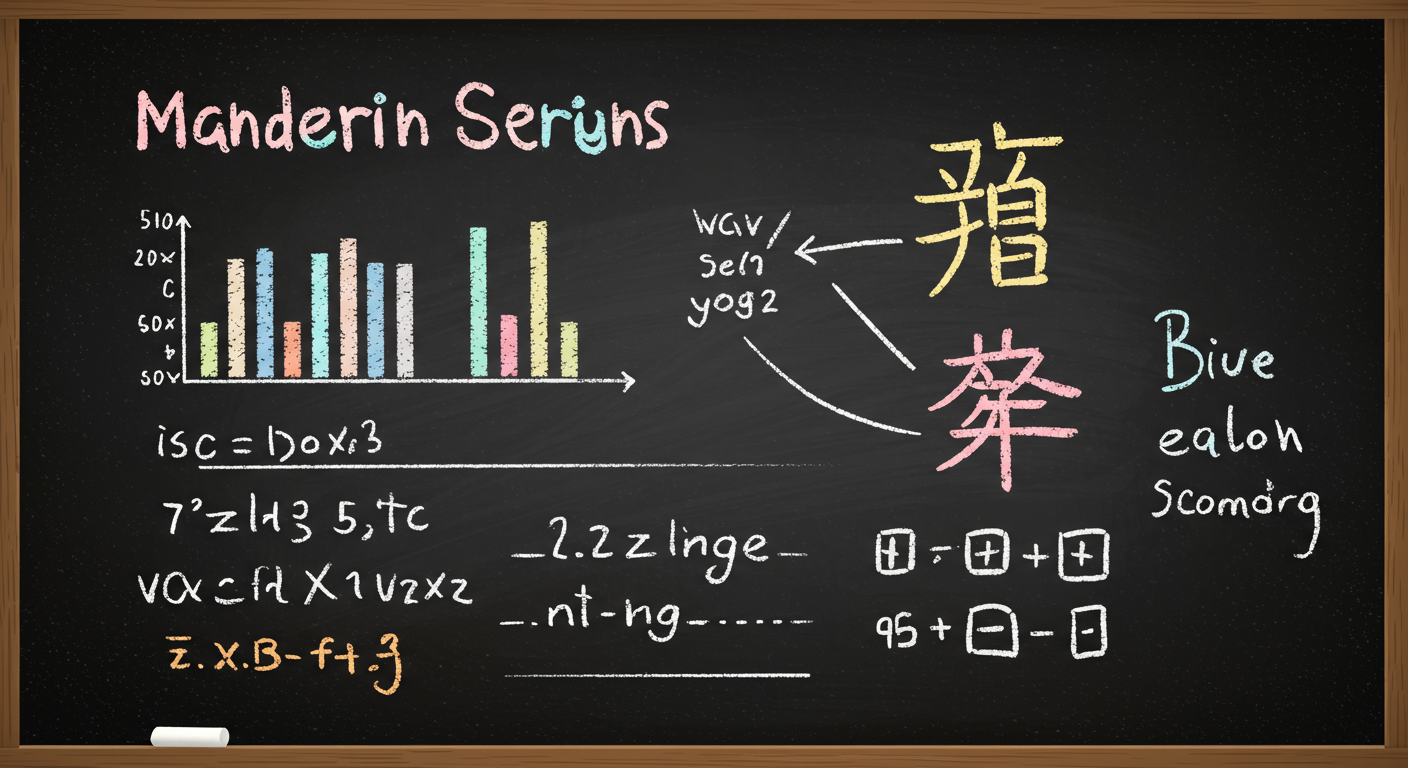
Standard Mandarin has four main lexical tones plus a neutral tone. Tone changes meaning.

Example with ma:

  • mā 妈 = mother
  • má 麻 = hemp
  • mǎ 马 = horse
  • mà 骂 = scold

Chinese writing adds another layer. It is logographic, which means characters represent morphemes and words, not just sounds.

Important correction: Chinese characters are not pure pictures. Many are phonetic-semantic compounds. A part of the character may hint at meaning, and another part may hint at pronunciation.

Why this is hard:

  • You must memorize visual forms
  • You must connect form to sound and meaning
  • You cannot rely on spelling rules the way you can in alphabetic languages

Why this is manageable:

  • Characters are built from recurring components
  • Frequent characters appear again and again in real text
  • Tone practice becomes much easier with short minimal-pair drills
illustration
A Mandarin learner looking at tone marks and Chinese characters with a tone contour diagram and character components

4. Arabic script and Hungarian grammar

note

Arabic script and root patterns

Modern Standard Arabic is written right to left. In most everyday text, short vowels are not written.

That creates two hurdles:

  • Reading requires context
  • Pronunciation cannot always be recovered directly from spelling

Arabic vocabulary often grows from consonantal roots. For example, the root k-t-b is related to writing:

  • kitab = book
  • kataba = he wrote
  • maktab = office

This root system is powerful because it compresses lots of meaning into a reusable pattern.

Hungarian grammar and case endings

Hungarian is famous for extensive case marking and suffix chains. It is agglutinative, so endings are attached in sequence.

Example:

  • ház = house
  • házban = in the house
  • házaimban = in my houses

This is hard for English speakers because English uses prepositions and word order more than endings.

The good news is that Hungarian endings are usually regular. The bad news is that there are many of them.

diagram

5. How to tackle super-hard languages

note

Strategies for super-hard languages

Use the bottleneck method:

  • Identify the one feature that blocks understanding most
  • Practice that feature in isolation
  • Put it back into real sentences quickly
  • Repeat with spaced review

Practical examples:

  • Mandarin: tone pairs, then short dialogues, then characters in context
  • Arabic: script recognition, then vowel-pattern reading, then root families
  • Hungarian: the most frequent case endings first, then common verb forms

What works best:

  • Spaced repetition
  • Minimal pairs for sound training
  • Sentence mining from real text
  • Daily speaking, even if short
  • Listening with transcripts

What to avoid:

  • Memorizing isolated word lists without context
  • Waiting too long to speak
  • Ignoring pronunciation until later
  • Treating a difficult language as if it were one skill instead of four
equation
R=nreviewedontimenscheduledR = \frac{n_{reviewed\,on\,time}}{n_{scheduled}}
diagram

Transcript

Welcome to Slate. Today we're looking at What Are the Hardest Languages to Learn (And Why)?. We'll cover FSI language difficulty rankings and what drives them, Why 'hard' depends entirely on your native language, Tonal languages, logographic scripts, and case systems, and Strategies for tackling languages in the 'super-hard' category. Let's get into it.

A language feels hard when it asks your brain to build new habits at several levels at once. Sounds, writing, grammar, and word order all matter. If your first language is English, Spanish may feel friendly because many words are familiar and the grammar is fairly regular. Mandarin, Arabic, and Hungarian feel harder because they ask you to learn more new patterns at the same time. The Foreign Service Institute, or F-S-I, grouped languages by how many classroom hours English speakers usually need to reach working proficiency. Their numbers are not a law of nature. They are a practical estimate from U.S. diplomats. But the pattern is useful. Languages that are distant from English usually take longer. Here the diagram shows the basic idea: difficulty is not one thing. It is a stack of challenges. A language can be easy to pronounce but hard to read. Or easy to read but hard to inflect. Think of it like learning a new board game. If the pieces, rules, and scoring all change at once, the first hour feels slow. Once you see which parts are unfamiliar, the work becomes more targeted.

The hardest language for one person may be manageable for another. That is because languages are compared against the language you already know. A Spanish speaker has a head start with Italian and Portuguese. A Hindi speaker may find Urdu easier to read than an English speaker does, because the spoken languages are closely related. A Japanese speaker already knows a logographic writing system, so Chinese characters are less shocking on the page than they are for someone who grew up with the Latin alphabet. This is the key idea: difficulty is relative, not absolute. The same feature can help one learner and hurt another. For example, English uses articles like a and the, but Russian does not. Russian speakers learning English must add that system. English speakers learning Russian must learn case endings instead. The tradeoff is real. A language can be hard because it has many rules, or because it has few rules but many exceptions, or because it organizes meaning in a way your first language never taught you. The chart on the right makes the point visually: the same language can move up or down the difficulty scale depending on where you start.

Mandarin is often called hard for two big reasons. First, it uses tones. In Standard Mandarin, the same syllable can mean different things depending on pitch shape. Ma can mean mother, hemp, horse, or scold, depending on tone. That means your ear has to hear pitch as part of the word, not just emotion or emphasis. Second, Mandarin uses Chinese characters, which are not an alphabet. You do not sound out a character the way you sound out cat or train. Many characters contain clues about meaning and pronunciation, but those clues are imperfect. The result is a different kind of memory load. You are learning sound, meaning, and visual form together. Think of alphabetic reading as decoding a code with a small set of symbols. Character reading is more like recognizing thousands of labeled icons, many of which share pieces with other icons. That sounds intimidating, but it also has a payoff: once you know a character, it can help you recognize related words across Chinese, Japanese, and Korean contexts. For learners, the practical move is to train tones and characters separately at first, then combine them in short, repeated phrases.

Arabic and Hungarian are hard for different reasons, and that contrast is useful. Arabic uses a script that runs right to left and usually leaves out short vowels in ordinary writing. So the same written pattern can map to several possible pronunciations, especially for beginners. Arabic also uses a root-and-pattern system. Many words grow from a three-consonant root. That is efficient once you know it, but it feels unfamiliar at first. Hungarian is a different kind of challenge. Its alphabet is not the main problem. Its grammar is. Hungarian is an agglutinative language, which means it stacks suffixes onto a word to show case, possession, number, and other meanings. A single word can carry the job that English would spread across several words. For example, the word házaimban means in my houses. That is not random complexity. It is a highly regular system. The diagram shows the logic: Arabic asks you to decode a script and a root system; Hungarian asks you to manage long chains of endings. Regularity helps, but it does not make the first months easy. It just means the rules are learnable.

If a language lands in the super-hard category for your background, the answer is not brute force. The answer is sequencing. Start with the part that blocks everything else. For Mandarin, that may be tones and high-frequency characters. For Arabic, it may be script and sound patterns. For Hungarian, it may be the most common noun cases and verb endings. Then build tiny wins. Short sentences beat long lists. Ten well-learned words in context are better than fifty words you only recognize on a flashcard. Spaced repetition helps because memory fades on a schedule. So review just before you forget. A simple pattern is one new item, one example sentence, one review the next day, then again after three days, a week, and two weeks. Also, protect pronunciation early. Bad habits fossilize fast. A learner who says a tone wrong a thousand times has trained the wrong reflex. The flowchart here shows the path: choose the bottleneck, practice it in context, and repeat until it becomes automatic. Hard languages are not conquered by intensity alone. They are mastered by removing friction one layer at a time.

XLinkedInWhatsApp

Keep going with Slate

Pick up where this left off in your own voice session.

Built with Slate