1. The AI skills employers screen for
0:007:20
Interview Prep

Top AI Skills Employers Want in 2026

AI skills appear in 89% of job postings with $30K-$50K salary premiums. Which ones to learn and how to prove them.

Apr 22, 20267 min listen5 chapters
What you'll learn
  • The AI skills employers actually hire for in 2026
  • Technical vs. applied AI literacy — which path fits you
  • How to demonstrate AI competency in interviews
  • Building a portfolio of AI projects that stand out

1. The AI skills employers screen for

note

Top AI Skills Employers Want in 2026

AI skills appear in 89% of job postings with $30K-$50K salary premiums. Which ones to learn and how to prove them.

note

AI skills employers want in 2026

Employers usually hire for a stack of skills, not one magic credential.

Core skills

  • Prompt design for business tasks
  • Workflow automation and agent setup
  • Data cleaning and verification
  • Output evaluation and fact-checking
  • Model limitations and risk awareness

What hiring managers mean

  • Can you save time without creating errors?
  • Can you explain your process clearly?
  • Can you handle messy real-world data?
  • Can you spot when AI is wrong?

Why this matters

A 2024 Stanford AI Index report found 71% of organizations used generative AI in at least one business function, up from 33% in 2023.

chart · bar
Where AI skill demand concentrates
PromptingAutomationData handlingEvaluationModel basics
diagram
note

A useful way to think about it

AI skill is like spreadsheet skill in the 2000s. Nobody hired people just because they knew Excel existed. They hired people who could build a budget, analyze sales, and catch mistakes before they reached finance.

2. Technical AI literacy versus applied AI literacy

note

Two AI literacy paths

Technical AI literacy

Best for: engineering, data, product, analytics

You can:

  • Call models through an API
  • Use embeddings and vector search
  • Build retrieval-augmented generation systems
  • Evaluate accuracy, latency, and cost

Applied AI literacy

Best for: operations, marketing, sales, support, HR, strategy

You can:

  • Draft and revise faster
  • Automate repetitive workflows
  • Summarize documents and meetings
  • Check AI output against source material

Which path fits you?

  • Choose technical if you like code and systems
  • Choose applied if you like process and communication
  • Choose both if your role sits between business and technology
diagram
note

A practical rule

If your work touches software or data, technical literacy raises your ceiling. If your work touches people, process, or communication, applied literacy raises your speed. In many roles, the best candidates show both.

equation
Salary premium=AI-skilled paybaseline paybaseline pay×100%\text{Salary premium} = \frac{\text{AI-skilled pay} - \text{baseline pay}}{\text{baseline pay}} \times 100\%

3. How to prove AI competency in interviews

note

The interview proof formula

1. Problem

What task was slow, expensive, or error-prone?

2. Method

What AI tool, model, or workflow did you use?

3. Verification

How did you check accuracy, bias, or safety?

4. Result

What changed in time, cost, quality, or revenue?

Strong example

"I used an LLM to draft first-pass customer replies, then I added a review step for policy-sensitive cases. Response time dropped by 38%, and escalation errors fell after we built a test set."

Weak example

"I use ChatGPT a lot and I’m very comfortable with AI."

note

sequenceDiagram participant I as Interviewer participant C as Candidate participant M as Model participant H as Human I->>C: Tell me about your AI work C->>M: Generate output M-->>C: Draft result C->>H: Verify against source H-->>C: Correction C-->>I: Measured outcome

note

What to say when you do not have a big project

Use a small but real example. A 2-hour workflow improvement with clear metrics beats a vague claim about a huge system you barely touched.
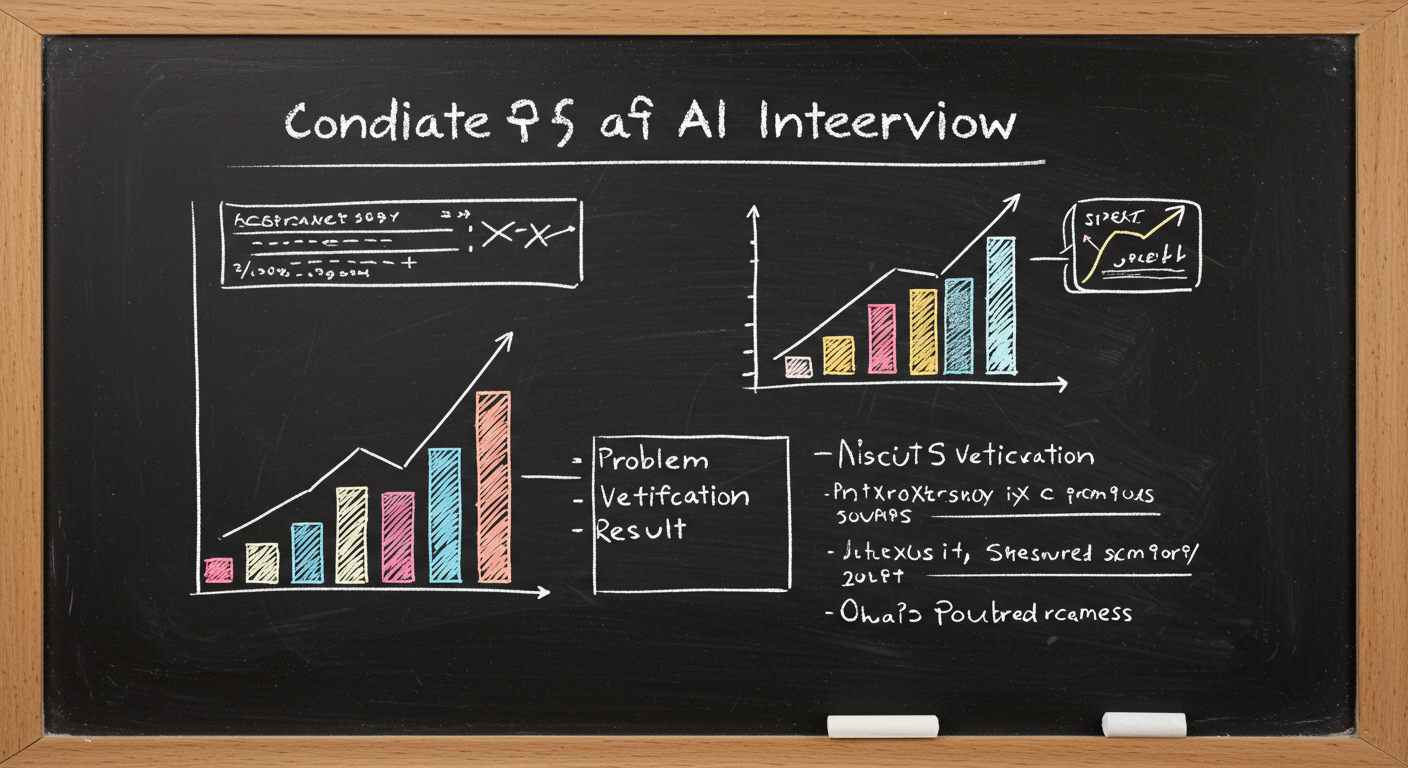
illustration
A candidate explaining an AI project in an interview while a whiteboard shows problem method verification result and measured outcomes

4. Building an AI portfolio that stands out

note

Portfolio projects that hiring managers notice

1. Workflow automation

Example: triaging inbox messages or support tickets

2. Data assistant

Example: summarizing survey comments or cleaning spreadsheets

3. Retrieval app

Example: searching company documents with citations

4. Evaluation project

Example: comparing model outputs against a labeled test set

What to include

  • Problem statement
  • Tool stack
  • Before and after screenshots
  • Metric or test result
  • Tradeoffs and limitations
diagram
note

Portfolio rule of thumb

If a project cannot be explained with a problem, method, metric, and limitation, it is probably not ready for a hiring manager.

equation
Improvement=Baseline timeAI timeBaseline time×100%\text{Improvement} = \frac{\text{Baseline time} - \text{AI time}}{\text{Baseline time}} \times 100\%

5. A 2026 learning plan that gets hired

note

30-day AI skill plan

Week 1

Learn the model, the tool, and the limits.

Week 2

Build one real workflow on a real task.

Week 3

Test edge cases and failure modes.

Week 4

Write the case study and practice the interview answer.

Priority order

  1. Relevance to your target job
  2. Proof through a project
  3. Verification and safety
  4. Clear explanation of results
chart · line
Skill stack to build first
PromptingVerificationAutomationData handlingAPIsEmbeddings
diagram
note

Final takeaway

The employers paying the premium are not buying AI hype. They are buying people who can use AI carefully, explain it clearly, and show results with numbers.

Transcript

Welcome to Slate. Today we're looking at Top AI Skills Employers Want in 2026. We'll cover The AI skills employers actually hire for in 2026, Technical vs. applied AI literacy — which path fits you, How to demonstrate AI competency in interviews, and Building a portfolio of AI projects that stand out. Let's get into it.

AI skills show up in job ads because employers are hiring for outcomes, not buzzwords. A recruiter does not need you to “know AI.” They need proof you can use it to save time, improve quality, or ship faster. The strongest signal in 2026 is still practical fluency with large language models, or L-L-Ms, plus the judgment to use them safely. Think of this like driving. Knowing the engine exists is not the same as being able to merge, brake, and park in traffic. The most requested skills usually cluster into five areas. First, prompt design and task framing. Second, workflow automation with tools such as Zapier, Make, or Microsoft Power Automate. Third, data handling, especially cleaning files, querying data, and checking outputs. Fourth, evaluation, meaning you can tell when an AI answer is wrong, biased, or incomplete. Fifth, basic model awareness: what a model can do, where it fails, and why hallucinations happen. The 2024 Stanford AI Index reported that 71% of organizations used generative AI in at least one business function, up from 33% in 2023. That means employers are not looking for science-fiction expertise. They want people who can work with AI in daily operations. The chart on the side shows why the market rewards this mix of speed and judgment.

There are two broad paths. Technical AI literacy is for people who build systems. Applied AI literacy is for people who use systems to get work done. Both are valuable. The mistake is thinking only one counts. Technical literacy means you understand APIs, or Application Programming Interfaces, embeddings, retrieval-augmented generation, and evaluation methods. You may not train a frontier model, but you can wire one into a product and measure whether it works. Applied literacy means you can use AI tools to draft, summarize, classify, research, and automate while keeping a human in the loop. That path matters in marketing, operations, product, sales, customer support, and HR. Here is the split. If you enjoy systems, debugging, and structured thinking, aim technical. If you enjoy workflow design, communication, and business process improvement, aim applied. The salary effect is real in both cases. A 2024 PwC analysis found workers with AI skills received a wage premium in every industry studied, with the largest premiums often in customer service, marketing, and software roles. The exact premium varies by job and market, but the signal is consistent: people who can use AI well are more expensive to replace. The diagram shows the fork in the road. Neither path is “lesser.” They are different proofs of value.

Interviewers want evidence, not enthusiasm. The best answers sound like a lab notebook: what you tried, what failed, what changed, and what improved. That structure is powerful because it shows judgment. Use a four-part story. First, name the problem. Second, explain the AI method you used. Third, show the check you applied. Fourth, quantify the result. For example: I used a language model to classify support tickets, then I sampled 100 outputs, found confusion between billing and cancellation requests, and added a rules layer that improved accuracy from 82% to 94%. That kind of answer works because it includes measurement. Employers care about false confidence. A model that sounds fluent but is wrong can cost money, time, or trust. The right interview answer shows you know how to verify. If you are asked about prompt engineering, do not describe “clever prompts” in the abstract. Show constraints, examples, and iteration. If you are asked about AI ethics, do not recite slogans. Talk about privacy, bias, consent, and human review in the exact context of the job. If you are asked about tools, explain why you chose one tool over another: cost, speed, integration, or control. The sequence diagram on the side shows the pattern employers like: request, model output, human check, business decision.

A strong portfolio does not need to be large. It needs to be legible. Hiring managers should understand the problem in ten seconds, the method in twenty, and the result in under a minute. Think of your portfolio like a product demo, not a scrapbook. The best projects prove different kinds of AI skill. One project should show workflow automation. Another should show data handling. A third should show evaluation. If you can, include one project with a real user, even if that user is a volunteer tester or a teammate. Real feedback matters because AI systems often look good in isolation and fail in practice. Good portfolio artifacts include a short README, a before-and-after example, a screenshot of the workflow, and a metric. Metrics can be small: time saved per task, reduction in manual steps, classification accuracy, or percentage of outputs accepted without edits. Use real numbers. In one well-known 2023 MIT study, generative AI helped knowledge workers complete writing tasks about 37% faster and with higher quality on average. That kind of measurable improvement is exactly what employers want to see in your own work. The flowchart shows a simple portfolio pipeline: pick a task, build a baseline, add AI, measure the difference, then document the tradeoffs.

The fastest path is not random tool hopping. It is building one skill stack on purpose. Start with AI literacy that matches your target role. Then add one technical layer or one applied layer. Then prove it with a project and an interview story. If you are early career, learn prompt framing, verification, and one automation tool. If you are moving into product, analytics, or operations, add basic data handling and simple evaluation. If you are aiming at engineering, learn APIs, embeddings, retrieval, and testing. In every case, practice on tasks that resemble the job you want. Employers can spot generic tutorials immediately. Use a 30-day plan. Week 1: learn how your chosen model behaves on simple tasks. Week 2: build one workflow on a real dataset or document set. Week 3: test it against edge cases. Week 4: write the case study and rehearse the interview story. That cadence matters because skill grows through feedback, not passive reading. The final chart gives a simple priority order. Start with the skill that maps to your target role, then add the one that makes your work safer, faster, and easier to explain. That combination is what gets hired.

XLinkedInWhatsApp

Keep going with Slate

Pick up where this left off in your own voice session.

Built with Slate