1. Expected value: the average outcome that matters
0:006:55
Math

Think in Probabilities, Not Certainties

Bayesian thinking, expected value, and optimal stopping — the math framework behind making better life decisions.

Apr 22, 20267 min listen5 chapters
What you'll learn
  • Expected value and why it beats gut instinct
  • Bayesian reasoning for updating beliefs
  • The optimal stopping problem: when to decide
  • How cognitive biases distort our probability intuitions

1. Expected value: the average outcome that matters

note

Think in Probabilities, Not Certainties

Bayesian thinking, expected value, and optimal stopping — the math framework behind making better life decisions.

note

Expected value in decision making

Expected value is the weighted average of possible outcomes.

If outcomes are x1, x2, ..., xn with probabilities p1, p2, ..., pn, then:

Expected value = p1x1 + p2x2 + ... + pnxn

Use it when you want the long-run average result of a choice.

Why it beats gut instinct:

  • It counts every outcome, not just the vivid one
  • It makes options comparable in the same units
  • It exposes hidden tradeoffs between chance and payoff

A common mistake is to confuse probability of winning with quality of the bet. A 1% chance of a huge prize can still have a poor expected value if the prize is too small relative to the cost.

equation
E[X]=i=1npixiE[X] = \sum_{i=1}^{n} p_i x_i
chart · bar
Two choices compared by expected value
Game A EVGame B EVDifference

2. Bayesian updating: changing your mind with evidence

note

Bayesian reasoning

Bayesian thinking updates beliefs with evidence.

Prior × Likelihood = Posterior up to a normalizing constant

In words:

  • Prior: what you believed before the new data
  • Likelihood: how compatible the data is with each possible explanation
  • Posterior: what you believe after updating

Why this matters:

  • It forces base rates into the calculation
  • It separates evidence quality from evidence volume
  • It helps you avoid overreacting to one dramatic signal

A useful analogy is weather forecasting. A dark cloud does not mean rain is certain. It changes the odds. Bayesian thinking does the same thing for life decisions.

diagram
equation
P(HE)=P(EH)P(H)P(E)P(H\mid E) = \frac{P(E\mid H)P(H)}{P(E)}
note

Base rate example

Suppose a disease affects 1 percent of people. A test is 99 percent sensitive and 95 percent specific.

If 10,000 people are tested:

  • About 100 truly have the disease
  • The test catches about 99 of them
  • About 9,900 do not have the disease
  • About 495 of those still test positive because of false positives

So among the 594 positive tests, only about 99 are true positives.

That is about 16.7 percent, not 99 percent.

3. The optimal stopping problem: when to stop searching

note

Optimal stopping

Optimal stopping asks when to stop collecting options and make a choice.

The tradeoff is simple:

  • Search longer and you may find something better
  • Stop sooner and you avoid the cost of waiting

The 37 percent rule is the famous result for the secretary problem when the total number of options is known.

It is not a universal law. It is a solution to one specific model:

  • Options arrive in random order
  • You cannot return to a rejected option
  • You want the single best choice

In real life, the right stopping point depends on time, money, and how costly regret would be.

diagram
equation
r1e0.368r \approx \frac{1}{e} \approx 0.368
note

Worked intuition

If you have 100 apartments to review, the 37 percent rule suggests using the first 37 to learn the market.

You are not trying to pick the winner from that first group. You are building a reference point for rent, commute, noise, and size.

Then, after you have a benchmark, you take the first option that clearly beats it. That reduces the risk of waiting forever for a perfect apartment that never appears.

4. Biases that break probability judgment

note

Common cognitive biases in probability

Base rate neglect

  • Ignoring how common something is before looking at evidence

Availability bias

  • Judging likelihood by how easy an example comes to mind

Conjunction fallacy

  • Believing a detailed story is more likely than a simpler one

Gambler's fallacy

  • Believing random events must balance in the short run

These biases make people misread risk, especially when outcomes are emotional or memorable.

diagram
note

The Linda problem

If Linda is described as a bank teller and active in social causes, many people say "bank teller and feminist" sounds more likely than "bank teller."

That cannot be true.

Why? Because every person who fits the first description also fits the second. The first set is a subset of the second set. A subset can never be larger than the whole set.

This is a clean example of how vivid detail can overpower probability logic.
illustration
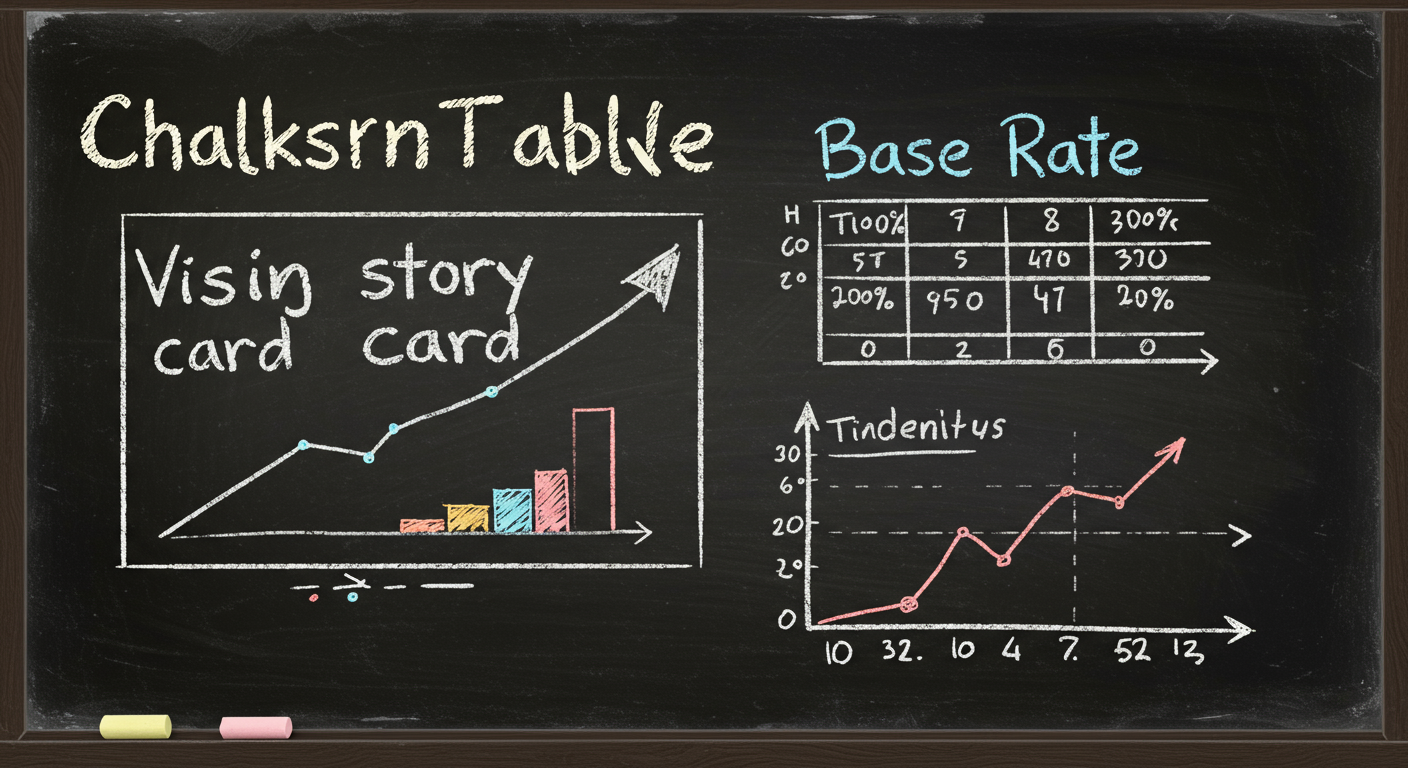
A student comparing a vivid story card and a base rate table on a classroom whiteboard

5. Putting it together: choose better under uncertainty

note

A decision workflow

  1. State your prior belief.
  2. Identify the possible outcomes.
  3. Assign probabilities and payoffs.
  4. Update with new evidence.
  5. Compare expected values.
  6. Stop searching when extra information is not worth the delay.

This workflow works well for hiring, investing, medical choices, and everyday tradeoffs.

diagram
chart · line
Belief update after evidence
PriorEvidence 1Evidence 2Evidence 3
equation
Decision score=iPi×Vicost of delay\text{Decision score} = \sum_i P_i \times V_i - \text{cost of delay}

Transcript

Welcome to Slate. Today we're looking at Think in Probabilities, Not Certainties. We'll cover Expected value and why it beats gut instinct, Bayesian reasoning for updating beliefs, The optimal stopping problem: when to decide, and How cognitive biases distort our probability intuitions. Let's get into it.

A decision is not the same as a result. A single coin flip can look lucky or unlucky. Expected value asks a different question: if you could repeat the choice many times, what would you gain on average? That is the number that helps you compare options fairly. The formula is simple. Multiply each outcome by its probability, then add them up. Here is the key idea: a choice with a lower chance of success can still be better if the payoff is large enough. Think of it like weighing ingredients on a scale. One heavy payoff can balance many small losses. In 1956, Leonard Savage made expected utility central to rational choice under uncertainty. In practice, expected value is the first pass. If a game pays 100 dollars with 10 percent chance and 0 otherwise, the expected value is 10 dollars. If another game pays 8 dollars for sure, the second is better on expected value, even if the first feels more exciting. Real life adds risk, time, and emotions. Still, expected value beats gut instinct when the same kind of choice repeats. Insurance, investment, and hiring decisions all depend on it. The visual here shows why people misread rare big wins. We notice the jackpot. The math notices the average.

Bayesian thinking is a disciplined way to update beliefs. You start with a prior. That is your belief before new evidence. Then you see data. The data changes the odds. The result is the posterior, your updated belief. The formula comes from Thomas Bayes, published after his death in 1763, and later generalized by Pierre-Simon Laplace. The logic is easy to picture. Imagine a courtroom. The prior is your starting impression. The evidence is a witness statement. The posterior is your revised view after weighing how likely that statement would be under different stories. The heart of the method is not certainty. It is calibration. If a medical test is 99 percent sensitive, that sounds strong. But if the disease is rare, false positives can still dominate. People often ignore base rates, the actual prevalence in the population. That is why a positive result is not the same as a 99 percent chance of disease. Here is the pattern to notice in the diagram. Strong evidence should move you more when your prior was uncertain and less when the evidence was weak. Bayesian reasoning keeps that update honest instead of emotional.

Some choices are not about picking the best item from a fixed list. They are about deciding when to stop looking. That is the optimal stopping problem. Each extra option gives you more information, but it also costs time and may make you miss a good current choice. The classic example is the secretary problem, studied by Thomas Ferguson in 1989, with roots in earlier work by Merrill Flood. You interview candidates one by one and must hire immediately or reject forever. If you know the number of candidates, the famous result is to skip the first 37 percent or so, then choose the next one who is better than everyone you have seen. For 100 candidates, that means roughly the first 37 are for learning, not for hiring. Why does this work? The early samples set a benchmark. After that, you stop when someone beats it. The benchmark is like a ruler. Without it, every candidate feels hard to compare. Real life is messier than the textbook problem. You do not know how many options remain. Still, the same logic appears in job searches, apartment hunting, dating, and sales. The question is always the same: how much value does one more look add, and what does waiting cost?

Human judgment is not random. It is systematically biased. That matters because bias changes the probabilities you think you see. Daniel Kahneman and Amos Tversky showed this in a long series of studies, starting in the early 1970s. People overweight vivid outcomes and underweight base rates. They also chase recent events. After a streak of wins, a gambler may think the odds have changed. In a fair game, they have not. Another bias is the conjunction fallacy. In the famous 1983 Linda problem, people judged a detailed story as more likely than a less detailed one, even though probability cannot increase when you add extra conditions. A more specific claim is always equal or less probable than a broader one. That is basic set logic. The diagram here helps separate intuition from math. Intuition loves stories. Probability asks for counts, frequencies, and denominators. When those disagree, trust the denominator. A good habit is to ask three questions: What is the base rate? What evidence would I expect if my belief were true? And what evidence would I expect if it were false? Those questions slow down the fast, confident mistake.

Good decisions under uncertainty use all three tools together. Expected value tells you what a choice is worth on average. Bayesian updating tells you how to revise your beliefs when new evidence arrives. Optimal stopping tells you when enough information is enough. Here is a practical sequence. First, write down your prior belief. Second, list the outcomes and their probabilities. Third, update those probabilities when new evidence appears. Fourth, compare the expected values of your options. Fifth, decide whether more searching is worth the delay. Suppose you are choosing between two job offers. One pays 95,000 dollars with a long commute. The other pays 88,000 dollars with a short commute and a stronger chance of promotion. Expected value is not just salary. It includes probability-weighted future gains, time, stress, and the cost of waiting for a third offer. That is why decision quality improves when you make the hidden numbers visible. The final diagram shows the loop. Belief leads to evidence. Evidence changes belief. Belief shapes action. Action changes what you learn next. That loop is Bayesian thinking in real life. Not certainty. Better odds, better timing, better choices.

XLinkedInWhatsApp

Keep going with Slate

Pick up where this left off in your own voice session.

Built with Slate