1. What makes a humanoid robot hard
0:007:34
Engineering

The Race to Build Humanoid Robots

Tesla Optimus, Figure, Boston Dynamics — how companies are teaching robots to walk, grasp, and think in the real world.

Apr 22, 20268 min listen5 chapters
What you'll learn
  • How robots learn from human movement data
  • Key players: Tesla Optimus, Figure, Boston Dynamics
  • The engineering challenges of real-world manipulation
  • Timeline and societal implications

1. What makes a humanoid robot hard

note

The Race to Build Humanoid Robots

Tesla Optimus, Figure, Boston Dynamics — how companies are teaching robots to walk, grasp, and think in the real world.

note

Humanoid robotics: the core problem

A humanoid robot is a machine with a humanlike body plan: two legs, two arms, a torso, and usually hands.

Why this is hard:

  • Balance is unstable by nature. A standing robot is constantly falling and correcting itself.
  • The body has many degrees of freedom. Each joint adds another control decision.
  • Real-world objects vary. A box can be light, heavy, wet, crushed, or oddly shaped.
  • Contact is unpredictable. Hands, feet, and tools all change the physics when they touch something.

A useful analogy: a humanoid robot is like a tightrope walker carrying a toolbox. It has to keep balance while doing useful work at the same time.

diagram
note

Why the real world is the test

A robot can look impressive in a lab and still fail on a factory floor. Real environments add:

  • uneven surfaces
  • changing lighting
  • cluttered shelves
  • people walking nearby
  • objects that do not match training examples

The best humanoid systems are judged by whether they can repeat tasks safely, not by one flashy demo.

equation
NDOF=number of controllable joints and axesForahumanoid,alargerNDOFmeansmoreflexibility,butalsoahardercontrolproblem.N_{DOF} = \text{number of controllable joints and axes} For a humanoid, a larger N_{DOF} means more flexibility, but also a harder control problem.

2. How robots learn from human movement data

note

Learning from demonstration

Three common data sources are used in humanoid robotics:

  • Teleoperation: a human remotely controls the robot
  • Motion capture: sensors record human body movement
  • Self-supervised robot experience: the robot tries many actions and learns from outcomes

The goal is to turn examples into a policy. In simple terms, a policy maps what the robot sees to what it should do next.

diagram
note

Why imitation is not enough

Copying a human motion is only the first step. The robot must also handle:

  • different limb lengths
  • different joint limits
  • different grip strength
  • different friction on the floor or object

A human can reach around a box in a fluid way. A robot may need a different elbow angle or wrist rotation to avoid collision.

chart · bar
Data sources in humanoid training
TeleoperationMotion captureSelf-play and trial

3. Tesla Optimus, Figure, and Boston Dynamics

note

Key players in humanoid robots

Tesla Optimus

  • First shown in 2021
  • Focus: manufacturing scale and factory tasks
  • Strength: vertical integration with Tesla hardware and AI stack

Figure

  • Founded in 2022
  • Figure 01 shown in 2024; Figure 02 later in 2024
  • Focus: general-purpose labor and data-driven manipulation

Boston Dynamics

  • Founded in 1992
  • Acquired by Hyundai in 2021
  • Atlas became famous for dynamic balance, running, jumping, and parkour-style motion
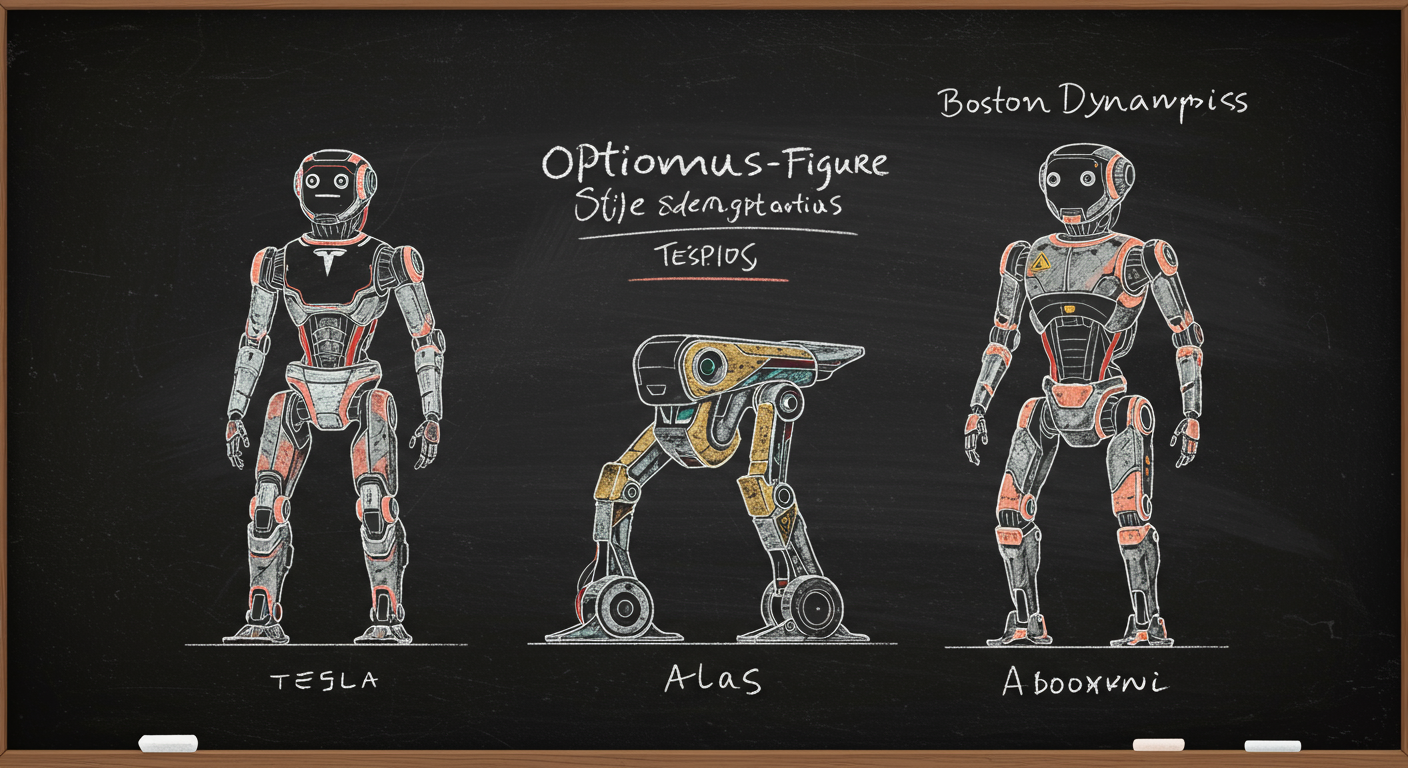
illustration
three humanoid robots in a factory comparison Tesla Optimus Figure and Boston Dynamics Atlas
diagram
note

A useful comparison

Tesla is betting that manufacturing efficiency will matter most. Figure is betting that flexible software will matter most. Boston Dynamics is showing what the body can do when control is excellent.

A robot company can win by being cheaper, smarter, or more agile. The hard part is that real customers want all three.

4. The engineering bottlenecks

equation
τ=IαThesumoftorquesdeterminesangularacceleration.Inhumanoids,controlsystemsmustmanagetorquesacrossmanyjointsatonce.\sum \tau = I\alpha The sum of torques determines angular acceleration. In humanoids, control systems must manage torques across many joints at once.
note

Main bottlenecks

Balance: the robot must keep its center of mass inside a stable region.

Manipulation: hands need force control, tactile sensing, and precise positioning.

Power: batteries limit runtime, and motors produce heat.

Reliability: a robot must repeat the same task thousands of times without drifting out of calibration.

Safety: if a robot falls or swings an arm into a person, the system must detect and stop quickly.

diagram
chart · line
Why narrow tasks come first
Demo walkingDoor openingBin handlingShelf pickingGeneral labor

5. Timeline and societal implications

note

Timeline

2017: Boston Dynamics Atlas shows backflips.

2021: Tesla introduces Optimus.

2022: Figure is founded.

2024: Figure 01 and Figure 02 are shown; Tesla continues Optimus demonstrations; Boston Dynamics unveils a new electric Atlas.

The pattern is clear: the field is moving from spectacular motion toward usable work.

diagram
note

Societal implications

Likely benefits:

  • fewer dangerous repetitive jobs for humans
  • more flexible automation in existing buildings
  • help in logistics, inspection, and manufacturing

Risks and tradeoffs:

  • displacement in some job categories
  • safety failures near people
  • overpromising before reliability is proven
  • concentrated control of physical automation by a few companies
note

The bottom line

Humanoid robots are not winning because they look human. They are winning only if they can work in human spaces, with human tools, at human speed, for long hours, and without constant rescue.

Transcript

Welcome to Slate. Today we're looking at The Race to Build Humanoid Robots. We'll cover How robots learn from human movement data, Key players: Tesla Optimus, Figure, Boston Dynamics, The engineering challenges of real-world manipulation, and Timeline and societal implications. Let's get into it.

A humanoid robot has to do three difficult things at once. It must balance, move, and manipulate objects. A wheeled robot only worries about the floor. A humanoid has knees, ankles, hips, shoulders, elbows, wrists, and hands. That is a lot of moving parts to coordinate. The real challenge is not making a robot look human. It is making it survive the messiness of the real world. A sock on the floor, a slippery box, or a door that sticks can break a neat plan. Here is the key idea. Walking is a control problem. Grasping is a contact problem. Thinking is a planning problem. The diagram shows how these stack together. If the robot loses balance, planning does not matter. If the hand misses the handle, the task fails even if the robot walked perfectly. That is why humanoid robotics sits at the intersection of mechanics, control theory, machine learning, and computer vision. Boston Dynamics has spent years showing what excellent body control looks like. Atlas demonstrated backflips in 2017 and parkour-style moves in 2024. Tesla and Figure are pushing a different bet. They want humanoids that can be trained from data and used in factories. The prize is flexibility. A factory built for people already has stairs, doors, shelves, and tools sized for human bodies. A humanoid can, in principle, fit that world without rebuilding everything.

Modern humanoid robotics is moving away from hand-coded motion for every step. Instead, teams collect human demonstrations and use them as training data. Here is the basic idea. A person performs a task, like picking up a battery pack or folding a shirt. Cameras, motion capture, and robot sensors record the movement. The robot then learns a policy, which is a rule for choosing actions from observations. This is similar to teaching a child by demonstration. You do not explain every muscle contraction. You show the motion, and the learner copies the pattern, then adjusts for its own body. That analogy is useful, but robots are less forgiving. A human wrist can compensate for a bad grasp. A robot hand often cannot. Tesla has said Optimus is trained using human motion data and teleoperation. Figure has described using humanoid data and end-to-end learning for manipulation tasks. In 2024, Figure announced Figure 01 and later Figure 02, with demonstrations focused on warehouse-style work. Boston Dynamics, by contrast, has historically relied more on model-based control for locomotion, though it has also added machine learning for perception and task behavior. The important engineering point is this. Data teaches the robot what successful behavior looks like. Physics still decides whether that behavior works when the floor is slippery or the object shifts in the hand.

The three names most people hear are Tesla, Figure, and Boston Dynamics, but they are aiming at slightly different points on the map. Tesla Optimus is built around mass production thinking. Elon Musk first showed the Optimus concept in 2021, and Tesla has since demonstrated walking, sorting objects, and simple factory-style tasks. The company’s bet is scale. If the hardware can be made cheaply enough, many robots could be deployed. Figure, founded in 2022, has moved quickly. Figure 01 was shown in 2024, and Figure 02 followed later that year with more capable hands, wiring, and onboard computing. Figure has emphasized general-purpose labor in logistics and manufacturing. Its pitch is that a humanoid can learn useful work from data and adapt to changing tasks. Boston Dynamics is the veteran. Atlas has long been the benchmark for dynamic motion. The company, founded in 1992, was acquired by Hyundai in 2021. Its robots are famous for acrobatics, but the deeper value is control under extreme motion. Atlas can do things that reveal how far balance and whole-body coordination have come. Think of it this way. Tesla is chasing manufacturable scale. Figure is chasing useful general labor. Boston Dynamics is chasing physical mastery. The market may reward all three, but the engineering paths are not the same.

Humanoid robots fail in the details. Walking over a flat floor is one thing. Walking while carrying a box changes the center of mass. The robot must keep the combined weight over its support area or it tips. Grasping has the same problem. A hand that can close around an object still needs the right force, the right angle, and the right timing. Here is a simple physics picture. If the center of mass moves outside the base of support, the robot falls unless it takes a corrective step. That is why foot placement matters so much. The robot is constantly solving a moving geometry problem. It is like balancing a broom on your palm, except the broom has 20 or more joints and the floor can move under it. There are also practical bottlenecks. Batteries are heavy. Motors heat up. Hands are fragile. Cameras can be blinded by glare. And every extra joint means more failure points. A robot that works for 20 minutes in a demo is not ready for an 8-hour shift. This is why many systems still start with narrow tasks. Sort parts. Open doors. Move bins. Pick and place. Those tasks teach the robot how to survive contact, which is the real exam in physical AI.

The timeline matters because humanoid robots have moved from science fiction to engineering roadmaps in just a few years. Boston Dynamics spent the 2010s proving that dynamic motion was possible. In 2021, Tesla introduced Optimus. In 2022, Figure was founded. In 2024, both Tesla and Figure showed more mature prototypes, while Boston Dynamics retired the hydraulic Atlas and introduced a new electric Atlas platform. That shift matters because electric systems are easier to maintain and better suited to productization. The social question is not whether humanoids will look impressive. It is where they will be useful first. Warehouses, manufacturing, and repetitive industrial work are the likely starting points. Those jobs are structured, measurable, and expensive when labor is scarce. But the consequences spread beyond factories. If humanoids become reliable and affordable, they could change labor markets, safety standards, and the design of workplaces. There is also a cautionary side. Robots that learn from data can inherit bad behavior if training is sloppy. Robots that work near people must obey strict safety rules. And if companies promise too much too soon, trust will collapse. The best near-term view is practical, not magical. Humanoids will arrive first as narrow specialists that happen to have human bodies. Only later, if the engineering holds up, will they begin to feel truly general.

XLinkedInWhatsApp

Keep going with Slate

Pick up where this left off in your own voice session.

Built with Slate