1. What a smart city is, and why buildings matter most
0:007:10
Engineering

Smart Cities: How Urban Design Is Changing

Green buildings, smart grids, and urban farming — how engineers are rebuilding cities for the next century.

Apr 22, 20267 min listen5 chapters
What you'll learn
  • Passive house design and net-zero buildings
  • Smart grid technology and distributed energy
  • Urban heat island effect and engineering solutions
  • Case studies: Singapore, Copenhagen, Barcelona

1. What a smart city is, and why buildings matter most

note

Smart Cities: How Urban Design Is Changing

Green buildings, smart grids, and urban farming — how engineers are rebuilding cities for the next century.

note

Smart cities and the building-first strategy

A smart city uses engineering, not just software, to reduce energy use, emissions, and operating costs.

Why buildings come first

  • Buildings account for about 30% of global final energy use
  • Buildings account for about 26% of energy-related carbon dioxide emissions
  • The cheapest energy is the energy a building never needs

Passive house in one sentence

A passive house is a building so well insulated and airtight that it needs very little heating or cooling.

Net-zero building in one sentence

A net-zero building produces as much energy as it uses over a year, usually with on-site renewable generation.

Core design moves

  • High-performance insulation
  • Airtight envelope
  • Triple-glazed windows
  • Heat recovery ventilation
  • Exterior shading and solar control
  • Efficient lighting and appliances
diagram
note

Worked example

A typical office building might need 150 kilowatt-hours per square meter each year for heating and cooling. A passive design can push that far lower by cutting heat loss through the envelope. If the building then adds rooftop solar, efficient lighting, and smart controls, it may reach net-zero annual energy use.

Why airtightness matters

Air leaks are like leaving a window cracked open all winter. Even strong insulation cannot fully compensate if warm air keeps escaping.

Design tradeoff

Passive design often costs more upfront for insulation, windows, and detailing. But it lowers operating costs for decades, which matters in cities where buildings last 50 to 100 years or more.

equation
Q=UAΔTQ = U A \Delta T
note

Reading the equation

Q is heat flow. U is the thermal transmittance of the wall or window. A is area. ΔT is the temperature difference.

If you lower U with better insulation, heat loss drops immediately. That is why envelope design is not a cosmetic choice. It is the first control knob in urban energy engineering.

2. Smart grids: the city’s electrical nervous system

note

Smart grid technology

A smart grid is an electricity network that uses sensors, software, and communication to balance supply and demand in real time.

What changes compared with a traditional grid

  • Power flows both ways
  • Grid devices report live data
  • Utilities can respond faster to faults
  • Demand can shift instead of only supply changing

Distributed energy resources

  • Rooftop solar photovoltaic systems
  • Battery storage
  • Electric vehicles that can charge on schedule
  • Microgrids for hospitals, campuses, and neighborhoods

Why this matters for cities

Urban electrification increases load, but smart control can keep that load manageable without building oversized power plants and wires.

diagram
chart · line
Daily city load with smart control
12am6am12pm6pm10pm

3. Fighting the urban heat island effect

note

Urban heat island effect

Urban areas become hotter than surrounding rural areas because built surfaces absorb and re-radiate heat.

Main causes

  • Dark roofs and pavements absorb solar radiation
  • Less vegetation means less evaporative cooling
  • Tall buildings can trap heat and reduce night-time airflow

Engineering solutions

  • Cool roofs with high solar reflectance
  • Cool pavements with lower heat storage
  • Street trees and urban forests
  • Green roofs and green walls
  • Ventilation corridors and better urban form

Why it matters

Heat islands increase cooling demand, strain the grid, and raise health risk during heat waves.
illustration
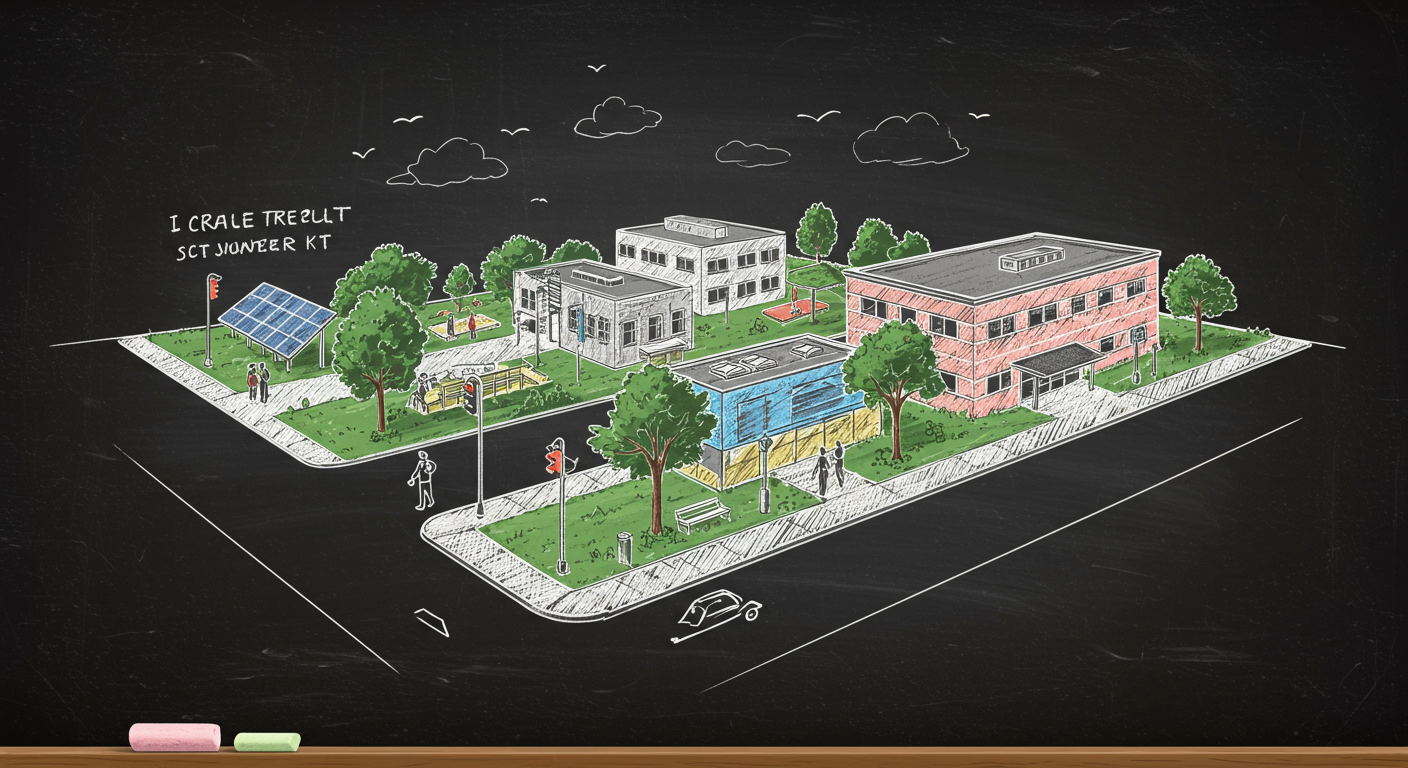
A city block with a cool roof, green roof, street trees, shaded sidewalks, solar panels, and pedestrians during a summer afternoon
diagram
note

Why trees help, and why they are not enough

Trees cool through shade and evapotranspiration. A mature tree can make a street feel much cooler, but trees need water, soil volume, and decades to grow. That is why the best city plans combine trees with reflective surfaces and building efficiency.

Practical tradeoff

A white roof can reflect sunlight immediately. A tree may take years to deliver full benefit. But the tree also improves stormwater management, biodiversity, and public space. Good urban design uses both.

4. Case studies: Singapore, Copenhagen, and Barcelona

note

Case study comparison

CityCore strategyEngineering strength
SingaporeGreen buildings and district coolingDense, land-scarce urban efficiency
CopenhagenDistrict heating and low-carbon mobilityLarge-scale thermal networks
BarcelonaSuperblocks and public-space redesignHeat relief, walkability, and air quality

Singapore

  • Green Mark building rating launched in 2005
  • Dense urban form makes district cooling especially effective
  • Strong emphasis on water, greenery, and building performance

Copenhagen

  • Long-running district heating system
  • More than 98% of district heating demand served by district heating networks
  • Cycling and compact land use support lower transport emissions

Barcelona

  • Superblocks reduce through-traffic in neighborhood interiors
  • More space for trees and shade
  • Better conditions for walking and social life
diagram
chart · bar
City strategy focus
SingaporeCopenhagenBarcelona

5. Designing the next century city

note

The city of the future is integrated

A high-performing city links buildings, energy, transport, water, and public space.

What to optimize together

  • Energy demand
  • Grid flexibility
  • Thermal comfort
  • Stormwater management
  • Mobility and walkability
  • Food access and urban farming

Urban farming in the city

  • Rooftop gardens
  • Community plots
  • Vertical farms near dense neighborhoods
  • Waste heat and rainwater reuse in controlled environments

Engineering takeaway

The best urban projects solve more than one problem at once: a roof can insulate, generate power, and grow food if the structure is designed for it.

diagram
note

What to remember

  • Passive house design cuts energy demand before a building ever needs extra power
  • Net-zero buildings balance annual use with clean generation
  • Smart grids coordinate solar, batteries, and flexible demand
  • Heat island solutions need roofs, trees, and street design together
  • Singapore, Copenhagen, and Barcelona show that city-scale engineering works best as a system

Transcript

Welcome to Slate. Today we're looking at Smart Cities: How Urban Design Is Changing. We'll cover Passive house design and net-zero buildings, Smart grid technology and distributed energy, Urban heat island effect and engineering solutions, and Case studies: Singapore, Copenhagen, Barcelona. Let's get into it.

A smart city is not just a city with sensors. It is a city that uses data, design, and infrastructure to cut waste and improve daily life. The biggest piece is often the building. Buildings use about 30 percent of global final energy and produce about 26 percent of energy-related carbon dioxide emissions, according to the United Nations Environment Programme. So if you want a city to run cleaner, start with walls, windows, roofs, and heating systems. A passive house is a good example. Think of it like a thermos. A thermos does not make heat. It keeps heat from escaping. Passive House standards, developed in Germany in the 1990s, use very thick insulation, airtight construction, triple-glazed windows, and heat recovery ventilation. That can cut heating demand by about 80 to 90 percent compared with conventional buildings. Net-zero buildings go one step further. Over a year, they produce as much energy as they use, usually with solar panels and efficient equipment. Here the key idea is simple: the cleanest kilowatt-hour is the one you never need in the first place. The diagram shows how smart cities stack these layers. First reduce demand. Then supply the rest with clean power. Then connect everything with data so the system can adapt in real time.

A smart grid is the electrical system with feedback. A traditional grid mostly pushes power one way, from big plants to users. A smart grid also listens. It measures demand, voltage, and frequency in real time, then adjusts supply and usage. That matters because cities are adding rooftop solar, electric vehicles, batteries, and heat pumps. Those devices do not behave like old-school loads. They can rise and fall quickly. The grid has to keep balance every second. Think of it like a highway at rush hour. A normal road only has stoplights. A smart road has traffic sensors, ramp metering, and navigation data that can reroute cars before a jam forms. In electricity, the equivalent tools are smart meters, demand response, distributed energy resources, and battery storage. Distributed energy means power is generated near where it is used. Rooftop solar on apartments, batteries in basements, and microgrids on campuses all reduce strain on transmission lines. The engineering challenge is coordination. Too much solar at noon can overload local circuits. Too many electric vehicles charging at 6 p.m. can create a new peak. Smart control systems solve that by shifting flexible loads to better times. The result is not just cleaner power. It is a more resilient city when storms, heat waves, or equipment failures hit.

Cities run hotter than nearby rural land because asphalt, dark roofs, and concrete store sunlight and release it slowly. This is the urban heat island effect. On a calm summer night, the difference can be several degrees Celsius, and in some places it can be much larger. The U.S. Environmental Protection Agency explains that urban heat islands raise energy demand, worsen air quality, and increase heat stress. Engineers attack the problem from three directions. First, reflect more sunlight with cool roofs and cool pavements. Second, add shade and water through trees, parks, and green roofs. Third, move air and reduce trapped heat with street geometry and ventilation corridors. Here the image shows a roof doing more than just covering a building. A green roof can lower roof surface temperature, slow stormwater runoff, and create habitat. But it is not free. It adds structural load, irrigation needs, and maintenance. That is why urban heat solutions are system problems, not single-product fixes. Copenhagen has used cool materials, district energy, and cycling infrastructure to support a lower-carbon urban form. Barcelona has expanded shaded public space through its superblock plan and added more green infrastructure. The engineering lesson is that comfort, energy, and public health are connected. Cooler streets mean less air-conditioning demand and fewer dangerous heat exposures.

Three cities show three different engineering styles. Singapore treats the city as a managed ecosystem. Its Green Mark building program, launched in 2005, pushes efficiency across new and existing buildings. The city also uses district cooling in dense areas, where chilled water is produced centrally and piped to many buildings. That is efficient when land is scarce and loads are concentrated. Copenhagen takes a district energy approach on a larger scale. More than 98 percent of its district heating demand is supplied by district heating networks, and the city has long used combined heat and power, waste heat recovery, and strong cycling infrastructure to cut emissions. Barcelona shows how street design changes comfort. The superblock model groups traffic away from interior streets, freeing space for trees, play, and walking. That reduces noise and can lower local heat exposure. Notice the pattern across all three. None of them relies on one technology. Each combines buildings, energy, transport, and public space. That is why smart-city engineering is really systems engineering. The best cities do not just add gadgets. They redesign flows of heat, power, water, and people so the whole city works better.

The next century city will be built around three linked goals: lower energy demand, cleaner supply, and better public space. Passive house design attacks demand at the building scale. Smart grids make electricity flexible and resilient. Heat island engineering keeps streets livable as summers get hotter. Urban farming adds another layer. Rooftop greenhouses, community gardens, and vertical farms can shorten supply chains and reuse waste heat or captured rainwater, though they rarely replace regional agriculture. The real skill is integration. A building with solar panels, batteries, and demand response can help the grid. A shaded street can reduce cooling load in the building next to it. A district energy network can reuse waste heat from data centers or industry. That is the city as a system of systems. If you remember one engineering idea, make it this: every design choice either creates friction or removes it from the city’s daily metabolism. The most successful smart cities do not feel futuristic because of screens. They feel better because they waste less energy, stay cooler, and give people more usable space. That is what urban design is changing: not only how cities look, but how they work from the inside out.

XLinkedInWhatsApp

Keep going with Slate

Pick up where this left off in your own voice session.

Built with Slate