What a qubit is
0:007:12
Science

Quantum Computing: What It Is and Why It Matters

Qubits, superposition, entanglement — finally explained in plain language. Plus: where quantum is actually useful today.

Apr 22, 20267 min listen5 chapters
What you'll learn
  • Qubits, superposition, and entanglement in plain language
  • What quantum advantage actually means
  • Real applications: cryptography, drug discovery, optimization
  • How close we are to practical quantum computers

What a qubit is

note

Quantum Computing: What It Is and Why It Matters

Qubits, superposition, entanglement — finally explained in plain language. Plus: where quantum is actually useful today.

note

Qubit: the quantum version of a bit

A classical bit stores one value: 0 or 1.

A qubit is a quantum two-level system. Before measurement, it can be in a superposition of both basis states:

  • |0⟩
  • |1⟩

The state is usually written as:

|ψ⟩ = α|0⟩ + β|1⟩

where α and β are complex numbers, and the probabilities are:

  • P(0) = |α|²
  • P(1) = |β|²

The probabilities must add to 1:

|α|² + |β|² = 1

Real qubits are physical objects, so they are noisy and fragile. That is why quantum hardware needs error correction, calibration, and extreme isolation.

diagram
equation
ψ=α0+β1|\psi\rangle = \alpha|0\rangle + \beta|1\rangle
note

Why superposition is not magic

Superposition is not the same as being secretly 0 and 1 in a hidden box. It is a real quantum state with phase, and phase matters. That phase lets amplitudes interfere.

Analogy: two sets of waves in a pond. If the crests line up, the wave gets taller. If a crest meets a trough, they cancel. Quantum algorithms try to steer wrong answers toward cancellation and right answers toward reinforcement.

That is why quantum computers are not just faster classical computers. They are different machines built for different kinds of problems.

Entanglement and interference

note

Entanglement: one state, two qubits

Entanglement means the joint state cannot be written as a simple product of two separate states.

Example: the Bell state

(|00⟩ + |11⟩) / √2

If you measure one qubit and get 0, the other will also be 0. If you get 1, the other will also be 1. The outcomes are correlated, but no usable signal travels faster than light.

Entanglement is a resource for quantum computing because it creates joint patterns that classical bits do not naturally share.

diagram
note

Interference: why amplitudes matter

Quantum algorithms are designed so that amplitudes for wrong answers cancel and amplitudes for right answers reinforce.

Analogy: noise-canceling headphones. They do not remove all sound. They use a carefully chosen opposite wave to suppress unwanted noise. Quantum circuits use gate sequences to suppress bad outcomes and amplify useful ones.

This is why the order of gates matters so much. Change the order, and the interference pattern changes.

chart · bar
Classical vs quantum query idea
Classical worst caseQuantum exampleClassical averageQuantum average

What quantum advantage really means

note

Quantum advantage, quantum supremacy, and utility

Quantum advantage: a quantum device outperforms the best known classical approach on a specific task.

Quantum supremacy: a historical term for a quantum device doing something infeasible for classical computers. The phrase is now used less often because it sounds grander than the evidence usually supports.

Quantum utility: the result helps solve a real problem better than current methods.

The best benchmark is not bragging rights. It is whether the output changes a real decision.

diagram
note

Where we are now

Most current devices have tens to hundreds of physical qubits, but many are too noisy for long calculations.

Useful fault-tolerant quantum computers will need logical qubits built from many physical qubits. For example, a single high-quality logical qubit may require thousands of physical qubits, depending on error rates and the error-correction code.

That gap is why progress is measured in coherence time, gate fidelity, and error rates, not just qubit count.

equation
Logical qubitsphysical qubits needed for error correction\text{Logical qubits} \ll \text{physical qubits needed for error correction}

Where quantum is useful today

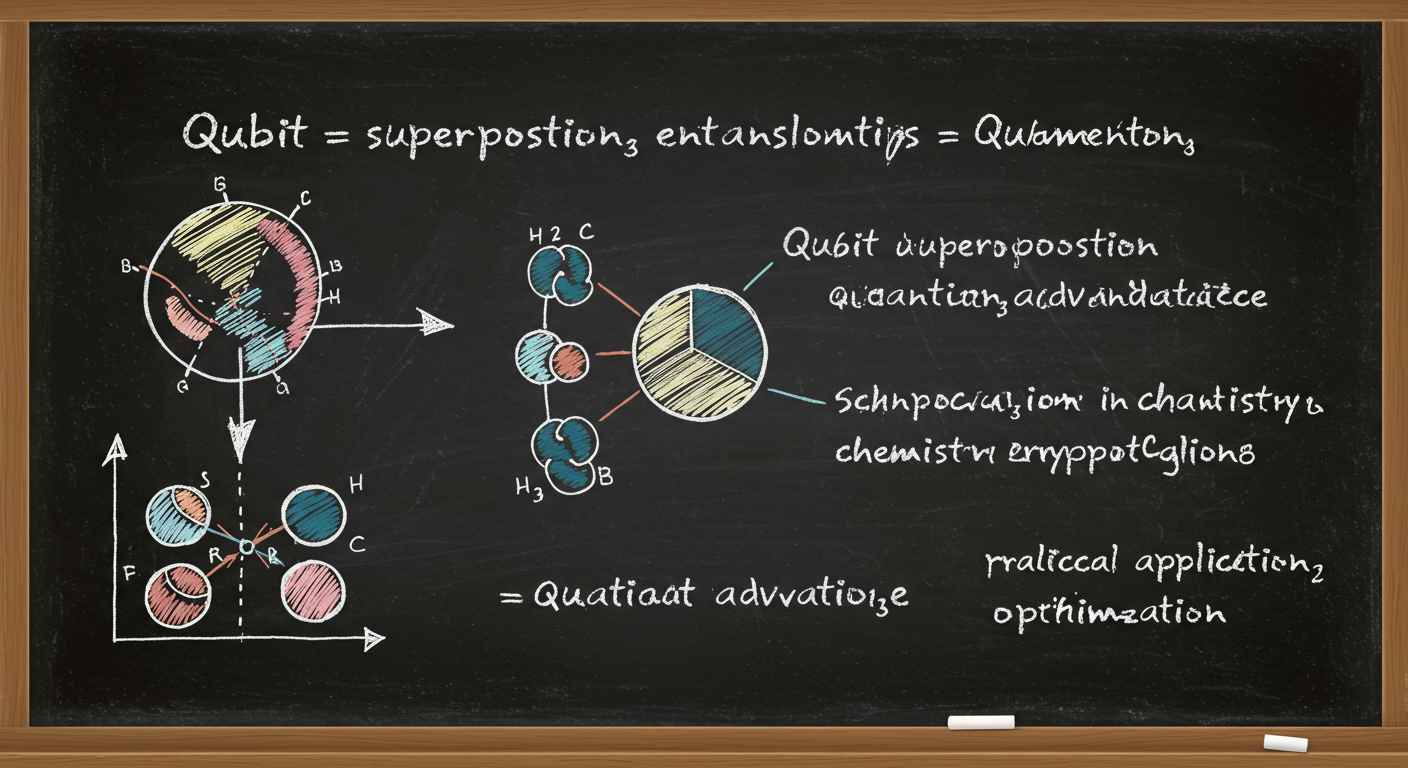
illustration
A classroom whiteboard showing qubit superposition entanglement quantum advantage and practical applications in chemistry cryptography and optimization
note

Real applications and real limits

Chemistry and materials science: promising because molecules are quantum systems.

Optimization: active research, but classical methods often still win on practical size and cost.

Cryptography: the clearest long-term impact. Shor’s algorithm threatens RSA and elliptic-curve cryptography once fault-tolerant machines exist.

Drug discovery: quantum simulation may help estimate molecular energies and reaction pathways, but today’s devices are still too noisy for broad industrial use.

The right question is not “Can a quantum computer do it?” The right question is “Can it do it better, sooner, or more reliably than the best classical method?”

diagram
chart · line
Hardware progress is measured by quality not just count
2015201820212024

How close practical quantum computers are

note

The road to a practical quantum computer

A practical machine needs:

  • low error rates
  • long coherence times
  • many high-quality qubits
  • error correction
  • scalable control electronics

The hard part is not only making one qubit work. It is making thousands or millions work together long enough to finish a useful algorithm.

diagram
note

What to remember

Qubits are not tiny classical bits. They are quantum states.

Superposition gives a qubit multiple possibilities before measurement.

Entanglement links qubits into one shared state.

Interference is how quantum algorithms shape probabilities.

Quantum advantage means a real task where quantum wins.

Today’s machines are promising, but mostly noisy and limited.

The most urgent real-world impact today is cryptography planning, not instant speedups everywhere.

equation
Useful quantum computing=hardware quality+error correction+problem structure\text{Useful quantum computing} = \text{hardware quality} + \text{error correction} + \text{problem structure}

Transcript

Welcome to Slate. Today we're looking at Quantum Computing: What It Is and Why It Matters. We'll cover Qubits, superposition, and entanglement in plain language, What quantum advantage actually means, Real applications: cryptography, drug discovery, optimization, and How close we are to practical quantum computers. Let's get into it.

A classical bit is a light switch. It is either off, or on. A qubit is different. It can be prepared in a blend of both possibilities. That blend is called superposition. On the canvas, imagine a spinning arrow on a sphere. The arrow is not just a cute picture. It stands for a quantum state. When you measure the qubit, you do not get the whole arrow. You get one result: zero or one. The probabilities come from the state before measurement. Here is the key idea. Quantum computing does not mean trying every answer at once and reading them all out. Measurement collapses the state to one outcome. The power comes from using superposition before measurement so that amplitudes can add or cancel. Think of ripples on water. Two ripples can reinforce each other, or flatten each other out. Quantum algorithms use that interference carefully. A real qubit can be built from many physical systems. Trapped ions use charged atoms held in electromagnetic fields. Superconducting qubits use tiny circuits cooled to about 0.01 kelvin. That is colder than deep space. Different hardware has different strengths, but all of them must fight noise. A qubit is fragile. Even a tiny stray field, heat, or vibration can disturb it.

Two qubits can become entangled. That means you cannot fully describe one qubit without the other. The pair behaves like one joint object, even when the qubits are far apart. On the visual, notice how the two state arrows are linked. The link is not a wire carrying a message. It is a shared quantum state. Entanglement is often described as spooky. Einstein used that phrase in 1935. But the important part is practical. Entanglement creates correlations stronger than any classical hidden-variable model can produce. Those correlations are a resource. They help quantum computers represent and manipulate patterns that are hard to mimic with ordinary bits. Interference is the second half of the story. If superposition gives you many paths, interference lets those paths work together. A famous example is the Deutsch-Jozsa algorithm, introduced in 1992. It can determine whether a function is constant or balanced with one query in the quantum version, while the classical deterministic version may need many queries. That does not mean quantum wins on every problem. It means the right structure matters. The catch is that quantum states are delicate. More qubits do not automatically mean more useful power. If noise destroys entanglement too quickly, the computation fails before you can read it out.

Quantum advantage means a quantum device solves a useful task better than the best known classical method. Better can mean faster, cheaper, or using less energy. It does not mean every quantum device beats every supercomputer. It means a specific task crosses a practical threshold. There are three levels people often mix up. Quantum supremacy was used in 2019 when Google reported that its Sycamore processor completed a sampled random circuit task in about 200 seconds. Google estimated that a classical supercomputer would need about 10,000 years for that exact benchmark. The word supremacy caused a lot of debate, so many researchers now prefer quantum advantage. That phrase is narrower and less loaded. Then there is utility. A result can be scientifically impressive and still not help chemistry, logistics, or finance. Utility means the answer improves a real workflow. That bar is much higher. Today, most quantum computers are in the noisy intermediate-scale quantum, or N-I-S-Q, era. That term was coined by John Preskill in 2018. It means devices have enough qubits to be interesting, but not enough error correction to run long, fault-tolerant algorithms. So the honest answer is this: quantum computers already do experiments. They do not yet beat classical machines on most valuable business problems.

The strongest near-term uses are not general-purpose speedups. They are narrow problems where quantum mechanics is already part of the system. Chemistry is the clearest example. Molecules are quantum objects, so simulating them on quantum hardware is a natural fit. That matters for catalysts, batteries, and some drug candidates. A better catalyst can lower energy costs in chemical manufacturing. A better battery material can improve electric vehicles. Optimization is another target. Airline scheduling, portfolio construction, and factory planning all involve many constraints. Quantum methods such as the quantum approximate optimization algorithm, or Q-A-O-A, have been tested on small instances. So far, classical solvers still dominate most real workloads. But hybrid methods, where a quantum processor handles one subproblem and a classical computer handles the rest, are an active research area. Cryptography is the most urgent long-term concern. Shor’s algorithm, published in 1994, can factor large integers efficiently on a fault-tolerant quantum computer. That threatens widely used public-key systems such as RSA and elliptic-curve cryptography. The practical fix is post-quantum cryptography, which the U.S. National Institute of Standards and Technology began standardizing in 2024. That migration matters even before large quantum computers arrive, because data stolen today can be decrypted later. The honest summary is this: quantum is promising now, useful in some research settings, and not yet a drop-in replacement for classical computing.

Practical quantum computers need error correction. That is the central bottleneck. A fault-tolerant machine can keep working even when individual qubits fail, but it pays a heavy overhead. Think of it like building a bridge with many backup cables. The bridge becomes reliable, but it takes a lot more material. Researchers have already demonstrated small error-correcting codes and logical qubits with better performance than the underlying physical qubits in some experiments. That is real progress. But scaling from a handful of logical qubits to thousands or millions is a much harder engineering problem. The timeline is uncertain. Some useful niche applications may arrive in the 2020s. Broad, fault-tolerant quantum computing for large chemistry or cryptography workloads is likely still years away, and perhaps decades away, depending on hardware progress. No serious researcher can give a guaranteed date. If you want the simplest summary, use this: quantum computers are real, but they are not finished. They are like the first aircraft before commercial aviation. They proved the principle. Now the hard work is making them reliable, economical, and large enough to matter every day.

XLinkedInWhatsApp

Keep going with Slate

Pick up where this left off in your own voice session.

Built with Slate