1. What a prompt is really doing
0:006:32
Computer Science

Prompt Engineering 101: Talk to AI Better

The highest-leverage AI skill you can learn in 30 minutes. Proven techniques from few-shot to chain-of-thought.

Apr 22, 20267 min listen5 chapters
What you'll learn
  • Core prompting techniques: few-shot, chain-of-thought, role-play
  • How to debug and iterate on prompts systematically
  • When to use structured output vs. free-form
  • Advanced patterns: self-consistency, tree-of-thought

1. What a prompt is really doing

note

Prompt Engineering 101: Talk to AI Better

The highest-leverage AI skill you can learn in 30 minutes. Proven techniques from few-shot to chain-of-thought.

note

Prompt anatomy

A strong prompt usually includes:

  • Task: what to do
  • Context: what the model should know
  • Constraints: what to avoid or include
  • Output format: how the answer should look

Why this matters

Large language models are sensitive to instruction detail. In practice, prompt quality often matters more than prompt length. A 20-word prompt with the right constraints can outperform a 200-word vague request.

Good vs weak prompt

Weak: "Write about climate change."

Stronger: "Write a 120-word explanation of climate change for a 14-year-old. Use one concrete example, avoid jargon, and end with one action people can take."

Key principle

Be explicit about the shape of the answer. The model cannot guess your preferred structure reliably if you leave it open."},{

diagram
chart · bar
Prompt detail and answer quality
Vague taskTask plus contextTask plus formatTask context format constraints

2. Few-shot prompting and role-play

note

Few-shot prompting

Few-shot prompting gives the model a small set of input-output examples before the real query.

Use it when:

  • The output format must be consistent
  • The task is ambiguous
  • You want the model to imitate a style or label scheme

Role-play prompting

Role-play sets a perspective or expertise level.

Examples:

  • "You are a senior editor"
  • "You are a patient math tutor"
  • "You are a compliance analyst"

Role-play works best when paired with concrete instructions. A role alone is too vague.

Why examples work

Examples reduce ambiguity. They show the boundary cases. In machine learning terms, you are giving the model a tiny in-context training set."},{

diagram
python
prompt = """
You are a customer support classifier.
Label each message as Positive, Negative, or Neutral.

Examples:
Message: Thanks, that fixed it.
Label: Positive

Message: This still does not work.
Label: Negative

Message: I have a question about billing.
Label: Neutral

Now label:
Message: The update helped a lot, but login is still slow.
Label:
"""

print(prompt)
note

Practical rule

Use three to five examples when consistency matters. Keep the examples short, clean, and representative. If the model starts copying the examples too literally, simplify the pattern or add a counterexample.

3. Reasoning prompts, chain-of-thought, and self-consistency

note

Chain-of-thought prompting

Chain-of-thought prompting asks the model to reason through intermediate steps before answering.

Best for:

  • Multi-step math
  • Logic problems
  • Planning tasks
  • Debugging code

Self-consistency

Self-consistency samples multiple reasoning paths and selects the most common answer.

Reference: Xuezhi Wang et al., 2022, Self-Consistency Improves Chain of Thought Reasoning in Language Models.

Tree-of-thought

Tree-of-thought search explores several branches instead of one linear path.

Use it when:

  • There are many plausible next steps
  • You need exploration, not just completion
  • The task has a clear evaluation criterion

Tradeoff

More reasoning usually means more latency and cost. For simple tasks, direct answers are faster and often just as good."},{

diagram
equation
P(correct)=1i=1n(1pi)P(\text{correct}) = 1 - \prod_{i=1}^{n} (1 - p_i)
note

When to ask for reasoning

Ask for step-by-step work when the task is hard enough that one hidden leap is likely to fail. For simple extraction, summarization, or rewriting, direct prompting is usually better.

4. Debugging prompts systematically

note

Prompt debugging checklist

  1. Identify the failure
  2. Remove unnecessary instructions
  3. Test with a small set of real inputs
  4. Add constraints one at a time
  5. Compare outputs against the goal

Structured output vs free-form

Use structured output when you need:

  • Reliable parsing
  • Database ingestion
  • API calls
  • Consistent fields

Use free-form when you need:

  • Brainstorming
  • Explaining
  • Teaching
  • Creative writing

Common failure modes

  • The model ignores a constraint because it is buried too late
  • The prompt asks for too many tasks at once
  • The examples conflict with the instructions
  • The format is underspecified"},{
diagram
json
{
  "name": "Mina",
  "role": "data analyst",
  "task": "Summarize the chart in two sentences",
  "output_format": "JSON with fields summary and risk"
}
chart · line
Iteration improves prompt quality
Draft 1Draft 2Draft 3Draft 4Tested prompt

5. Advanced patterns and a practical workflow

note

Advanced prompt patterns

Self-consistency

Use multiple sampled reasoning paths and choose the most common answer.

Tree-of-thought

Explore several branches, score them, and keep the best path.

Structured output

Use schemas, tables, or JSON when another system depends on the result.

Practical workflow

  • Write the task in one sentence
  • Choose free-form or structured output
  • Add examples if the task is ambiguous
  • Test on real cases
  • Revise one variable at a time

Decision rule

Human reader: free-form

Software reader: structured

Hard reasoning: step-by-step plus sampling

Exploration: tree-of-thought
diagram
illustration
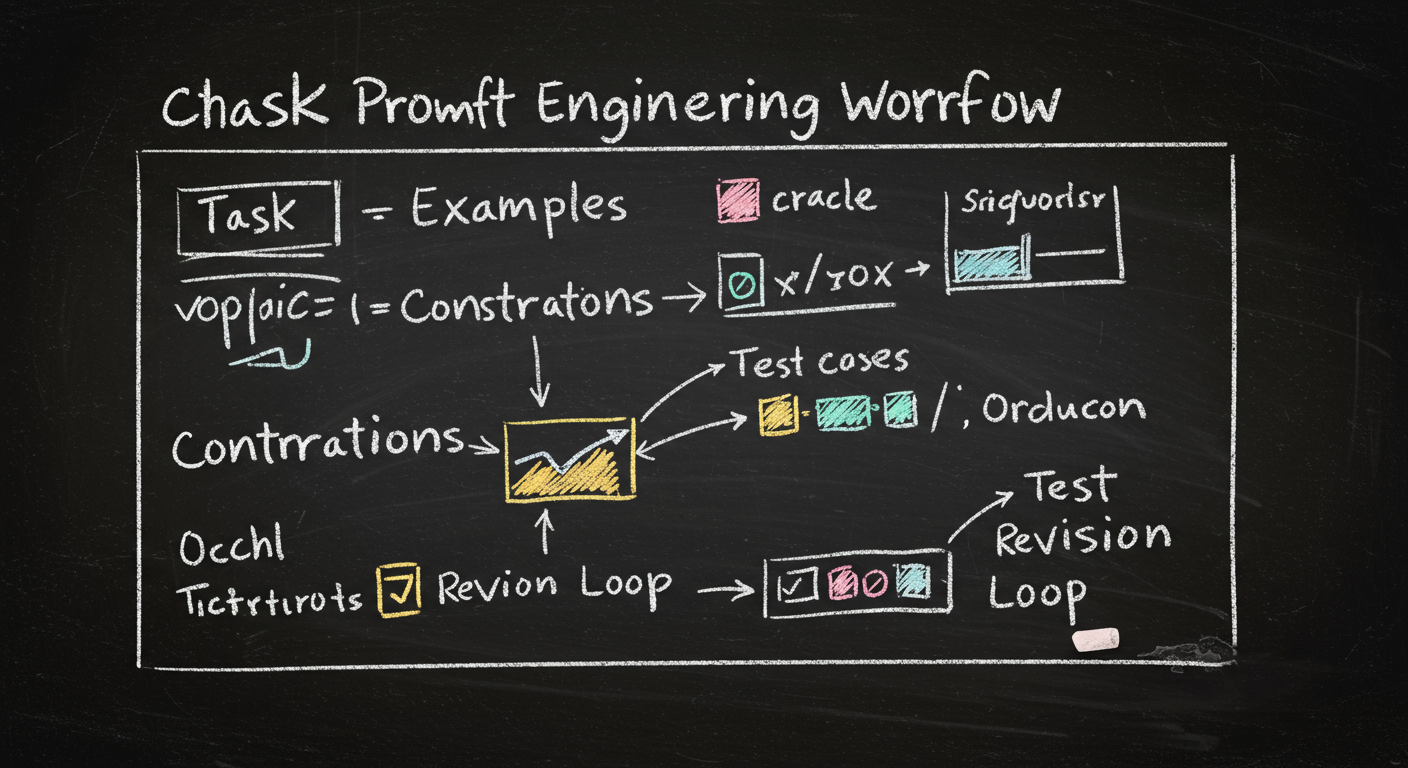
A whiteboard showing a prompt engineering workflow with task, examples, constraints, test cases, and revision loop
equation
Expected utility=Answer qualityLatency costParsing cost\text{Expected utility} = \text{Answer quality} - \text{Latency cost} - \text{Parsing cost}

Transcript

Welcome to Slate. Today we're looking at Prompt Engineering 101: Talk to AI Better. We'll cover Core prompting techniques: few-shot, chain-of-thought, role-play, How to debug and iterate on prompts systematically, When to use structured output vs. free-form, and Advanced patterns: self-consistency, tree-of-thought. Let's get into it.

A prompt is not a magic phrase. It is instructions plus examples plus constraints. The model reads your words and predicts the next token, one step at a time. That means small wording changes can shift the output a lot. Here’s the mental model: you are not commanding a person. You are shaping a probability machine. The most useful prompt has four parts. First, the task. Second, the context. Third, the format. Fourth, the quality bar. For example, “Summarize this article” is weak. “Summarize this article for a busy product manager in three bullets, using plain language, and include one risk” is much better. The diagram shows why: each extra constraint narrows the search space. Think of prompting like giving directions in a city. “Go downtown” is vague. “Take the blue line to Central, exit on 5th, and stop at the library” gets you there faster and with fewer wrong turns. There is one more key idea: the model does not truly know your intent unless you make it explicit. If you want a table, say table. If you want JSON, say JSON. If you want a tone, name the tone. Clarity beats cleverness almost every time.

Few-shot prompting means showing the model examples before asking for the real answer. The examples act like a stencil. They tell the model what pattern to copy, not just what topic to discuss. This is especially useful when the task is subjective, repetitive, or format-sensitive. Here’s a concrete case. Suppose you want product reviews labeled as positive, negative, or neutral. One example may help a little. Three well-chosen examples help much more, because the model sees the boundary between categories. The examples should be close to the real task. Random examples are noise. Role-play is different. You assign a perspective, like “You are a tax accountant explaining this to a freelancer.” That does not make the model smarter, but it changes the style, priorities, and vocabulary it uses. It is a shortcut to domain framing. A strong trick is to combine both. Give the role, then give examples, then ask for a new item. That is like showing a cook the dish, naming the cuisine, and then asking for the next plate. The model follows patterns much better when the pattern is visible.

Some tasks need reasoning, not just pattern matching. That is where chain-of-thought prompting comes in. The idea is to ask the model to work through the problem step by step before giving the final answer. The benefit is usually better accuracy on multi-step tasks like arithmetic, logic, planning, and code debugging. But there is a catch. You do not always need the model to expose every internal step. In many products, it is better to ask for a brief explanation or a short solution path, not a wall of hidden reasoning. The goal is better answers, not longer answers. Self-consistency is a powerful extension. Instead of trusting one reasoning path, you sample several and choose the most common final answer. This was described by Xuezhi Wang and colleagues in 2022. It works because one bad chain can fail, but a majority vote across several chains is more robust. Think of it like asking three mechanics before replacing a part. Tree-of-thought goes further. The model explores multiple branches, evaluates them, and keeps the promising ones. That is useful for puzzles, strategy, and open-ended planning. It is slower and more expensive, but it can beat a single straight-line answer when the problem has many possible paths.

Prompt debugging is closer to software debugging than to writing poetry. Start by naming the failure mode. Did the model misunderstand the task, ignore a constraint, invent facts, or use the wrong format? Once you know the bug, you can fix the right layer. A useful sequence is: simplify, isolate, test, then add constraints back. If a prompt fails, strip it down to the minimum version that still fails. That reveals whether the problem is the task, the examples, or the formatting. Then change one thing at a time. This is the same logic as diagnosing a noisy engine: you do not replace every part at once. Structured output helps debugging because it is easier to check. If you need reliable downstream parsing, ask for JSON or a table. If you want creativity, free-form text gives the model more room. The tradeoff is control versus flexibility. A good prompt is rarely perfect on the first try. The best practitioners keep a small test set of real examples and run their prompt against them repeatedly. That turns prompt writing from guesswork into an experiment.

Advanced prompting is about control. Self-consistency helps when one answer path is brittle. Tree-of-thought helps when the problem needs exploration. Structured output helps when another system has to read the result. The right choice depends on the job, not on what sounds sophisticated. A practical workflow is simple. First, define the task in one sentence. Second, choose the output shape. Third, add one or two examples if the task is ambiguous. Fourth, test on real inputs. Fifth, record failures and fix the weakest point. That loop is how prompt engineers work in practice. Here is a useful rule of thumb. If humans will read the answer, free-form text is fine. If software will read it, use structure. If accuracy matters more than speed, add reasoning and self-consistency. If exploration matters more than speed, use tree-of-thought. The image shows the whole pipeline: goal, prompt, test cases, revision, and final version. That is the real skill. Not memorizing tricks. Building a repeatable process that gets better with each round.

XLinkedInWhatsApp

Keep going with Slate

Pick up where this left off in your own voice session.

Built with Slate