What microplastics are, and how they get inside you
0:006:21
Science

Microplastics Are Inside You. Now What?

Found in blood, lungs, and placentas — what science knows about the health risks and what you can actually do.

Apr 22, 20266 min listen5 chapters
What you'll learn
  • Where microplastics come from and how they enter your body
  • What the latest research says about health risks
  • Practical steps to reduce your exposure
  • Policy changes happening globally in 2026

What microplastics are, and how they get inside you

note

Microplastics Are Inside You. Now What?

Found in blood, lungs, and placentas — what science knows about the health risks and what you can actually do.

note

Microplastics: definition and sources

Microplastics are plastic particles smaller than 5 millimeters. The category includes:

  • Primary microplastics: manufactured small, such as microbeads and some industrial pellets
  • Secondary microplastics: fragments and fibers formed when larger plastic items break down

Common sources include synthetic clothing, tire wear, packaging, paint, fishing gear, and the breakdown of single-use plastics.

How they enter the body

Main exposure routes:

  • Inhalation of airborne fibers and dust
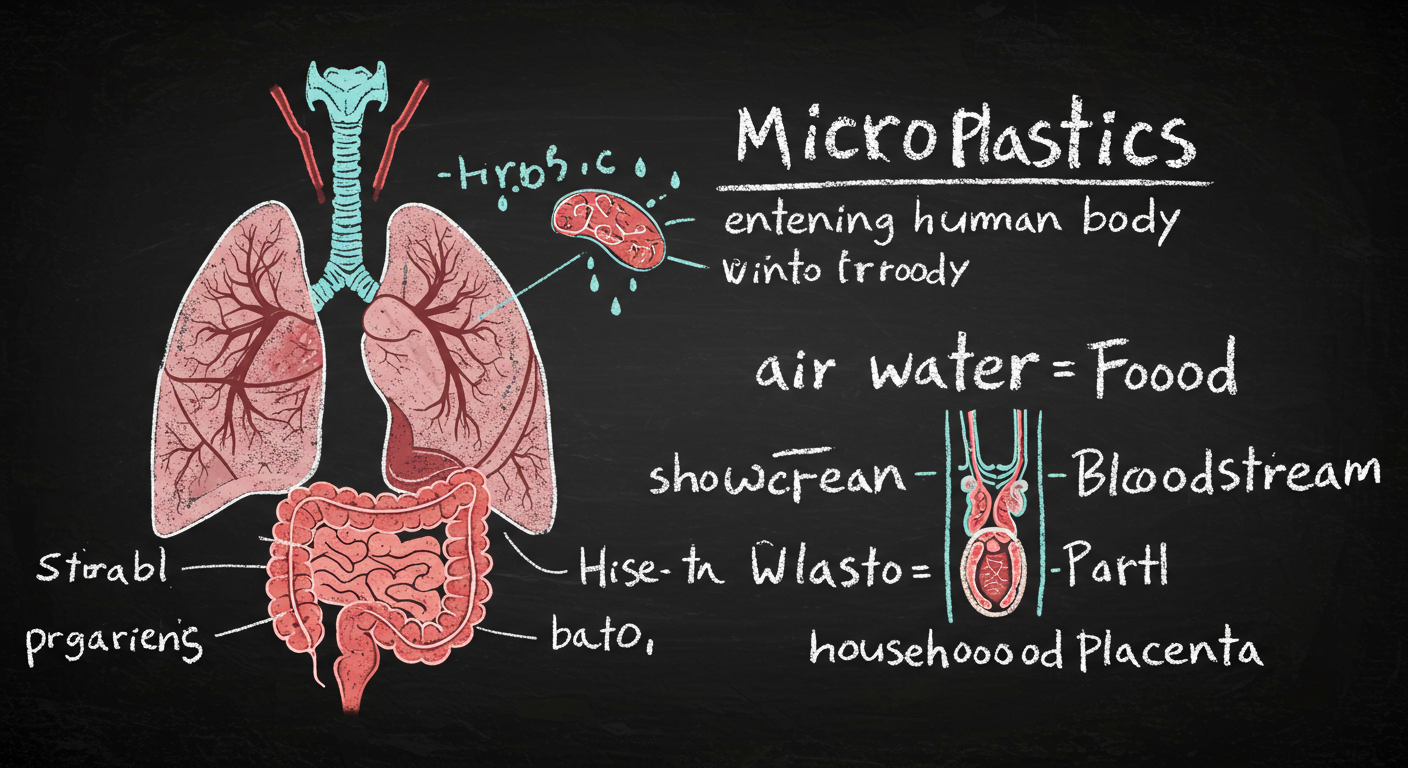
  • Ingestion through food, water, and hand-to-mouth contact
  • Less commonly, medical or occupational exposure

A key point: the smallest particles are most likely to cross biological barriers, but larger particles can still matter if they carry additives or irritate tissue.

diagram
note

Where they come from in daily life

A few major contributors dominate:

  • Tire wear: a major source of plastic particles in urban dust and runoff
  • Synthetic textiles: polyester, nylon, and acrylic shed fibers during washing and wear
  • Fragmentation of packaging: especially thin films and bottles exposed to heat and sunlight

Why size matters

A 2023 review in the journal Environmental Science & Technology described how smaller particles are more likely to interact with cells and tissues. That does not prove disease, but it helps explain why researchers focus so much on particle size and shape.
illustration
microplastics entering the human body through air water food and household dust with lungs gut bloodstream and placenta shown

What the health evidence actually shows

note

What has been detected in human tissue

Published studies have reported microplastics in:

  • Blood, 2022, Environment International
  • Lung tissue, 2022
  • Placenta, 2023
  • Carotid artery plaque, 2024

Detection is not the same as disease. It means exposure has crossed into human tissue, which is the first step in studying health effects.

What risks are being investigated

Researchers are testing links with:

  • Cardiovascular disease
  • Lung inflammation
  • Gut barrier disruption
  • Endocrine effects from plastic additives
  • Reproductive and developmental effects

What the evidence can and cannot say

Human studies are mostly observational. They can identify associations, but they cannot fully rule out confounding by pollution, diet, smoking, or occupation.

diagram
chart · bar
Where microplastics have been reported in humans
BloodLung tissuePlacentaArtery plaque

How scientists test harm, and why the answer is still incomplete

note

Three kinds of evidence

1. Cell studies

Show mechanisms such as oxidative stress, membrane damage, and inflammatory signaling.

2. Animal studies

Show effects across organs, but doses are often higher than real-world human exposure.

3. Human studies

Show what is happening in real people, but they are harder to interpret because many exposures occur at once.

Why additives matter

Microplastics can contain or carry chemicals such as:

  • Phthalates
  • Bisphenol A and related compounds
  • Flame retardants and other industrial additives

These chemicals do not prove harm from every microplastic particle, but they are part of the risk picture.

equation
Risk=Exposure×Hazard×Time\text{Risk} = \text{Exposure} \times \text{Hazard} \times \text{Time}
diagram
note

The big uncertainty

We still lack:

  • Standardized methods for measuring tiny particles
  • Long-term studies that track the same people for years
  • Clear threshold doses for most health outcomes

That is why headlines can sound more certain than the science really is.

How to reduce exposure without pretending you can eliminate it

note

Practical steps that can lower exposure

Prioritize the biggest and most realistic changes:

  • Use glass or stainless steel for hot food and drinks
  • Do not microwave food in plastic when alternatives exist
  • Improve indoor dust control with HEPA filtration and wet dusting
  • Wash synthetic clothes less aggressively and use full laundry loads
  • Choose durable textiles and reduce unnecessary single-use plastic
  • If you drink bottled water often, consider switching where safe and practical

What not to overclaim

No consumer habit removes all exposure. The goal is reduction, not perfection.

Focus on high-yield settings

  • Kitchens, where heat and plastic contact matter
  • Bedrooms and living rooms, where dust accumulates
  • Laundry, where synthetic fibers are released
diagram
chart · line
Exposure reduction priorities
Indoor dust controlAvoid heating plasticSwitch to reusable containersReduce bottled waterLaundry changes

What policy is changing in 2026

note

Policy changes to watch in 2026

Global

The United Nations plastics treaty negotiations, launched after the 2022 United Nations Environment Assembly decision, remain the main international process.

European Union

  • Restrictions on intentionally added microplastics under REACH
  • 2024 rules to reduce plastic pellet loss in transport and handling

National and local action

  • Microbead bans in cosmetics
  • Restrictions on certain single-use plastics
  • New attention to tire wear, textile fibers, and packaging design

Why policy matters

Individual exposure is shaped by the products available in the market. Better rules can reduce exposure for millions of people at once.

diagram
note

Bottom line

Microplastics are now found inside the human body. That is real. The strongest evidence says exposure is widespread, while the clearest disease links are still being worked out. The smart response is not panic. It is reduction: fewer hot plastics, less indoor dust, better filtration, smarter clothing and laundry choices, and stronger policy that prevents plastic from fragmenting in the first place.

Transcript

Welcome to Slate. Today we're looking at Microplastics Are Inside You. Now What?. We'll cover Where microplastics come from and how they enter your body, What the latest research says about health risks, Practical steps to reduce your exposure, and Policy changes happening globally in 2026. Let's get into it.

Microplastics are plastic pieces smaller than 5 millimeters. Some are made that small on purpose, like microbeads once used in scrubs. Others are born from bigger plastics breaking apart. Think of a plastic bottle as a cliff face. Sunlight, heat, and friction chip it into gravel, then dust. That dust is what we are talking about. The smallest particles, especially in the micrometer range, can move with air, water, and food. A human hair is about 70 micrometers wide, so some microplastics are much smaller than what you can see. The diagram shows the main routes in: breathing indoor dust, drinking contaminated water, eating food packaged or processed with plastic contact, and swallowing particles that settle on hands and surfaces. Researchers have found microplastics in human blood, lung tissue, placenta, and even arterial plaque. That does not mean every particle causes harm. It does mean the body is not a closed system. Exposure is now part of everyday life, especially indoors, where synthetic textiles, carpet fibers, and household dust keep shedding.

The strongest human evidence so far is about exposure, not certainty of disease. Scientists have found microplastics in blood in a 2022 study in Environment International, in lung tissue in 2022, and in placenta in 2023. More recently, a 2024 study reported microplastics in carotid artery plaque, and people with plaque particles had higher rates of heart attack, stroke, or death during follow-up. That finding is serious, but it is still observational. It shows a link, not proof that the particles caused the events. Here is the key distinction. A smoke alarm tells you there is a fire risk. It does not tell you which spark started the fire. Microplastics may be a marker of pollution exposure, and they may also contribute directly through inflammation, oxidative stress, and immune activation. In lab and animal studies, particles can injure cells, disturb the gut barrier, and alter metabolism. But dose matters. Shape matters. Additives matter. The body’s response to a few particles is not the same as to a heavy occupational exposure. The honest answer is that science has moved from “Are they inside us?” to “Which exposures matter most, and for whom?”

To understand risk, researchers use three layers of evidence. First, cell studies ask what happens when particles touch lung, gut, or immune cells. Second, animal studies look for inflammation, fertility changes, or metabolic effects across a whole organism. Third, human studies check whether exposed people have more disease. Each layer has strengths and blind spots. A petri dish is like a map, not the territory. It can show the route of damage, but not the full journey through a living body. In lab work, very small particles can trigger oxidative stress and inflammatory signaling. Some plastic additives, such as phthalates and bisphenols, are already known endocrine disruptors. That matters because microplastics are not just inert beads. They can act as carriers for additives and for chemicals stuck to their surface. Still, dose is everything. A concentration used in a cell dish may be far above what most people breathe or swallow. That is why careful exposure measurement is so important. The field is now moving toward better particle counting, better size analysis, and studies that compare everyday exposure with health outcomes over time.

You cannot avoid microplastics completely. The goal is to cut the biggest sources first. Start with air, because indoor air can be a major route for fibers. A vacuum with a HEPA filter can remove fine particles better than sweeping. Ventilation helps, especially after cleaning or cooking. Next, focus on heat and friction in food contact. Heating food in plastic can increase particle release, so use glass or stainless steel for microwaving when possible. Bottled water can contain more particles than tap water in some studies, though results vary by brand and method. If your tap water is safe, a good filter may help with some contaminants, but not every filter captures every particle size. For clothes, synthetic fabrics shed more fibers than cotton or wool. Washing full loads, using cooler cycles, and choosing durable garments can reduce shedding. One useful analogy: exposure reduction is like closing the biggest windows in a storm. You do not stop the weather, but you keep a lot less of it inside.

The policy picture is moving faster than the health evidence. In March 2022, the United Nations Environment Assembly agreed to negotiate a global plastics treaty. By 2026, those talks are still central, with countries pushing over production limits, product design, waste management, and chemicals of concern. The European Union has already restricted intentionally added microplastics in many products under its REACH rules, with phase-ins that stretch through the 2030s for some uses. The EU also passed a regulation in 2024 to reduce pellet loss from plastic supply chains. Several countries have tightened rules on cosmetic microbeads and single-use plastics, and more are targeting tire wear, textile shedding, and packaging design. Here is the pattern. Policy is shifting from cleanup to prevention. That is like fixing a leaky roof instead of mopping the floor forever. The science still needs better exposure thresholds and better health studies, but regulators do not wait for perfect certainty when the signals are strong enough. For the public, the takeaway is practical: personal choices help, but the biggest gains will come from product standards, producer responsibility, and less plastic entering the environment in the first place.

XLinkedInWhatsApp

Keep going with Slate

Pick up where this left off in your own voice session.

Built with Slate