1. Compound interest: time is the real asset
0:006:42
Business

Investing for Beginners: Build Wealth Early

Index funds, Roth IRAs, compound interest — the strategies that actually work if you start in your 20s or 30s.

Apr 22, 20267 min listen5 chapters
What you'll learn
  • The power of compound interest with real numbers
  • Index funds vs. stock picking — what the data says
  • Tax-advantaged accounts: Roth IRA, 401k, HSA
  • The three mistakes that cost young investors the most

1. Compound interest: time is the real asset

note

Investing for Beginners: Build Wealth Early

Index funds, Roth IRAs, compound interest — the strategies that actually work if you start in your 20s or 30s.

note

Compound interest

Compound interest means your money earns returns, and then those returns earn returns too.

If you invest early, time does more of the work. That is why a 10-year delay can cost more than many people expect.

Real example

  • 200 dollars per month
  • 7 percent average annual return
  • 30 years
  • Future value: about 236,000 dollars

Wait 10 years to start, and the same plan is only about 113,000 dollars.

The gap comes from lost compounding years, not just lost contributions.

equation
FV=P(1+r)n1rFV = P \cdot \frac{(1+r)^n - 1}{r}
chart · line
Compound growth at 7 percent
Year 0Year 5Year 10Year 15Year 20Year 25Year 30
note

Why early dollars matter most

The first dollars you invest are like seeds. They have the longest runway to grow.

A late start can still work. But you need to save much more each month to catch up, because compounding has less time to act.

2. Index funds beat most stock pickers

note

Index funds vs. stock picking

An index fund owns many stocks at once. A stock picker owns a few and tries to choose winners.

For beginners, index funds usually win on three fronts:

  • diversification
  • low cost
  • simplicity

What the data says

SPIVA reports have shown that most active U.S. equity funds underperform their benchmarks over long periods, especially after fees.

diagram
note

Why fees matter

A fund charging 0.03 percent per year leaves almost all of your money working. A fund charging 1 percent takes a much bigger slice over time.

That difference compounds too. Over 30 years, cost can matter almost as much as performance.

chart · bar
Typical annual fund costs
Index fundLow cost active fundHigh cost active fund

3. The tax shelters that accelerate growth

note

Tax-advantaged accounts

These accounts help you keep more of your returns.

Roth IRA

  • Contributions are made with after-tax money
  • Qualified withdrawals are tax-free
  • 2024 limit: 7,000 dollars, or 8,000 dollars if age 50 or older

401k

  • Contributions are usually pre-tax
  • Growth is tax-deferred
  • 2024 employee limit: 23,000 dollars, plus 7,500 dollars catch-up if age 50 or older

HSA

  • Tax-deductible or pre-tax contributions
  • Tax-free growth
  • Tax-free withdrawals for qualified medical expenses
  • Best used only if you have an HSA-eligible health plan
diagram
note

A simple priority order

  1. Get the full employer match in the 401k.
  2. Fund a Roth IRA if you qualify.
  3. Add more to the 401k or HSA.

The employer match is free money. Skipping it is like refusing part of your salary.

equation
AfterTaxValue=Contribution×(1+r)nAfterTaxValue = Contribution \times (1 + r)^n

4. The three mistakes that hurt young investors most

note

The three costly mistakes

1. Waiting to start

Delaying investing reduces the number of compounding years.

2. Chasing hot stocks or trends

Past winners are not guaranteed future winners.

3. Ignoring fees and taxes

A small percentage can become a large dollar amount over decades.

diagram
note

A better system

Use automatic investing.

Set a monthly transfer. Buy broad index funds. Rebalance once or twice a year. That removes emotion from the process and makes good behavior easier to repeat.

chart · scatter
Risk of emotional decisions

5. A practical starter plan for your 20s and 30s

note

A beginner investing plan

  1. Build a small emergency fund.
  2. Get the full 401k employer match.
  3. Invest in a low-cost index fund.
  4. Use a Roth IRA if you qualify.
  5. Use an HSA if you have an eligible health plan.
  6. Rebalance once a year.

Asset allocation

A mix like 80 percent stocks and 20 percent bonds can reduce panic selling for some beginners, but the right mix depends on your goals and risk tolerance.
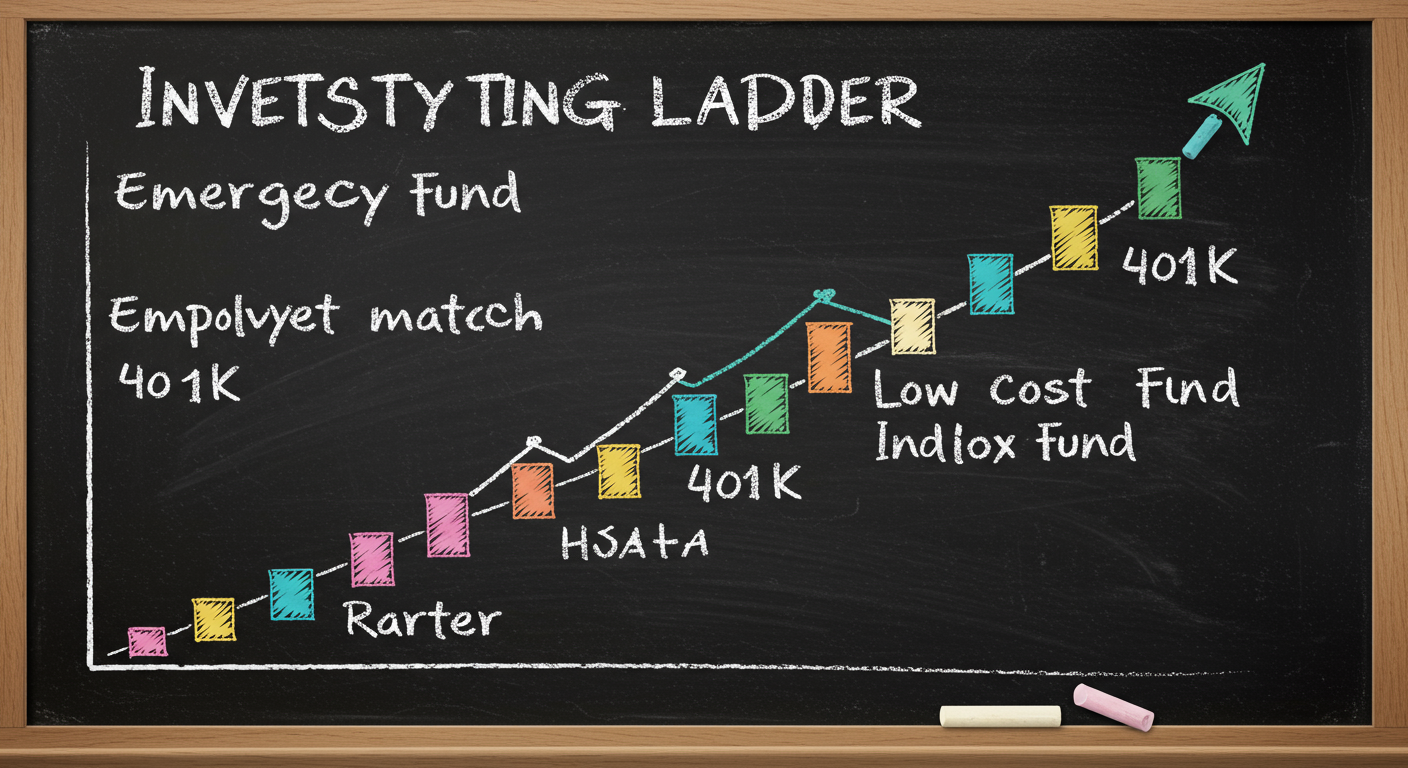
illustration
A clear investing ladder showing emergency fund, employer match, Roth IRA, 401k, HSA, and low-cost index fund
diagram
note

The main takeaway

Start early. Keep costs low. Use tax-advantaged accounts. Own the market instead of trying to beat it.

That combination is plain, not flashy. It works because it gives time, discipline, and math room to do their job.

Transcript

Welcome to Slate. Today we're looking at Investing for Beginners: Build Wealth Early. We'll cover The power of compound interest with real numbers, Index funds vs. stock picking — what the data says, Tax-advantaged accounts: Roth IRA, 401k, HSA, and The three mistakes that cost young investors the most. Let's get into it.

A small amount, started early, can become a large amount because earnings begin earning their own earnings. That is compound interest. If you put 200 dollars a month into an account earning 7 percent a year, and you do it for 30 years, the future value is about 236,000 dollars. Put the same plan off for 10 years, and the total falls to about 113,000 dollars. Same monthly habit. Very different ending. Here’s the key idea: time matters more than intensity. A person who invests 200 dollars a month from age 25 to 35, then stops, can often end up with more than someone who waits until 35 and invests for 30 years, depending on the return and taxes. The chart on the screen shows the curve bending upward. That bend is the compounding effect. Think of it like a snowball rolling downhill. At first it looks small. Then every turn adds more snow, and the growth starts feeding itself. The math is simple, but the emotional trap is not. Early investing feels slow for years, so people underestimate it. The first decade is where the foundation gets built.

Picking individual stocks feels active and intelligent. The problem is that the odds are stacked against most people. In the S&P Dow Jones Indices SPIVA scorecard, more than 80 percent of U.S. large-cap active funds have underperformed the S&P 500 over 10-year periods in many recent reports. That does not mean every fund fails. It means the average active approach has a hard time beating the market after fees and trading costs. An index fund is different. It does not try to guess the winners. It buys the whole basket. That is like owning the entire class photo instead of trying to predict which student will become valedictorian. You do not need to identify the next Apple or Nvidia to build wealth. You need broad exposure, low costs, and patience. A total U.S. stock market index fund or an S&P 500 fund gives you that. Costs matter because a 1 percent fee sounds tiny, but over decades it can take a serious bite out of returns. The visual here compares broad index investing with the long odds of stock picking. The lesson is not that stock picking is impossible. It is that for most beginners, it is unnecessary risk.

Taxes can quietly slow investing, so the account type matters as much as the investment inside it. A Roth IRA is powerful because you contribute after-tax money, then qualified withdrawals in retirement are tax-free. For 2024, the contribution limit is 7,000 dollars, or 8,000 dollars if you are age 50 or older. A traditional 401k works differently. Contributions usually lower your taxable income now, and the money grows tax-deferred until withdrawal. In 2024, workers can contribute up to 23,000 dollars, plus a 7,500 dollar catch-up contribution if they are 50 or older. A Health Savings Account, or H-S-A, is even more tax-efficient when used correctly: contributions can be tax-deductible or pre-tax, growth is tax-free, and qualified medical withdrawals are tax-free. That is why people call it a triple tax advantage. The diagram shows the flow of money through each account. The practical order is often simple: grab an employer match in the 401k first, then consider a Roth IRA, then add more to the 401k or HSA if eligible. The exact best order depends on your tax rate, income, and employer match.

Most beginner losses do not come from one giant crash. They come from repeated small mistakes. The first is waiting too long. Every year you delay is a year of compounding you never get back. The second is chasing performance. People buy what already went up, then sell after it falls. That pattern often means buying high and selling low. The third is paying too much in fees, taxes, or trading friction. A 1 percent fee may not feel painful in one year, but over decades it can remove tens of thousands of dollars from a growing portfolio. There is also a behavior mistake behind all three: lack of a written plan. Without a plan, every market headline feels urgent. With a plan, you know your asset allocation, your monthly contribution, and when you will rebalance. That is the difference between driving with a map and driving by random exits. The visual shows the three traps side by side, because seeing them clearly makes them easier to avoid. Beginners do not need perfect timing. They need a system that is boring enough to repeat for years.

A good beginner plan is not glamorous. It is repeatable. Start by building a small emergency fund so you do not raid your investments for car repairs or a medical bill. Then capture any employer match in your 401k. After that, use a low-cost index fund inside a Roth IRA if you qualify, or keep building the 401k if that is the better tax move. If you have a high-deductible health plan, the HSA deserves a close look because the tax treatment is unusually strong. Choose a stock allocation you can actually hold through a bear market. For many beginners, a simple 80 percent stock and 20 percent bond mix is easier to stick with than an all-stock portfolio, though the right mix depends on your risk tolerance and time horizon. Rebalance once a year so your portfolio does not drift too far from your plan. The image on the screen shows the ladder: emergency fund, employer match, Roth IRA, 401k or HSA, then more investing. That order protects you from the most common beginner errors. Wealth building is not about finding the perfect trade. It is about giving ordinary habits enough time to compound.

XLinkedInWhatsApp

Keep going with Slate

Pick up where this left off in your own voice session.

Built with Slate