Introduction to Game Theory and Strategic Decisions
Explore the fundamental concepts of game theory, including strategic interactions, player rationality, and key examples like the Prisoner's Dilemma and Nash equilibrium.
Apr 18, 20262 min listen4 chapters
What you'll learn
Define game theory and its core components
Analyze strategic interactions using the Prisoner's Dilemma
Understand the concept of Nash equilibrium
Explore how repeated games influence player strategies
What is Game Theory?
note
Game theory is a framework for understanding situations where decision-makers interact and their choices affect each other's outcomes.
diagram
The Prisoner's Dilemma: A Classic Example
note
Prisoner B Silent
Prisoner B Confess
Prisoner A Silent
Both: 1 year
A: 10 years, B: Free
Prisoner A Confess
A: Free, B: 10 years
Both: 5 years
Understanding Nash Equilibrium
diagram
illustration
Strategic Choices in Repeated Games
diagram
Transcript
Hello, Raghav. Where should we begin on Game theory today — prerequisites, conceptual overview, or diving straight into central concepts?
Excellent, straight to the heart of it. Game theory is fundamentally about strategic interactions, and it assumes players act rationally. Here's how we break it down. Any strategic interaction is made of three parts. Are you ready to see those components? for the heart of it. Game theory is all about strategic interactions. We assume everyone's acting rationally. Here's how we break it down. Any interaction has three parts. Ready to see those components?
Think of these components as the rules of engagement. You have the players, the strategies they can choose, and the payoffs they get based on those choices. Now, the most famous example of this whole setup was cooked up to understand cooperation. Ready for that story?
Back in the 1950s, mathematicians were trying to model competition and cooperation, especially during the Cold War. They came up with this scenario: two people are arrested but held in separate rooms. Each person can either confess or stay silent. The key is that their best individual choice leads to a worse result for both of them. Let me show you what that matrix looks like. See how the incentives play out?
This brings us to a crucial concept: the outcome that players kind of settle on. We call it the Nash equilibrium. It's where neither player has any reason to change their strategy on their own, given what the other player is doing. Would you like to find the Nash equilibrium in our prisoner table?
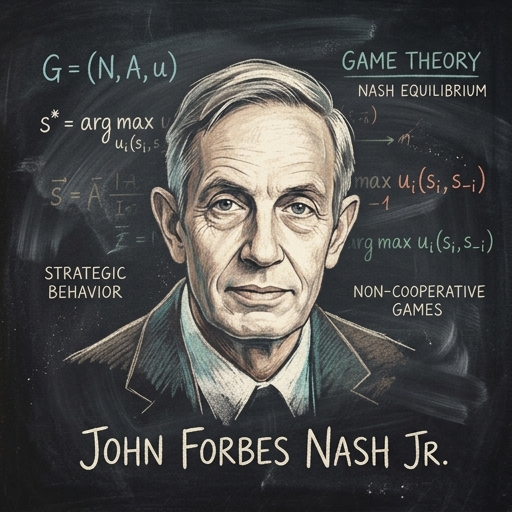
Certainly, let me sketch a quick portrait of John Nash, the mathematician who formulated that idea. Keep in mind, his life's work went way beyond this one game. Just one moment.So, while Nash didn't invent game theory, he provided the key mathematical framework for analyzing these strategic interactions. His concept helps us understand why systems might stay stuck in an undesirable state, even if a better alternative exists for everyone. Does that make sense?
Glad it's clicking. Now, the story gets even richer when players meet more than once. This opens up the possibility for trust, punishment, or forgiveness. Want to talk about how that changes things?
Yes, still here. I was just about to show you how repeating the game completely changes the players' behavior. Let me sketch out a classic strategy for that. This diagram shows how a player might choose to respond to their opponent.