What we mean by real
0:006:45
Humanities

How to Tell What Is Real in a Deepfake World

AI generates convincing text, images, and video. The philosophy of truth meets practical media literacy for 2026.

Apr 22, 20267 min listen5 chapters
What you'll learn
  • The philosophy of truth from Plato to post-modernism
  • How deepfakes and AI-generated content erode trust
  • Epistemic responsibility: what you owe as a consumer of information
  • Practical frameworks for evaluating claims in 2026

What we mean by real

note

How to Tell What Is Real in a Deepfake World

AI generates convincing text, images, and video. The philosophy of truth meets practical media literacy for 2026.

note

Truth, trust, and evidence

A claim is not true because it feels convincing. A claim is true when it fits the world and survives checking.

In media literacy, separate three layers:

  • The content itself
  • The source that published it
  • The evidence that can verify it

A photograph can be authentic but misleading. A screenshot can be edited but still quote a real message. A video can be synthetic and still point to a real event if it is labeled clearly.

Why this matters in 2026

Generative AI can produce text, images, audio, and video that imitate real people with low cost and high speed. That means your first impression is no longer a safe guide. You need a method, not just intuition.

diagram
note

Plato's cave, updated

In Plato's cave, prisoners see shadows and treat them as the whole world. A deepfake works the same way when it is detached from context. The image is the shadow. The event, the location, the timestamp, and the chain of custody are the world outside the cave.

A useful rule: do not ask only, 'Does this look real?' Ask, 'What would make this real enough to trust?' That question forces evidence into the room.

note

A simple test

When you encounter a striking post, write down:

  • The exact claim
  • The date and place it allegedly happened
  • The source of the media
  • The fastest independent check you can do

If you cannot name the claim precisely, you cannot verify it precisely.

From Plato to postmodernism

note

Three classic theories of truth

Correspondence theory: a statement is true if it matches reality. Coherence theory: a statement is true if it fits a consistent system of beliefs. Pragmatic theory: a statement is true if it proves reliable in practice.

Each theory catches something real. Each theory also has blind spots.

For media literacy, correspondence is the anchor. If a video claims an event happened, the event either occurred or it did not. The other theories help with interpretation, but they cannot replace evidence.

diagram
note

What postmodernism gets right and wrong

Postmodern critique is strongest when it exposes hidden power in institutions, headlines, and framing. It becomes dangerous when people use it to dismiss all standards of evidence.

A healthy version says:

  • Be suspicious of authority
  • Check who benefits
  • Ask what was left out
  • Still respect evidence

That last line matters. Skepticism without standards becomes cynicism.

note

Why this matters for deepfakes

Deepfakes exploit a gap between appearance and proof. Philosophy helps you name the gap. Media literacy helps you close it.

equation
Belief qualityEvidence strength+Source reliability+Independent confirmation\text{Belief quality} \approx \text{Evidence strength} + \text{Source reliability} + \text{Independent confirmation}

How deepfakes break trust

note

How synthetic media spreads

Deepfakes work because human perception is fast and pattern-based. We recognize faces, voices, and emotional cues before we analyze them. That speed is useful in daily life, but it is a weakness under attack.

Common forms:

  • Face swaps in video
  • Voice cloning in audio
  • Text generated to imitate style or authority
  • Image synthesis that invents people, places, or events

The danger is not only deception. It is confusion about what counts as evidence.

chart · line
Generation is cheap verification is not
20172020202220242026
diagram
note

The liar's dividend

When fake media becomes common, real evidence can be denied more easily. That is the liar’s dividend, a term popularized by scholars Chesney and Citron in 2019.

Example: a genuine audio clip of a politician may be rejected as synthetic. The fake does not need to replace the truth. It only needs to make truth feel uncertain.

note

The practical consequence

Institutions now need provenance chains. Think of provenance like a receipt trail for media. Who captured it, when, where, with what device, and what changed afterward? Without that trail, a file is just a file.

Your responsibility as a reader

note

Epistemic responsibility

Epistemic responsibility is the duty to manage your beliefs carefully. In plain terms: be fair to the truth.

That means:

  • Distinguish evidence from emotion
  • Separate original sources from reposts
  • Check whether a claim is within your expertise
  • Correct yourself when new evidence arrives

This is not about being skeptical of everything. It is about being disciplined with high-stakes claims.

diagram
note

A useful rule of thumb

Use the SIFT approach, developed by digital literacy educator Mike Caulfield: Stop Investigate the source Find better coverage Trace claims to the original context

This is fast enough for daily use and strong enough to catch many manipulations.

note

What not to do

Do not rely on a single reverse-image search and call it done. Do not trust a watermark alone. Do not assume 'verified' social media badges prove truth. Do not share because a post matches your politics.

Truth is not partisan.

A 2026 verification framework
illustration
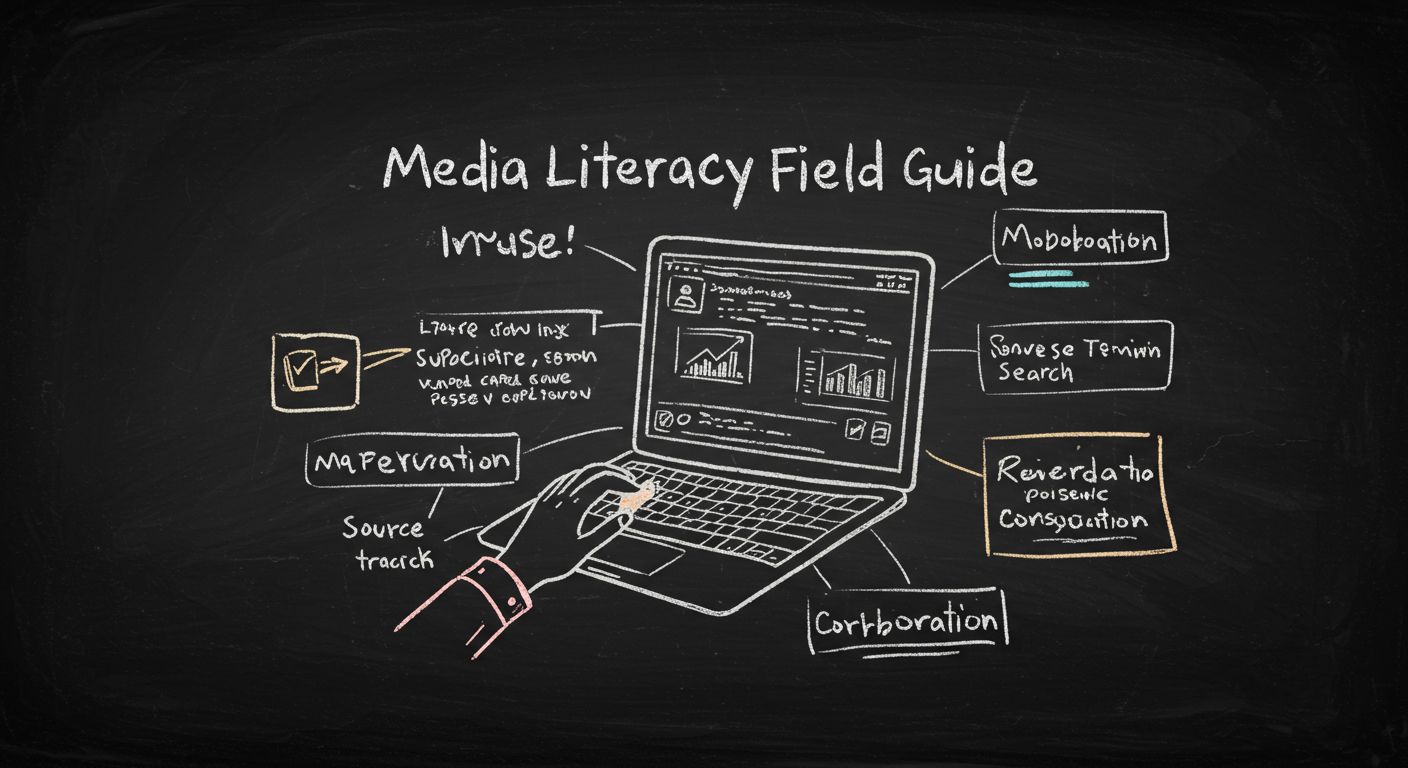
A media literacy field guide showing a person checking a suspicious image on a laptop with source tracing, metadata, reverse search, and corroboration notes around the screen
note

A practical verification stack

  1. Identify the exact claim.
  2. Trace the earliest source.
  3. Check whether the media matches the context.
  4. Search for independent confirmation.
  5. Ask what evidence would falsify the claim.

If a claim survives those five steps, it deserves more trust. If it fails one, treat it cautiously. If it fails two or more, do not share it.

diagram
note

Red flags

  • A shocking claim with no original source
  • A clip that appears only on one account
  • A story that outruns every reputable outlet
  • A file with missing or inconsistent metadata
  • A post that asks for instant sharing before checking

These are not proof of fakery. They are reasons to slow down.

equation
Confidence=Independent confirmationsIndependent checks\text{Confidence} = \frac{\text{Independent confirmations}}{\text{Independent checks}}

Transcript

Welcome to Slate. Today we're looking at How to Tell What Is Real in a Deepfake World. We'll cover The philosophy of truth from Plato to post-modernism, How deepfakes and AI-generated content erode trust, Epistemic responsibility: what you owe as a consumer of information, and Practical frameworks for evaluating claims in 2026. Let's get into it.

A deepfake is not just a fake picture. It is a challenge to how we know anything at all. Plato framed this problem in The Republic, around 375 BCE, with the cave of shadows. People mistake appearances for reality when they cannot check the source. That old problem now sits inside your phone. A video can show a face, a voice, and a setting, yet still be synthetic. Here is the key distinction. Truth is about whether a claim matches the world. Trust is about whether you believe the source. Real media can be false. Synthetic media can be truthful. The two are related, but they are not the same. The diagram shows that split. Think of it like a passport. A passport is not the person. It is evidence about the person. Media works the same way. An image is evidence, not the event itself. When you see a claim, ask three questions: What is being asserted, what would count as proof, and who can independently check it? That habit is the start of media literacy.

The history of truth is a history of methods for testing appearances. Aristotle, around 350 BCE, treated truth as saying of what is that it is, and of what is not that it is not. That sounds plain, but it matters. Truth is not just sincerity. A person can be honest and still wrong. Later, medieval thinkers tied truth to correspondence between mind and reality. In the seventeenth century, René Descartes pushed doubt further. In 1637, he asked what could survive radical skepticism. His answer was not 'trust everything.' It was to test carefully. By the twentieth century, philosophers argued more about language, power, and perspective. Michel Foucault showed how institutions shape what counts as knowledge. Postmodern thinkers warned that narratives can hide interests. That warning is useful, but it can be abused. If all truth is treated as merely a story, then evidence loses its force. The visual timeline helps here. Think of philosophy as a set of tools, not a single verdict. Correspondence asks, does the claim match reality? Coherence asks, does it fit with other well-supported claims? Pragmatism asks, does it work in practice? A strong thinker uses all three. A weak one uses whichever is most convenient.

Deepfakes do more than fool one person. They change the social cost of believing. In 2017, researchers at the University of Washington used machine learning to map a speaker’s mouth movements onto video. In 2018, the first public wave of face-swap tools spread online. By 2024 and 2025, open models could generate photorealistic images and short video clips in seconds, while voice cloning could imitate a speaker from only a few seconds of audio. That speed matters. A lie that once took a studio now takes a laptop. The result is not only false content. It is the erosion of the common checkpoint we used to rely on. If anyone can fake anything, then real evidence starts to feel optional. That is the liar’s dividend. A real recording can be dismissed as fake because fakes are now plausible. The chart on the right should make the pattern visible. As generation gets cheaper, verification has to get stronger. Notice the asymmetry. Creating a fake may take minutes. Proving authenticity can take much longer. That is why institutions need provenance, timestamps, metadata, and independent witnesses. Trust now depends on systems, not vibes.

Epistemic responsibility means you owe careful thinking to other people, not only to yourself. The phrase sounds abstract, but the practice is simple. Do not forward what you have not checked. Do not treat a first impression as a verdict. Do not confuse a confident tone with evidence. In 2026, a good reader behaves a little like a forensic accountant. You trace the numbers. You ask where the money came from, where the image came from, and whether the story has independent support. Here is a useful analogy. A rumor is like a stain on white cloth. If you press it around without checking, you spread it. If you verify before sharing, you stop the stain at the source. The best readers also know their own limits. If a claim sits outside your expertise, pause and look for domain experts, primary documents, and direct records. The visual checklist shows a workflow, not a moral lecture. Start with the source. Then the date. Then the original file. Then corroboration from at least two independent places. When the stakes are high, slow down. In medicine, elections, war, and finance, speed is often the enemy of truth.

Here is the part you can use immediately. Start with the claim, not the clip. Ask what kind of claim it is. Is it a fact claim, a time claim, a location claim, or a causal claim? Each one needs different evidence. Then check provenance. For images, look for the earliest appearance, metadata if available, and whether the shadows, reflections, and text all agree. For audio, ask whether the speaker’s cadence, background noise, and lip sync match the setting. For video, compare frames, search for the original upload, and look for out-of-place motion around hands, teeth, earrings, and edges. For text, inspect the author, the date, the cited sources, and whether the argument depends on invented references. The image block shows a field guide, but the real skill is pattern recognition plus patience. One strong framework is lateral reading, a method studied by Sam Wineburg and the Stanford History Education Group. Open new tabs. Leave the page. Check reputation elsewhere. Another is the simple courtroom test: what would convince a reasonable outsider? If you cannot answer that, you do not yet know enough. In a deepfake world, careful readers become first responders for reality.

XLinkedInWhatsApp

Keep going with Slate

Pick up where this left off in your own voice session.

Built with Slate