1. What sleep is doing for your brain and body
0:007:24
General

How to Sleep Better: What Science Actually Says

Circadian rhythms, sleep stages, light exposure, and CBT-I — evidence-based strategies, not mattress ads.

Apr 22, 20267 min listen5 chapters
What you'll learn
  • The four sleep stages and why each matters
  • How light, temperature, and timing regulate your circadian clock
  • Evidence-based interventions: CBT-I, sleep restriction, stimulus control
  • Wearable sleep tracking — what is useful vs. what causes anxiety

1. What sleep is doing for your brain and body

note

How to Sleep Better: What Science Actually Says

Circadian rhythms, sleep stages, light exposure, and CBT-I — evidence-based strategies, not mattress ads.

note

The four sleep stages

Sleep is organized into repeating cycles, usually about 90 minutes long in adults.

  • N1: very light sleep, the transition into sleep
  • N2: stable light sleep, the largest share of the night
  • N3: deep slow-wave sleep, hardest to wake from
  • REM: rapid eye movement sleep, vivid dreaming and active brain patterns

Why each stage matters

N1 is the doorway. N2 helps consolidate the night into stable sleep. N3 supports physical restoration and memory processes. REM is linked to emotion regulation, learning, and flexible thinking.

A useful analogy: sleep is a factory with different shifts. The first shift settles the building. The deep-night crew does repairs. The dream-heavy shift handles sorting and integration.

diagram
equation
Sleep efficiency=total sleep timetime in bed×100%\text{Sleep efficiency} = \frac{\text{total sleep time}}{\text{time in bed}} \times 100\%

2. Your circadian clock and the three strongest signals

note

Circadian rhythm basics

The circadian clock is the body’s daily timing system. It helps set sleepiness, alertness, body temperature, hormone release, and digestion.

The main clock is in the suprachiasmatic nucleus, or SCN, in the hypothalamus.

The three strongest signals

  • Light: strongest reset signal, especially morning light
  • Timing: a consistent wake time anchors the clock
  • Temperature: a cooler night environment supports the natural evening drop in core body temperature

Practical meaning

If you want sleep to come earlier, the most powerful move is bright outdoor light soon after waking and dimmer light at night. A bedroom around 18 to 20°C, or 65 to 68°F, works well for many adults, though comfort varies.

diagram
chart · bar
Strength of common circadian signals
Morning lightRegular wake timeCool bedroomMeal timingExercise timing

3. What actually works for insomnia

note

CBT-I: the best-supported treatment for chronic insomnia

Cognitive behavioral therapy for insomnia, or CBT-I, is first-line treatment in major guidelines, including the American College of Physicians guideline from 2016.

Core components

  • Sleep education
  • Stimulus control
  • Sleep restriction
  • Cognitive restructuring
  • Relaxation strategies

Why it works

Insomnia often becomes a learned loop: worry about sleep increases arousal, arousal makes sleep harder, and the bed starts predicting frustration. CBT-I breaks that loop.

Sleep restriction in plain language

You temporarily reduce time in bed to better match actual sleep time. That increases sleep drive and usually improves sleep efficiency before time in bed is expanded again.

diagram
python
def sleep_efficiency(total_sleep_time_minutes, time_in_bed_minutes):
    return 100 * total_sleep_time_minutes / time_in_bed_minutes

# Example: slept 6.0 hours out of 8.0 hours in bed
print(round(sleep_efficiency(360, 480), 1))  # 75.0

4. What to do with light, caffeine, naps, and wearables

note

High-yield sleep habits

  • Get bright outdoor light in the morning
  • Dim lights in the last 1 to 2 hours before bed
  • Keep caffeine earlier in the day
  • Use naps sparingly and keep them short
  • Keep wake time steady, even after a bad night

Wearable sleep tracking: useful and limited

Useful for:

  • spotting trends across weeks
  • seeing bedtime drift
  • noticing effects of alcohol, travel, or schedule changes

Limited because:

  • consumer devices estimate sleep, they do not measure brain waves directly
  • quiet wakefulness is often mistaken for sleep
  • sleep stages are approximate, not clinical-grade
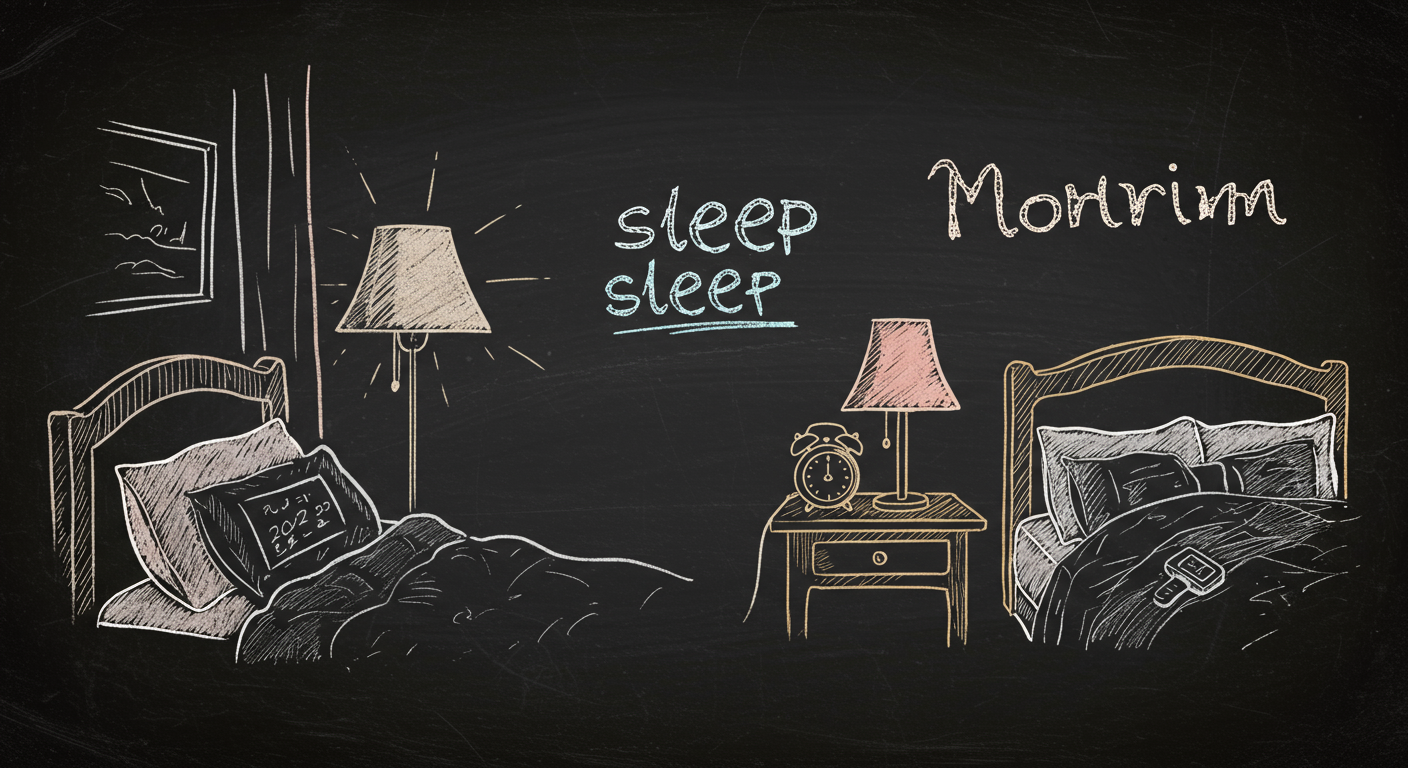
chart · line
Example caffeine remaining in the body
0 h5 h10 h15 h20 h
illustration
A bedroom scene showing morning sunlight, a dim evening lamp, a bedside clock, and a person using a wearable sleep tracker

5. A realistic sleep plan you can start tonight

note

A practical sleep checklist

  1. Fix your wake time.
  2. Get morning light.
  3. Make evenings dim and calm.
  4. Keep the bedroom cool and dark.
  5. Use the bed only for sleep and sex.
  6. If insomnia is chronic, seek CBT-I.

When to get medical help

Talk to a clinician if you have:

  • loud snoring
  • witnessed pauses in breathing
  • gasping at night
  • severe daytime sleepiness
  • restless legs symptoms
  • insomnia lasting more than 3 months
diagram

Transcript

Welcome to Slate. Today we're looking at How to Sleep Better: What Science Actually Says. We'll cover The four sleep stages and why each matters, How light, temperature, and timing regulate your circadian clock, Evidence-based interventions: CBT-I, sleep restriction, stimulus control, and Wearable sleep tracking — what is useful vs. what causes anxiety. Let's get into it.

Sleep is not one thing. It is a repeating cycle of brain states. On the sleep graph, you can see the night moving through stages in roughly 90-minute loops. That cycle matters because different jobs happen in different stages. Non-rapid eye movement sleep, or N-R-E-M sleep, includes three stages. Stage N1 is the light bridge from wakefulness into sleep. Stage N2 is the workhorse. It takes up about half of total sleep time in healthy adults. Stage N3 is deep slow-wave sleep, when the brain makes large, slow electrical waves and the body is hardest to wake. Then rapid eye movement sleep, or R-E-M sleep, arrives. The eyes move quickly under the lids, the brain becomes more active, and vivid dreaming is common. Think of sleep like a nightly maintenance crew. N2 helps sort and stabilize information. N3 is the heavy repair shift. R-E-M seems important for emotion, learning, and flexible thinking. A 2017 review in Nature and Science of Sleep by Matthew Walker and colleagues summarized how these stages support memory and recovery. The key point is not that one stage is magical. It is that healthy sleep needs the full cycle, repeated across the night. If sleep is cut short, the later cycles are often hit hardest, which means less R-E-M sleep and less total recovery.

Your circadian rhythm is your internal 24-hour timing system. The master clock sits in a tiny brain region called the suprachiasmatic nucleus, or S-C-N, in the hypothalamus. It does not run on its own like a perfect watch. It gets reset by outside signals called zeitgebers, meaning time givers. Light is the strongest one. Morning light pushes the clock earlier and makes it easier to feel sleepy at night. Bright light in the evening pushes the clock later. That is why a phone at midnight can make sleep feel delayed, even if you are tired. The graph shows the timing effect clearly: light is the big lever. Temperature matters too. Core body temperature normally falls in the evening and reaches a low point near the biological night. A cooler bedroom helps the body follow that drop. Timing matters as well. Regular wake time is one of the strongest anchors for the clock. In a landmark 2017 study in Current Biology, Kenneth Wright and colleagues showed that camping with natural light-dark cycles shifted people’s circadian timing earlier and improved alignment. The lesson is simple. Your clock listens to light first, then routine, then temperature. If those signals conflict, the clock gets mixed messages.

For chronic insomnia, the strongest evidence is for cognitive behavioral therapy for insomnia, or C-B-T-I. It is not a sleep tip list. It is a structured treatment. In randomized trials, C-B-T-I often improves sleep onset, wake after sleep onset, and sleep quality more reliably than medication alone, and the benefits can last after treatment ends. The core tools are stimulus control and sleep restriction. Stimulus control teaches the brain that bed means sleep, not worry, scrolling, or planning. If you cannot fall asleep after about 15 to 20 minutes, you get out of bed and do something quiet in dim light. Return only when sleepy. That sounds counterintuitive, but it breaks the bed equals frustration link. Sleep restriction sounds harsh, but it is a precision tool. You temporarily limit time in bed to match actual sleep time, then expand it as sleep efficiency improves. The point is to rebuild sleep drive. Think of it like tightening a loose rubber band so it springs back strongly again. A 2015 meta-analysis in Sleep Medicine Reviews found C-B-T-I produced meaningful improvements in insomnia severity. If you are using it, expect a short adjustment period. That is normal. If you have bipolar disorder, seizure risk, or severe daytime sleepiness, work with a clinician before changing sleep time aggressively.

A good sleep plan is mostly about reducing friction, not chasing perfection. Start with light. Get outdoor light soon after waking, ideally within the first hour. At night, dim the room and reduce bright overhead light. Blue-light filtering glasses can help some people, but the bigger effect usually comes from lowering brightness and stopping stimulating activity. Caffeine is another major factor. Its half-life is about five hours on average, but it varies widely. A coffee at 3 p.m. can still be active at 8 p.m. or later. For many people, cutting caffeine after lunch helps. Naps are useful only when they are short and early. A 10 to 20 minute nap can boost alertness. Long or late naps can steal sleep pressure from the next night. Now for wearables. Sleep trackers can be helpful for spotting patterns, like later bedtimes on weekends or shorter sleep after alcohol. But they are not precise sleep-stage machines. Consumer devices estimate sleep from motion and heart signals, and they often misclassify quiet wakefulness as sleep. That is why chasing a perfect score can backfire. If the device makes you anxious, use it less, not more. The best use is trend tracking over weeks, not minute-by-minute judgment of one bad night.

The best sleep plan is boring in a good way. Pick a fixed wake time and protect it seven days a week. Get outside in the first hour after waking. Keep your bedroom cool, dark, and quiet. Stop caffeine early enough that it is mostly gone by bedtime. If you are awake in bed and getting frustrated, leave the bed and come back only when sleepy. If insomnia has been going on for months, ask for CBT-I rather than relying on supplements or endless sleep advice online. Here is the most useful way to think about progress. You are not trying to force sleep. You are setting up conditions where sleep can happen on its own. That is like making a ski slope smoother so the sled moves without pushing. Track one or two numbers, not ten. A steady wake time and how long it takes to fall asleep are enough for most people. If you snore loudly, stop breathing in sleep, wake with headaches, or feel overwhelmingly sleepy during the day, that is a different problem and needs medical evaluation for sleep apnea or another disorder. Good sleep is not about perfect habits. It is about consistent signals to a clock, enough sleep pressure, and a bed that your brain trusts.

XLinkedInWhatsApp

Keep going with Slate

Pick up where this left off in your own voice session.

Built with Slate