1. The three numbers that decide a salary negotiation
0:007:29
Interview Prep

How to Negotiate Salary (Scripts That Work)

BATNA, anchoring, tactical empathy — proven negotiation frameworks with actual scripts you can use tomorrow.

Apr 22, 20267 min listen5 chapters
What you'll learn
  • BATNA, anchoring, and the zone of possible agreement
  • Tactical empathy from Chris Voss and FBI negotiation
  • Salary negotiation scripts that actually work
  • How to handle objections without damaging relationships

1. The three numbers that decide a salary negotiation

note

How to Negotiate Salary (Scripts That Work)

BATNA, anchoring, tactical empathy — proven negotiation frameworks with actual scripts you can use tomorrow.

note

Salary negotiation basics

BATNA means Best Alternative to a Negotiated Agreement. It is the best outcome you can get if this deal falls through.

Anchoring is the effect of the first number on the rest of the discussion. In salary negotiation, the first credible number often becomes the reference point.

The zone of possible agreement, or ZOPA, is the overlap between what you want and what the employer can accept.

A strong negotiation starts with three prepared numbers:

  • your target salary
  • your walk-away salary
  • the employer’s realistic range

If you do not know those numbers, you are guessing under pressure.

diagram
chart · bar
Example salary range planning
Walk-awayTargetAskEmployer max

2. How to anchor without sounding greedy

note

Anchoring scripts that sound professional

Use a range when you open the conversation.

Example:

  • Based on my research, I was expecting something in the $128,000 to $135,000 range.
  • Given the scope of the role, I think $132,000 is a fair starting point.
  • I am open to discussing the full package, including bonus and equity.

Good anchors are built from three inputs:

  • market data
  • the level of responsibility
  • your recent results

Avoid anchors that sound random, emotional, or unprepared.

diagram
python
market_low = 115000
market_high = 135000

# A credible opening anchor often sits near the high end
anchor = 132000

print(f"Suggested anchor: ${anchor:,.0f}")
print(f"Range: ${market_low:,.0f} to ${market_high:,.0f}")

3. Tactical empathy and the script that opens doors

note

Tactical empathy in salary negotiation

Tactical empathy means accurately recognizing the other side’s concerns and naming them out loud.

Three tools from Chris Voss’s negotiation method:

  • Mirroring: repeat the last few words they said
  • Labeling: name the constraint or emotion
  • Calibrated questions: ask questions that invite problem solving

Example script:

  • I understand budget is tight, and I respect that.
  • I also want to make sure the offer reflects the scope of the role.
  • What flexibility do you have on base salary?

This keeps the tone calm while still pushing for more.
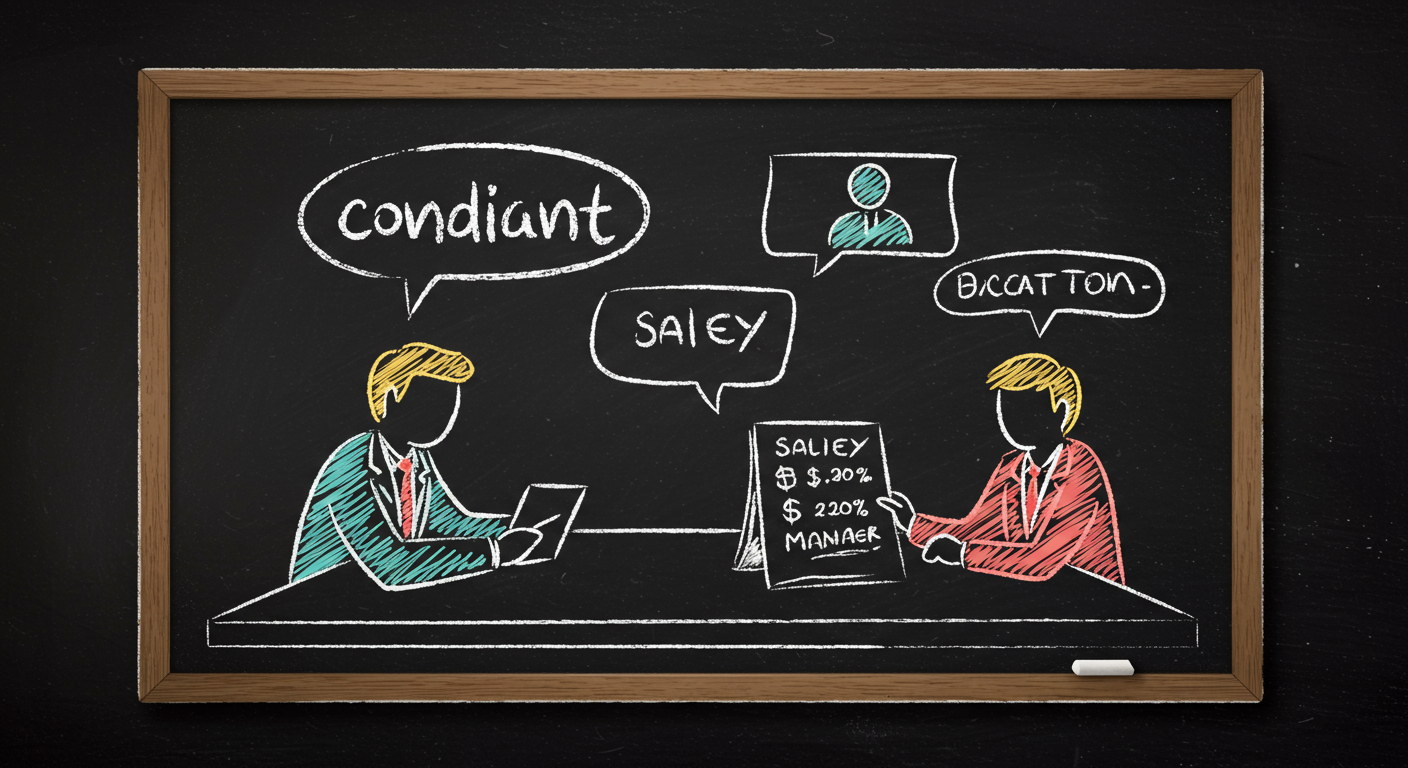
diagram
illustration
A candidate and hiring manager at a table with a salary range on a notepad and speech bubbles showing a respectful negotiation

4. Scripts for the three most common objections

note

Objection handling scripts

If they say: “The budget is fixed.”

Reply:

  • I understand. Where is there flexibility, if any, on base, bonus, or sign-on?

If they say: “This is our standard offer.”

Reply:

  • I appreciate that. Based on my results and the scope here, I think a higher number is justified.

If they say: “We cannot move on base.”

Reply:

  • Could we look at sign-on bonus, equity, title, or a six-month review?

Useful fallback levers:

  • sign-on bonus
  • annual bonus
  • equity
  • title
  • remote flexibility
  • earlier compensation review
equation
3×7500=225003 \times 7500 = 22500
diagram

5. Close the deal without leaving money on the table

note

Closing scripts and final checks

Use a summary close:

  • Thank you. I am excited about the role.
  • If we can get to $128,000 base, I am ready to move forward.
  • If base is fixed below that, could we discuss a sign-on bonus or an earlier review?

Before accepting, verify:

  • base salary
  • bonus formula
  • equity terms
  • vesting schedule
  • review timing
  • start date

A strong final offer is clear, written, and complete.

chart · pie
Example total compensation mix
Base salaryBonusEquity

Transcript

Welcome to Slate. Today we're looking at How to Negotiate Salary (Scripts That Work). We'll cover BATNA, anchoring, and the zone of possible agreement, Tactical empathy from Chris Voss and FBI negotiation, Salary negotiation scripts that actually work, and How to handle objections without damaging relationships. Let's get into it.

Salary negotiation starts before anyone says a number. You need three numbers in your head: your target, your walk-away point, and their likely range. Your walk-away point is your Best Alternative to a Negotiated Agreement, or BATNA. That is your fallback if this offer fails. Think of it like the spare tire in your trunk. You hope not to use it, but you need to know it is there before you drive fast. If your current job pays $92,000 and you already have interviews that could reasonably reach $100,000, that changes your BATNA. If this offer is your only option, your BATNA is weaker. The zone of possible agreement is the overlap between what you need and what they can pay. If they can go to $118,000 and you need at least $110,000, there is room. If they top out at $105,000, there is not. Anchoring matters because the first credible number shapes the rest of the conversation. A 2012 study by Dan Ariely and colleagues found that even arbitrary anchors can pull estimates. In salary talks, a strong anchor is not arbitrary. It is based on market data, scope, and your proof of impact. That is why preparation beats improvisation. Before the call, write down your number, their likely range, and your BATNA. Then you are negotiating with structure, not hope.

The first offer matters because it sets the frame. But a good anchor is not a random high number. It is a number tied to evidence. Use market data, scope, and your results. If a role pays between $115,000 and $135,000 in your city, asking for $130,000 is a real anchor. Asking for $180,000 without justification usually sounds disconnected. The trick is to state the number with calm confidence and a reason. For example: Based on my research and the scope of this role, I was expecting something in the $128,000 to $135,000 range. That sentence does three things. It gives a range, not a single hard line. It shows you did homework. And it invites discussion instead of conflict. If they ask for your current salary, you can redirect. In many U.S. states, employers are restricted from asking about salary history, and even where it is legal, your current pay should not define your future value. You can say, I would rather focus on the value I will bring to this role and the market range for the position. Anchoring works best when you sound like a professional solving a problem, not a bidder in an auction. The goal is to make your number feel normal, not aggressive.

Chris Voss, a former FBI hostage negotiator, teaches tactical empathy. That means showing the other side that you understand their position, even while you ask for more. It is not agreeing. It is not surrendering. It is naming reality from their point of view. In negotiation, that lowers tension. The brain hears, This person gets it, so I do not need to defend as hard. A useful tool is mirroring. Repeat the last few important words with a curious tone. If they say, The budget is tight this quarter, you can respond, Tight this quarter? That simple echo often gets them to explain more. Another tool is labeling emotions or constraints. You might say, It sounds like you are working within a very fixed budget. That phrasing is powerful because it does not accuse. It reflects. Here is a script that combines empathy and firmness: I understand you have budget constraints, and I want to be respectful of that. At the same time, based on the scope and the market, I was expecting something closer to $130,000. What flexibility do you have? That script keeps the relationship intact while moving the discussion forward. In a 2016 study in the Journal of Applied Psychology, negotiators who used perspective-taking and rapport-building tended to reach better outcomes. The lesson is simple: people are more open when they feel understood.

Most salary talks break on three objections. First: We do not have room in the budget. Second: This is our standard offer. Third: We cannot move on base salary, but we can add other compensation. Each one needs a different response. If they say the budget is fixed, do not argue with the word fixed. Ask where flexibility exists. Try: I understand. If base salary is fixed, is there flexibility in bonus, sign-on, or equity? That question turns a wall into a map. If they say the offer is standard, respond with data and fit. I appreciate that this is your standard starting point. Based on my experience leading X and Y, I believe the role justifies a higher level. If they cannot move on base, shift to total compensation. A one-time $10,000 sign-on bonus is not the same as a permanent raise, but it can close a gap. Over three years, a $7,500 raise is worth $22,500 before compounding; a $10,000 sign-on bonus is still only $10,000. That is why base salary matters. Keep your tone steady. You are not demanding. You are testing options. The best negotiators stay curious when they hear no. Curiosity keeps the conversation alive.

The final step is to make the decision easy. Summarize the agreement, confirm the numbers, and ask for the written offer. If you have multiple levers, bundle them. For example: If we can get to $128,000 base, I am excited to move forward. If base cannot move that far, could we do $120,000 base, a $10,000 sign-on bonus, and a six-month salary review? That works because it gives them options. People say yes more often when they can choose among acceptable paths. Before you accept, check the whole package. A role with a lower base but a 15 percent bonus and meaningful equity may beat a slightly higher base with no upside. But do the math carefully. A 15 percent bonus on $120,000 is $18,000 only if it is actually paid and not discretionary. Ask how bonus targets are measured and when equity vests. In U.S. startups, four-year vesting with a one-year cliff is common. If the offer is close but not enough, ask for time. A good line is: I am very interested. I want to review the details and get back to you tomorrow. That pause protects you from a rushed yes. Negotiation is not about winning every point. It is about making a clear, informed decision with your future income on the line.

XLinkedInWhatsApp

Keep going with Slate

Pick up where this left off in your own voice session.

Built with Slate