1. What anxiety is doing in your brain and body
0:006:34
General

How to Manage Anxiety: Proven Techniques

CBT, mindfulness, somatic exercises — evidence-based tools for the mental health challenge defining our era.

Apr 22, 20267 min listen5 chapters
What you'll learn
  • The anxiety response: what is happening in your brain and body
  • CBT techniques you can apply immediately
  • Mindfulness and somatic approaches — what the research says
  • When self-help is enough vs. when to seek professional help

1. What anxiety is doing in your brain and body

note

How to Manage Anxiety: Proven Techniques

CBT, mindfulness, somatic exercises — evidence-based tools for the mental health challenge defining our era.

note

Anxiety is a threat-response system

Anxiety is the body preparing for possible danger. It becomes a problem when the alarm turns on too often, too strongly, or at the wrong time.

What happens in the body

  • Amygdala: detects threat quickly
  • Prefrontal cortex: evaluates risk and chooses a response
  • Sympathetic nervous system: increases heart rate, breathing, and muscle tension
  • HPA axis: releases cortisol and other stress hormones

Why symptoms feel so convincing

A racing heart, tight chest, or shaky hands can be interpreted as proof that something is wrong. That interpretation can amplify the anxiety loop.

Common signs

  • Restlessness
  • Muscle tension
  • Trouble sleeping
  • Irritability
  • Difficulty concentrating
  • Avoidance of situations that trigger fear
diagram
equation
Anxiety loop=triggerbody alarmcatastrophic interpretationmore alarm\text{Anxiety loop} = \text{trigger} \rightarrow \text{body alarm} \rightarrow \text{catastrophic interpretation} \rightarrow \text{more alarm}
chart · line
Typical anxiety escalation
TriggerBody sensationWorryAvoidanceShort-term relief

2. CBT techniques that change the anxiety loop

note

Core CBT tools for anxiety

1. Thought labeling

Write the thought exactly as it appears. Then label it as a prediction, not a fact.

Example:

  • Fact: My hands are shaking.
  • Prediction: Everyone will notice and judge me.

2. Evidence check

Ask:

  • What supports this thought?
  • What does not support it?
  • What would I tell a friend?

3. Balanced replacement thought

Not fake positivity. A more accurate sentence.

Example:

  • “I am anxious, and I can still finish this task.”

4. Exposure

Make a fear ladder from easiest to hardest. Practice the easier steps repeatedly until anxiety drops.

Why CBT works

CBT changes both interpretation and behavior. That weakens the anxiety feedback loop over time.

diagram
python
fear_ladder = [
    "Read a meeting agenda",
    "Ask one question in a small group",
    "Speak for 30 seconds in a meeting",
    "Give a 3 minute update",
    "Lead a presentation"
]

for step in fear_ladder:
    print(step)
note

A simple CBT worksheet

Situation: __________________

Automatic thought: __________________

Emotion and intensity: __________________

Evidence for the thought: __________________

Evidence against the thought: __________________

Balanced thought: __________________

Action I will take: __________________

3. Mindfulness and somatic tools for calming the body

note

Mindfulness for anxiety

Mindfulness means paying attention on purpose, in the present moment, without immediately fighting the experience.

What it changes

  • Less reactivity to physical sensations
  • Less spiraling about future threats
  • Better ability to notice thoughts as mental events

Somatic techniques

Longer exhale breathing

Try 4 seconds in, 6 seconds out for 2 to 5 minutes.

Grounding

Use the 5-4-3-2-1 method:

  • 5 things you see
  • 4 things you feel
  • 3 things you hear
  • 2 things you smell
  • 1 thing you taste

Progressive muscle relaxation

Tense and release muscle groups to reduce bodily tension.

Important limit

If breathing exercises make you more panicked, stop and switch to grounding or movement.
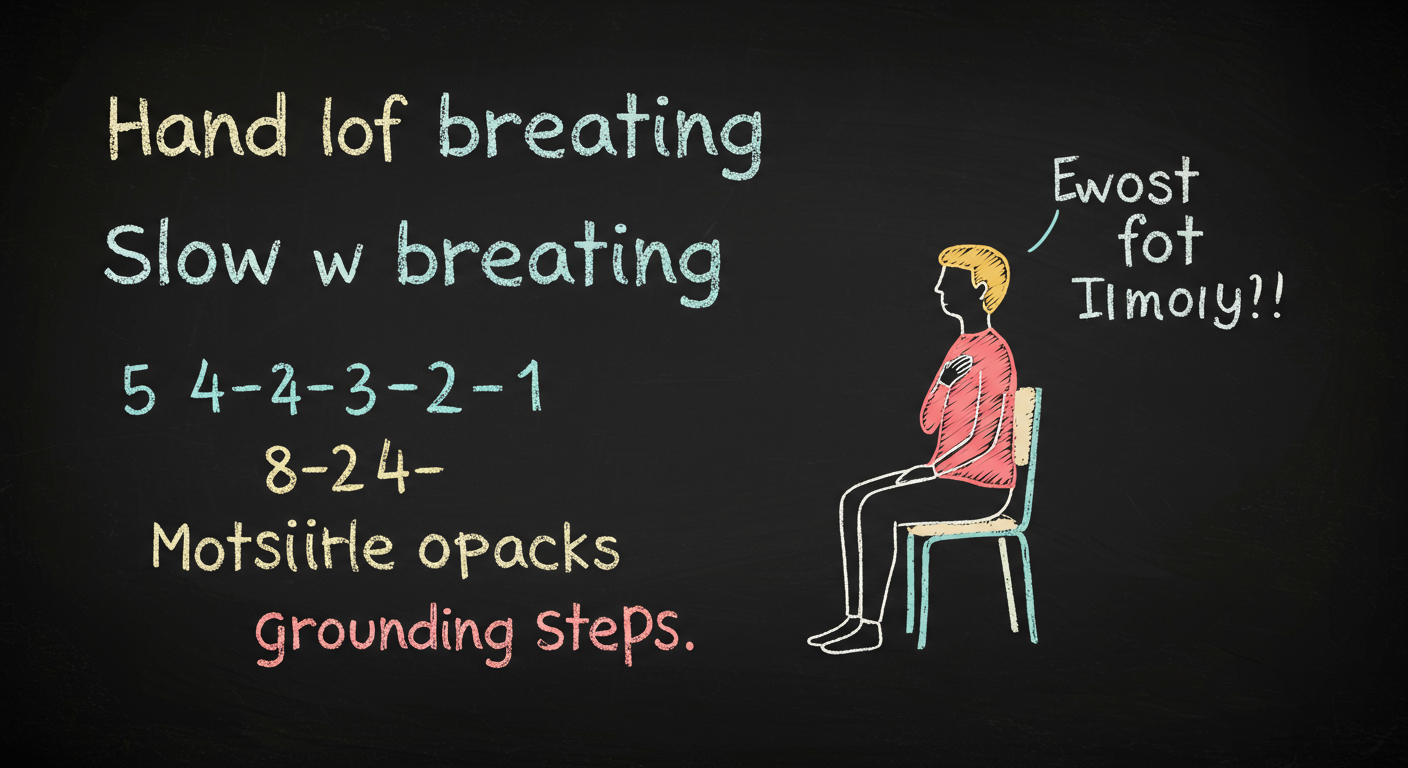
illustration
A person sitting on a chair practicing slow breathing with a hand on the chest and a simple diagram of the 5-4-3-2-1 grounding steps beside them
diagram
chart · bar
Common anxiety tools and what they target
CBTMindfulnessBreathingGroundingExposure

4. When self-help is enough and when to get help

note

When self-help may be enough

  • Symptoms are mild to moderate
  • You can still function at work, school, or home
  • You can practice CBT, mindfulness, or exposure consistently
  • You are seeing gradual improvement over 2 to 6 weeks

When to seek professional help

  • Anxiety is severe or persistent
  • Panic attacks are frequent
  • Avoidance is expanding
  • Sleep, eating, or work are being disrupted
  • You rely on alcohol, cannabis, or sedatives to cope
  • You have trauma, obsessive compulsive symptoms, or depression

When to seek urgent help

  • Thoughts of self-harm
  • Feeling unsafe
  • Inability to care for yourself

Types of professional care

  • CBT with a licensed therapist
  • Exposure and response prevention for obsessive compulsive disorder
  • Medication evaluation with a clinician when appropriate
diagram
equation
Seek help sooner if symptoms, avoidance, function\text{Seek help sooner if } \text{symptoms} \uparrow,\ \text{avoidance} \uparrow,\ \text{function} \downarrow
note

A practical next step

Choose one tool from each category:

  • One CBT thought check
  • One body-based calming skill
  • One exposure step

Use them for 7 days before deciding whether the plan is helping.

5. A 7-day plan you can actually follow

note

7-day anxiety practice plan

Day 1

Pick one trigger and write down the anxious prediction.

Day 2

Do one evidence check and create a balanced thought.

Day 3

Practice 4 in, 6 out breathing for 3 minutes.

Day 4

Use the 5-4-3-2-1 grounding exercise.

Day 5

Do the easiest exposure step on your fear ladder.

Day 6

Repeat the same exposure step.

Day 7

Review what changed in your anxiety before, during, and after practice.

What success looks like

  • Less avoidance
  • Faster recovery after spikes
  • More confidence handling symptoms
  • Better ability to stay present while anxious
javascript
const log = [
  { day: 1, before: 7, during: 8, after: 6 },
  { day: 2, before: 6, during: 7, after: 5 },
  { day: 3, before: 5, during: 6, after: 4 }
];

const averageAfter = log.reduce((sum, d) => sum + d.after, 0) / log.length;
console.log('Average anxiety after practice:', averageAfter.toFixed(1));
diagram
chart · area
Anxiety before and after practice over 3 days
Day 1Day 2Day 3Day 4Day 5

Transcript

Welcome to Slate. Today we're looking at How to Manage Anxiety: Proven Techniques. We'll cover The anxiety response: what is happening in your brain and body, CBT techniques you can apply immediately, Mindfulness and somatic approaches — what the research says, and When self-help is enough vs. when to seek professional help. Let's get into it.

Anxiety is not a character flaw. It is a threat system doing its job a little too loudly. Here’s the basic picture. Your amygdala helps detect danger fast. The prefrontal cortex helps you judge whether the danger is real and what to do next. When anxiety spikes, the body gets messages through the autonomic nervous system. Heart rate rises. Breathing gets shallow. Muscles tense. Digestion slows. That is useful if you need to run from a fire. It is less useful before a meeting. Think of it like a smoke alarm that is too sensitive. A real alarm should be loud. But if it screams every time you make toast, the problem is not your toast. It is the threshold. Research helps explain why this feels so physical. In a 2013 meta-analysis, anxiety disorders were linked with heightened reactivity in threat circuits and altered regulation by frontal brain regions. And the body loop matters. A faster heart can feel like danger, which creates more fear, which speeds the heart again. The goal is not to erase anxiety. The goal is to teach your brain and body that not every alarm means emergency.

Cognitive behavioral therapy, or C-B-T, works because it targets the link between thoughts, feelings, and actions. The key idea is not that thoughts are always false. It is that anxious thoughts are often treated as facts when they are really predictions. Here is a practical example. You notice your heart racing before a presentation. The anxious thought says, “I am going to panic and embarrass myself.” CBT asks for evidence. What happened last time? Did panic actually occur? What is a more balanced prediction? Maybe, “I feel activated, but I can still speak.” That shift matters because the brain responds to meaning, not just sensation. The strongest CBT tool is exposure. Avoidance teaches the brain that the fear was dangerous. Gradual, repeated exposure teaches the opposite. In a 2018 review, exposure-based CBT remained one of the most effective treatments for many anxiety disorders, including panic disorder, social anxiety, and specific phobias. A useful rule: do not argue with anxiety in the abstract. Test it in real life, in small steps, long enough for the nervous system to learn something new.

Mindfulness helps because it changes your relationship to the sensation. Instead of “My heart is racing, so I am unsafe,” the practice becomes “My heart is racing, and I can notice that without adding a second alarm.” That sounds small. It is not. It reduces the extra layer of fear about fear. The research is real, but it is not magic. A 2014 meta-analysis found mindfulness-based stress reduction and mindfulness-based cognitive therapy produced moderate reductions in anxiety symptoms. The effect is strongest when people practice consistently, not when they expect one breathing exercise to erase a month of stress. Somatic tools work through the body first. Slow exhalation can help shift the autonomic nervous system toward a calmer state. A simple pattern is breathing out longer than you breathe in, such as four seconds in and six seconds out. Grounding also helps. Notice five things you can see, four you can feel, three you can hear. That brings attention back to the present moment. These tools are like turning down the volume on the alarm. They do not solve every problem. But they create enough space for clear thinking.

Self-help is a good fit when anxiety is uncomfortable but still leaves room for school, work, relationships, and sleep to function most days. It is also a good fit when symptoms are mild to moderate and you can practice skills regularly. If you are improving over a few weeks, that is a good sign. Professional help is the better call when anxiety is persistent, severe, or getting worse. It is especially important if you are avoiding more and more of life, having panic attacks, using alcohol or drugs to cope, or feeling stuck despite trying strategies on your own. If anxiety is tied to trauma, obsessive compulsive symptoms, or depression, treatment often needs to be more specific. There is a second threshold. If you have thoughts of self-harm, feel unable to stay safe, or cannot function day to day, seek urgent help now. Think of self-help like physical therapy for a mild sprain. It can work well when the injury is manageable. But if the pain is sharp, constant, or worsening, you want an expert to assess what is actually going on.

A good anxiety plan is small enough to repeat. That matters more than intensity. The brain learns through repetition. One perfect hour is less useful than ten minutes a day. Start by picking one trigger. Maybe it is meetings, driving, or health worries. Then choose one thought record, one body skill, and one exposure step. Keep the exposure modest. If speaking in meetings is hard, start by turning on your camera and saying one sentence. That is enough to begin. Track three numbers each day: anxiety before practice, anxiety during practice, and anxiety 15 minutes later. You are looking for a pattern, not perfection. Often the first win is not that anxiety disappears. It is that it rises and then falls without you escaping. If you want a simple benchmark, many people should expect some improvement within a few weeks of regular practice. If you are doing the work and nothing is changing, that is useful information. It means the plan may need more structure, more support, or a different diagnosis. The point is not to become fearless. The point is to become less ruled by fear.

XLinkedInWhatsApp

Keep going with Slate

Pick up where this left off in your own voice session.

Built with Slate