1. Is it too late to learn a language?
0:007:42
Languages

How to Learn a Language as an Adult

Neuroscience-backed methods that actually work — comprehensible input, spaced repetition, and the role of AI tutors.

Apr 22, 20268 min listen5 chapters
What you'll learn
  • Critical period hypothesis — is it ever too late?
  • Comprehensible input theory and why immersion works
  • Spaced repetition and the forgetting curve
  • How AI tools are changing language acquisition in 2026

1. Is it too late to learn a language?

note

How to Learn a Language as an Adult

Neuroscience-backed methods that actually work — comprehensible input, spaced repetition, and the role of AI tutors.

note

The critical period hypothesis

The critical period hypothesis proposes that there is a biologically sensitive window for some aspects of language learning, especially phonology and morphosyntax. The strongest evidence is not that adults cannot learn. It is that early exposure makes certain outcomes easier.

What the data actually show

  • Johnson and Newport, 1989: earlier arrivals in the United States generally performed better on English grammar tests.
  • Large studies of second language pronunciation show age is a strong predictor, but not destiny.
  • Adults can still reach high proficiency with enough input, practice, and feedback.

Adult learners have real advantages

  • Better metacognition: you can notice patterns and make plans.
  • Stronger memory strategies: you can use mnemonics and spaced repetition.
  • Clear goals: travel, work, exams, or family create urgency.

The takeaway

Too late for effortless native-like acquisition? Often yes. Too late to become highly fluent and useful? No.

diagram
chart
Could not render chart — invalid data.

2. Why comprehensible input works

note

Comprehensible input

Comprehensible input is language you can understand with support from context, prior knowledge, visuals, or simplified grammar. The goal is not perfect understanding. The goal is enough understanding to infer meaning and notice new forms.

Why immersion works

Immersion works when it contains comprehensible input. It fails when it is only exposure.

Good immersion looks like this:

  • A learner reads a graded story with 95 to 98 percent known words.
  • A listener watches a short video with images and predictable language.
  • A learner chats with a tutor who adjusts speed and vocabulary.

The 95 percent rule

Research on extensive reading suggests that around 95 percent known vocabulary is often near the threshold for comfortable comprehension, while 98 percent gives more fluid reading. The exact number varies by text and learner, but the principle is stable: too many unknown words block learning.

Best practice

Choose material that is slightly above your level, not wildly above it.
diagram
illustration
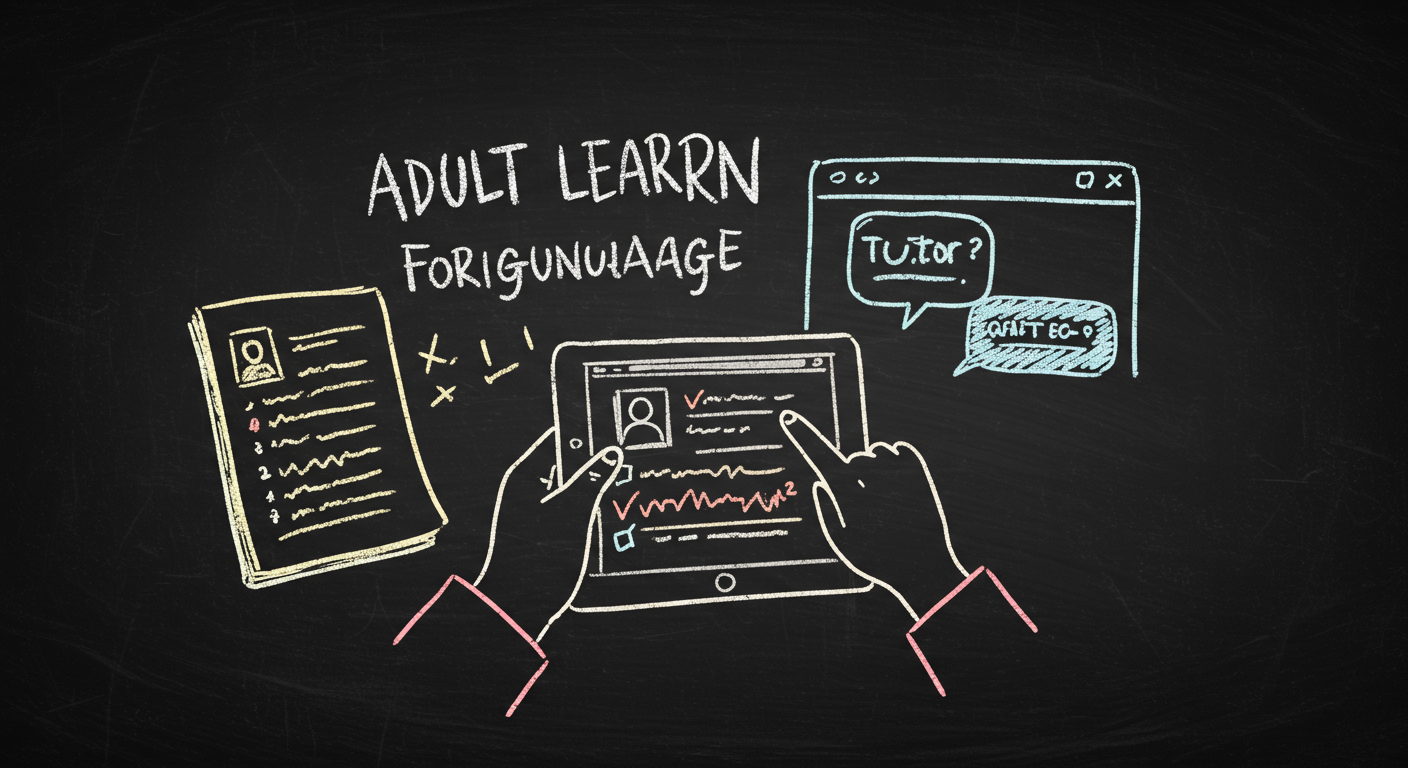
adult learner using a tablet to study a foreign language with captions, graded reader, and tutor chat window
note

A concrete example

If you know 2,000 words in Spanish, a short news story with 100 unfamiliar words is too hard. A simplified story with 20 unfamiliar words is much better. You can infer the new words from repeated context, and your brain gets the same pattern many times. That is how input becomes learning.

3. Spaced repetition and the forgetting curve

note

The forgetting curve

Hermann Ebbinghaus first described systematic forgetting in the 1880s. The exact numbers vary across studies, but the pattern is consistent: memory drops rapidly soon after learning, then the decline slows.

Why spaced repetition works

Each successful recall does two things:

  • It strengthens the memory trace.
  • It increases the interval before the next review.

That means you spend more time on weak items and less time on strong ones.

What to put in flashcards

Good cards are specific:

  • One word with one meaning
  • One phrase in a real sentence
  • One pronunciation contrast
  • One verb form or pattern

Bad cards are vague:

  • Entire paragraphs
  • Too many facts on one card
  • Definitions without context

A practical rule

If a card takes more than about 10 seconds to answer, it is probably too dense.

chart
Could not render chart — invalid data.
note

The tradeoff

Spaced repetition is powerful, but it can become a trap if you collect cards faster than you can review them. A good deck is a garden, not a warehouse. Prune ruthlessly. Keep the cards that support speaking, listening, and reading.

4. How to use AI tutors without fooling yourself

note

What AI tutors do well

  • Generate endless practice at the right level
  • Explain grammar in multiple ways
  • Create dialogue for specific situations
  • Turn mistakes into personalized review items
  • Provide instant feedback without fatigue

What AI tutors do poorly

  • Guarantee factual accuracy without checking
  • Replace real human conversation entirely
  • Detect subtle pronunciation errors from text alone
  • Know your exact proficiency unless you test it

Best uses in 2026

Use AI for:

  • Graded conversation
  • Vocabulary recycling
  • Sentence transformation drills
  • Personalized feedback on writing
  • Role-play before real-life speaking

Safety check

If the AI says something important, verify it with a dictionary, a trusted grammar source, or a human tutor.

diagram
python
mistakes = [
    "I very like coffee",
    "Yesterday I go home",
    "Can you explain me this?"
]

corrections = {
    "I very like coffee": "I like coffee very much.",
    "Yesterday I go home": "Yesterday I went home.",
    "Can you explain me this?": "Can you explain this to me?"
}

for s in mistakes:
    print(s, "->", corrections[s])
note

A good rule for AI practice

If the AI can do the whole task for you, the task is too easy. Keep one hard step for your brain: recalling a word, choosing the tense, or summarizing the idea in your own language.

5. A practical adult learning plan

note

A realistic adult routine

Daily

  • 20 to 30 minutes of comprehensible input
  • 10 to 15 minutes of spaced repetition
  • 5 to 15 minutes of speaking or writing

Weekly

  • One longer conversation with a tutor or partner
  • One review of recurring mistakes
  • One slightly harder input session

How to measure progress

Use performance, not feelings:

  • Understand a podcast segment without pausing every sentence
  • Hold a 5-minute conversation on familiar topics
  • Read a short article with only a few dictionary lookups
  • Write a message with fewer repeated errors

Common failure modes

  • Too much passive exposure with no retrieval
  • Flashcards without context
  • Speaking only when you feel ready
  • Switching resources every week

The core idea

Adults learn best when they combine meaning, memory, and use.

diagram
equation
ProgressInput quality×Retrieval frequency×Feedback speedProgress \approx \text{Input quality} \times \text{Retrieval frequency} \times \text{Feedback speed}
chart · pie
A balanced weekly plan
InputSpaced repetitionSpeakingFeedback and review

Transcript

Welcome to Slate. Today we're looking at How to Learn a Language as an Adult. We'll cover Critical period hypothesis — is it ever too late?, Comprehensible input theory and why immersion works, Spaced repetition and the forgetting curve, and How AI tools are changing language acquisition in 2026. Let's get into it.

Adults do not learn like children, but that is not a dead end. The critical period hypothesis says there may be a window in childhood when some language skills, especially pronunciation and grammar intuition, are easier to acquire. A classic study by Johnson and Newport in 1989 found that Korean and Chinese speakers who arrived in the United States earlier tended to score higher on English grammar tests. But the curve did not drop to zero after puberty. Adults still learned, just with different starting conditions. Here is the practical picture. Children get massive exposure and little analysis. Adults get less time, but they bring attention, memory strategies, and goals. That matters. Think of it like learning to play piano. A child may absorb rhythm by sheer repetition. An adult can also improve fast if they practice deliberately and listen for mistakes. The key question is not whether you can become native-like in every detail. The real question is whether you can become fluent enough for your needs. For most learners, the answer is yes. Studies of ultimate attainment show huge variation. Age matters, but motivation, hours of exposure, and quality of practice matter too. The diagram shows the main idea: age shifts the difficulty, but it does not close the door. So the adult advantage is not magic. It is strategy. You need methods that respect how adult brains actually learn: clear input, repeated retrieval, and feedback that is immediate and specific.

Comprehensible input means language that you can mostly understand, with just enough new material to stretch you. Stephen Krashen made this idea famous in the 1980s, and the core insight still holds up: your brain learns patterns when meaning is clear and the next step is just slightly harder than what you already know. Here is why immersion helps when it is done well. If every sentence is total noise, your brain cannot map sound to meaning. If every sentence is already easy, nothing new gets learned. The sweet spot is the narrow band where you can follow the story, guess from context, and notice repeated forms. That is why graded readers, slow podcasts, picture-supported videos, and simple conversations work so well. Think of it like building a bridge plank by plank. You need the far side in sight, but each plank has to connect to the one before it. Too big a gap, and you fall. Too small, and you never cross. The best input is rich, repeated, and meaningful. A hundred encounters with a common verb in different contexts teach more than a hundred isolated flashcards. But input alone is not enough. You also need retrieval practice, because recognition is easier than production. The visuals here show the loop: understand, notice, repeat, then use.

Memory fades quickly at first, then more slowly. Hermann Ebbinghaus measured this in the 1880s and drew what we now call the forgetting curve. The exact shape varies, but the lesson is simple: if you review too late, you have already lost too much. If you review just as a memory starts to weaken, you strengthen it efficiently. Spaced repetition systems use that principle. A card you know well comes back later. A card you miss comes back sooner. This is not busywork. It is a way of forcing retrieval at the right moment. Retrieval is the workout. Re-reading is only watching someone else lift. Suppose you learn the Spanish word mesa. If you review it today, then tomorrow, then three days later, then a week later, each successful recall makes the memory more durable. The intervals grow because the memory is getting stronger. That is why apps like Anki can feel almost unfairly effective when used well. But there is a catch. Flashcards are best for atoms of language: words, phrases, verb forms, pronunciation pairs. They are not enough for full sentences in real life. You still need input and conversation to teach your brain how those atoms work together. The chart shows the pattern: forgetting drops fast, then spacing slows the loss.

AI tutors are changing language learning because they can supply endless, patient interaction at a low cost. In 2026, the best systems can role-play conversations, explain grammar in plain language, generate graded examples, and adapt difficulty on the fly. That is useful. But the tool is only as good as the task you give it. Here is the danger. An AI can make you feel fluent because it is easy to talk to. But comfort is not competence. If the model corrects you too gently, you may repeat the same mistakes. If it gives you perfect translations too early, you stop struggling with meaning. Good use of AI means forcing retrieval and checking accuracy. Think of AI as a tireless sparring partner. It can keep the rally going, but you still need a coach who watches your form. The best workflow is simple: ask for comprehensible input at your level, then ask for corrections, then repeat the same idea in your own words. Modern AI tools are especially strong for personalized practice. They can generate 20 sentences using your target verb, or turn your own mistakes into flashcards. They can also simulate realistic situations: ordering food, booking a hotel, or explaining a problem to a doctor. The sequence diagram shows the loop: prompt, response, correction, review, reuse. That is where the learning happens.

A good language plan is boring in the best way. It repeats the same core cycle until it becomes automatic. Start with input you can mostly understand. Add spaced repetition for the high-frequency words and phrases that keep appearing. Then use AI or a human tutor to turn passive knowledge into active speech. Here is a simple weekly structure. Read or listen for 20 to 30 minutes a day. Do 10 to 15 minutes of spaced repetition. Speak for 15 minutes, even if it is clumsy. That adds up to roughly three to five hours a week, which is enough to make real progress over months. If you can do more, great. If not, consistency beats heroic weekends. The biggest mistake is mixing too many methods at once. Pick one input source, one review system, and one speaking outlet. Measure progress with real tasks, not vibes. Can you understand a short podcast without subtitles? Can you order food without freezing? Can you write a simple message without translation? The final diagram is the whole system. Input feeds memory. Memory supports output. Output reveals gaps. Then you go back and fill them. That loop is adult language learning in practice. It is not glamorous. It works.

XLinkedInWhatsApp

Keep going with Slate

Pick up where this left off in your own voice session.

Built with Slate