Why difficult conversations go sideways
0:007:16
Interview Prep

How to Have Difficult Conversations at Work

Giving tough feedback, asking for a raise, addressing conflict — research-backed frameworks for the talks you dread.

Apr 22, 20267 min listen5 chapters
What you'll learn
  • The Harvard Negotiation Project's three-conversation model
  • Nonviolent communication in practice
  • Delivering critical feedback without triggering defensiveness
  • Having the conversation you have been avoiding

Why difficult conversations go sideways

note

How to Have Difficult Conversations at Work

Giving tough feedback, asking for a raise, addressing conflict — research-backed frameworks for the talks you dread.

note

What makes a conversation difficult

A difficult conversation is one where at least one of these is true:

  • The stakes are real: pay, trust, reputation, workload, promotion, or team health.
  • The facts are incomplete or disputed.
  • The other person may hear criticism, rejection, or loss of status.

The Harvard Negotiation Project’s framework says most hard talks contain three conversations at once:

  • The “what happened” conversation
  • The feelings conversation
  • The identity conversation

If you treat a raise request like a data-only meeting, you may miss the identity layer. If you treat feedback like a personality judgment, you inflate the conflict. The skill is to name the issue without turning it into a character verdict.

diagram
note

The hidden cost of defensiveness

Defensiveness is not stubbornness. It is self-protection. When people feel blamed, their brain spends more energy on safety than on problem solving. In practice, that means they interrupt, justify, counterattack, or go silent.

A useful analogy: if a smoke alarm goes off, people do not calmly inspect the wiring. They react to the alarm. Criticism can work the same way. If your message sounds like a fire, the other person stops hearing the details.

chart · bar
Where hard conversations break down
Unclear factsUnspoken feelingsIdentity threatPoor timingNo next step

Use the three-conversation model before you speak

note

The three questions to ask yourself

Before the meeting, write down:

  1. What happened, in observable terms?
  2. What am I feeling?
  3. What is the identity threat for me and for them?

Example: “My teammate interrupted me in the client meeting.”

  • Facts: I was speaking; they cut in.
  • Feelings: embarrassed, irritated.
  • Identity threat: I may feel dismissed; they may think they were being helpful.

That distinction matters because you can address the behavior without attacking the person.

diagram
note

A better opening sentence

A strong opening has three parts:

  • The issue
  • The reason it matters
  • A request to understand or solve it

Example for a raise conversation:

“I’d like to talk about my compensation. Over the last year I took on the client launch, trained two new hires, and kept the support queue under target. I want to understand how my pay compares with the scope of the role.”

That is direct, specific, and hard to misread as a complaint.

equation
Clarity=Observed behavior+Why it matters+Next step\text{Clarity} = \text{Observed behavior} + \text{Why it matters} + \text{Next step}

Nonviolent Communication in real workplace language

note

The four steps of Nonviolent Communication

Marshall Rosenberg’s framework uses four parts:

  • Observation
  • Feeling
  • Need
  • Request

Example:

“When the weekly status report was sent after the client meeting, I felt stressed because I need enough time to prepare. Could we move it to noon on Thursdays?”

The power is in the first word. Observation means something a neutral witness could see or hear.

diagram
note

What not to do

Avoid these traps:

  • “You always” and “you never”
  • Diagnosing motives: “You do not respect me”
  • Hidden requests disguised as complaints
  • Requests so vague they cannot be acted on

A request should be specific enough that the other person can answer yes, no, or propose a different option.

note

A practical script for feedback

Try this structure:

  • When I saw X
  • I felt Y
  • Because I need Z
  • Would you be willing to do W?

Example:

“When I saw the client deck sent without the updated numbers, I felt concerned because I need accuracy in external materials. Would you be willing to add a final verification step before sending?”

Give critical feedback without triggering a fight

note

A feedback structure that works

Use this three-step pattern:

  1. Describe the behavior.
  2. Explain the impact.
  3. Make a clear request.

Example:

“During the meeting, you interrupted twice while I was answering the client. That made it harder to finish the explanation and it changed the tone in the room. Next time, please let me finish my answer before jumping in.”

This keeps the focus on behavior that can change.

diagram
chart · line
Feedback quality over time
VagueSpecificBehavior basedTimelyFollow up

The conversation you have been avoiding

note

A decision tree for the conversation you have avoided

Ask yourself:

  • Is this a facts problem, a feelings problem, or both?
  • Do I need to persuade, repair, or set a boundary?
  • What outcome would be good enough?
  • What will I do if the first answer is no?

For a raise, good enough might mean a raise now, a written review date, or a promotion plan with criteria.

For conflict, good enough might mean a behavior change, a new process, or a mediated follow-up.
diagram
illustration
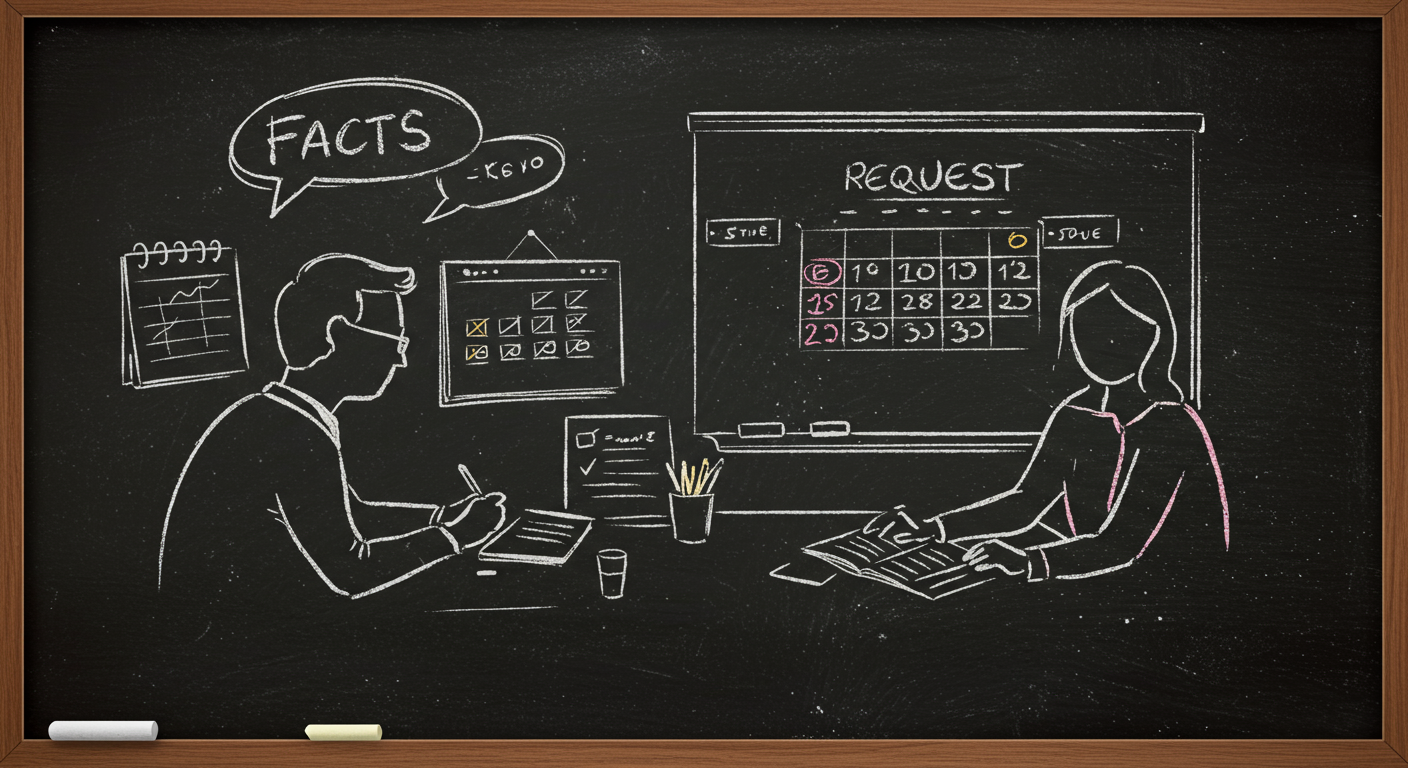
A workplace conversation between two colleagues in a meeting room with a notebook, a calendar, and a simple whiteboard showing facts feelings needs request
note

Your final checklist

Before the conversation:

  • Write the facts in one sentence.
  • Name your feeling in one word.
  • Identify the need or standard.
  • Decide on a specific request.
  • Plan your follow-up.

If you can do those five things, you are ready to begin.

Transcript

Welcome to Slate. Today we're looking at How to Have Difficult Conversations at Work. We'll cover The Harvard Negotiation Project's three-conversation model, Nonviolent communication in practice, Delivering critical feedback without triggering defensiveness, and Having the conversation you have been avoiding. Let's get into it.

Most hard talks fail before the first sentence lands. The real problem is not the topic. It is the hidden mix of facts, feelings, and identity. A performance review can sound like a spreadsheet. To the other person, it can feel like a verdict. That mismatch is where defensiveness starts. The Harvard Negotiation Project, especially Douglas Stone, Bruce Patton, and Sheila Heen in Difficult Conversations, published in 1999, gives a useful map: every tough talk has three conversations inside it. What happened. The emotions. And the identity threat. If you only argue about facts, the feelings leak out sideways. If you ignore identity, people protect themselves instead of solving the issue. Here is the key pattern to notice in the diagram: the topic is usually not the whole problem. The threat underneath is. A manager saying, “Your report was late,” may really be asking, “Can I rely on you?” A teammate hearing that may hear, “I am incompetent.” Once you see that split, the conversation becomes more precise. You stop trying to win a debate and start trying to reduce danger. That is the first skill in any hard conversation: separate the issue from the story each person is telling about it.

Before a difficult conversation, do a fast diagnosis. Ask three questions. What happened, from my view? What am I feeling? What identity story am I telling myself? Then ask the same three about the other person. This is not mind reading. It is hypothesis building. You are trying to predict where the conversation may snag. If the issue is a missed deadline, the facts matter. But so does whether the person may be embarrassed, overloaded, or afraid of looking careless. The model is powerful because it keeps you from overcorrecting. Some people come in with a pile of evidence and no empathy. Others bring empathy and no clarity. You need both. A good opening sounds like a bridge, not a verdict. Instead of “You keep missing deadlines,” try “I want to talk about the last two project dates and what got in the way, because I need to understand the pattern and figure out how we prevent it next time.” That sentence does three things. It names the issue. It signals curiosity. And it points toward a shared goal. The visual here should feel like a checklist in your head, not a script to memorize. The point is to prepare your mind so your tone stays steady when the other person reacts.

Nonviolent Communication, or N-V-C, was developed by Marshall Rosenberg and popularized in the 1960s and 1970s. The core idea is simple: separate observation from evaluation, then connect feeling to need, then make a clear request. That sounds soft until you use it well. It is actually very precise. If you say, “You are careless,” you have mixed observation with judgment. If you say, “The spreadsheet had three broken formulas in the revenue tab,” you have something the other person can verify. Then comes the feeling. Not “I feel like you do not care,” because that is a hidden accusation. Try “I felt anxious when I saw the errors.” Next is the need. Maybe you need reliability, time, or shared standards. Finally, ask for a specific action. “Can you review the formulas with me before the next send?” The analogy is a camera before a courtroom. A camera records what happened. A courtroom argues what it means. N-V-C starts with the camera so the conversation does not begin as a trial. It also helps with raises and conflict. You can say, “When my scope grew by two projects without a title change, I felt frustrated because I need role alignment. Can we discuss what a promotion path would look like?” That is much harder to dismiss than vague dissatisfaction.

Critical feedback lands best when it is narrow, timely, and behavior-based. The goal is not to unload your frustration. The goal is to change future behavior. Research on feedback shows that vague praise or vague criticism helps less than specific information about the task. One practical rule is to discuss the impact, not the person. Say what the behavior did to the work. Not who they are. For example, “When the client was told the deck was ready and it still had missing numbers, I lost trust in the handoff,” is cleaner than “You are unreliable.” Another useful move is to invite their view early. That lowers the feeling of being ambushed. Ask, “How did you see it?” or “What got in the way?” Then listen for constraints, not just excuses. Sometimes the problem is skill. Sometimes it is workload. Sometimes it is a misunderstanding of standards. If you need a concrete model, use this sequence: describe, impact, ask. Describe the behavior. State the impact. Ask for a change. The visual should make the sequence feel almost mechanical, because that is the point. In a stressful moment, a simple structure keeps your words from turning sharp. Think of it like a seat belt. It does not prevent the crash. It reduces the damage.

The hardest conversations are usually the ones you postpone because the outcome matters and the answer is uncertain. Asking for a raise. Naming a pattern of disrespect. Saying you cannot keep absorbing extra work. Avoidance feels safer in the short term, but it quietly teaches the other side that the status quo is acceptable. So the last skill is commitment. Set the meeting. State the topic. Bring one or two concrete examples. And decide in advance what you will do if the answer is no or if the other person gets defensive. That is not pessimism. It is preparation. A raise request, for instance, should include your evidence, your market context, and your ask. A conflict conversation should include the behavior you need to stop, the standard you want, and the consequence if it continues. Here is the pattern to remember: prepare, open, listen, clarify, and close with next steps. The closing matters because many talks feel good in the room and disappear afterward. Write down who will do what by when. If you want one sentence to carry into the real world, use this: be kind, be specific, and stay with the issue. That is how difficult conversations become workable ones.

XLinkedInWhatsApp

Keep going with Slate

Pick up where this left off in your own voice session.

Built with Slate