How Much Energy Does AI Actually Use?
Training one AI model can use as much electricity as 100 homes in a year. The hidden environmental cost of the AI boom.
- The true energy cost of training and running AI models
- How data centers are driving nuclear and renewable investment
- Efficiency techniques: distillation, sparsity, edge computing
- The tension between AI ambition and environmental cost
1. Where AI energy use actually happens
How Much Energy Does AI Actually Use?
Training one AI model can use as much electricity as 100 homes in a year. The hidden environmental cost of the AI boom.
AI energy use: training vs inference
Training is the one-time or periodic cost of teaching a model from data. Inference is the repeated cost of using that model after it is deployed.
For large models, training can dominate the total energy bill during development. But at internet scale, inference can become the bigger number because millions of requests arrive every day.
A useful mental model: training is the factory setup. Inference is the assembly line.
Why the answer is not one number
Electricity use depends on:
- Model size and architecture
- Number and type of accelerators
- Batch size and utilization
- Data center power efficiency
- Training duration
- How many users call the model after launch
2. What the numbers look like in the real world
Real energy numbers to keep in view
The International Energy Agency reported that data centers, cryptocurrencies, and AI used about 460 terawatt-hours in 2022. That was roughly 2% of global electricity demand.
For AI specifically, the footprint depends on whether you are looking at:
- A one-time training run
- Repeated fine-tuning
- High-volume inference at scale
- The cooling and overhead around the servers
Why home-equivalent comparisons can mislead
Saying “one model equals 100 homes” is useful only if you also ask:
- Over what time period?
- In which country?
- With what electricity mix?
- Does it include cooling and networking?
A house in France, where nuclear power dominates the grid, has a different carbon footprint from a house on a coal-heavy grid.
3. Why data centers are reshaping power markets
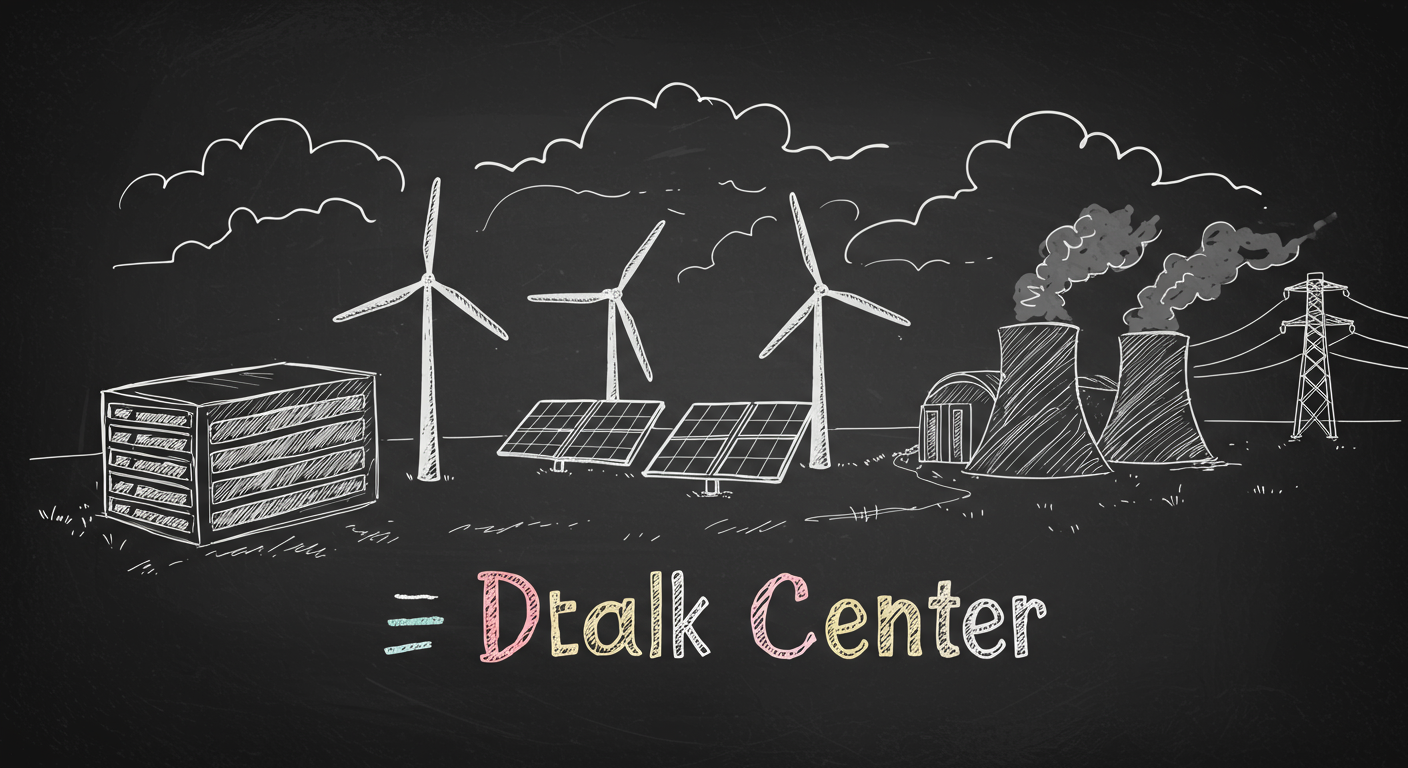
Data centers are changing electricity demand
A modern AI data center can require 50 to 100 megawatts or more. At the top end, that is comparable to the electricity demand of a small city.
This is why AI companies are signing deals for:
- Utility-scale solar and wind
- Battery storage
- Grid upgrades and transmission
- Nuclear power, including existing plants and restarts
Why utilities care
New data centers create:
- Large, predictable loads
- Demand for 24/7 reliability
- Pressure to expand generation and cooling infrastructure
That can speed up investment in clean power. It can also stress local grids if growth is too fast.
4. How engineers cut AI energy use
Main efficiency techniques
Distillation : A large teacher model transfers behavior to a smaller student model.
Sparsity : Only part of the network activates for each input.
Quantization : Uses lower-precision numbers, such as 8-bit instead of 16-bit or 32-bit.
Edge computing : Runs the model near the user, on-device or close to it.
Tradeoffs
Every efficiency gain can affect quality, latency, or engineering complexity.
The best system is rarely the biggest one. It is the smallest model that still does the job well.
# Simple illustration of quantization savings
# 32-bit float uses 4 bytes per number
# 8-bit integer uses 1 byte per number

parameters = 7_000_000_000
bytes_fp32 = parameters * 4
bytes_int8 = parameters * 1

print(f'FP32 storage: {bytes_fp32 / 1e9:.1f} GB')
print(f'INT8 storage: {bytes_int8 / 1e9:.1f} GB')
print(f'Size reduction: {bytes_fp32 / bytes_int8:.0f}x')5. The hard tradeoff: ambition versus footprint
The central tension in sustainable AI
AI can create value in medicine, science, and infrastructure. It can also consume enormous amounts of electricity.
A responsible strategy has four parts:
- Measure training and inference separately
- Choose efficient model architectures
- Match workloads to low-carbon electricity
- Report energy and carbon data clearly
A practical rule
If a smaller model delivers nearly the same result, the smaller model is usually the better engineering choice.
That is not austerity. It is good systems design.
Keep going with Slate
Pick up where this left off in your own voice session.