1. Two lines of defense
0:006:24
Science

How Does Your Immune System Fight Disease?

White blood cells, antibodies, T-cells, and immune memory — your body's military defense system decoded.

Apr 22, 20266 min listen5 chapters
What you'll learn
  • Innate vs. adaptive immunity: two lines of defense
  • How T-cells and B-cells identify and destroy invaders
  • Immune memory: why you only get chicken pox once
  • Autoimmune disease: when the system attacks itself

1. Two lines of defense

note

How Does Your Immune System Fight Disease?

White blood cells, antibodies, T-cells, and immune memory — your body's military defense system decoded.

note

Innate immunity and adaptive immunity

Innate immunity is the body’s rapid, built-in defense. It includes barriers like skin, mucus, and stomach acid, plus cells such as neutrophils, macrophages, and natural killer cells.

Adaptive immunity is slower to start, but highly specific. It uses B-cells, T-cells, and antibodies to target a particular pathogen.

Key difference

Innate immunity answers the question: “Is this dangerous?”

Adaptive immunity answers: “What exactly is it?”

Why both matter

Innate immunity can respond in minutes to hours. Adaptive immunity usually takes days on first exposure. That delay is the price of precision.

diagram
note

A useful analogy

Innate immunity is the security guard at the door. It checks for obvious trouble and reacts immediately.

Adaptive immunity is the detective unit. It takes longer, but it identifies the suspect with much more precision.

Real-world example

If you cut your skin, neutrophils arrive early and attack bacteria. If you catch influenza, the adaptive response becomes essential because the virus hides inside your own cells.

chart · bar
Typical timing of immune responses
MinutesHoursDaysWeeks

2. How B-cells make antibodies

note

B-cells and antibodies

B-cells are white blood cells that recognize antigens with receptors on their surface.

When activated, B-cells divide and become plasma cells. Plasma cells secrete antibodies.

Antibodies help by:

  • neutralizing toxins and viruses
  • tagging microbes for phagocytes
  • clumping pathogens together
  • activating complement proteins

Antibody classes

IgM is usually the first antibody made in a new infection. IgG is the most abundant antibody in blood and can cross the placenta. IgA protects mucosal surfaces. IgE is important in allergies and defense against parasites.

diagram
chart · line
Antibody response after first and second exposure
Day 0Day 3Day 7Day 14Day 21
note

Why antibodies are so effective

Antibodies work because shape matters. A matching antibody can block a virus like a key jammed into a lock.

That blocking action is called neutralization.

They also make it easier for macrophages and neutrophils to eat the microbe. This process is called opsonization.

Concrete example

After vaccination or infection, your body can make IgG antibodies that remain in the blood for months or years. That is one reason a second exposure is often much less severe.

3. T-cells find and destroy infected cells

note

T-cells and antigen presentation

T-cells do not usually recognize free-floating germs. They inspect antigens displayed on MHC molecules.

CD4 helper T-cells coordinate the immune response. CD8 cytotoxic T-cells kill infected cells.

MHC in one sentence

MHC molecules are display platforms that let T-cells see what is happening inside a cell.

Why this matters

Viruses replicate inside cells, so antibodies alone are not enough. T-cells are essential for clearing infected cells and for controlling many intracellular infections.

diagram
note

Analogy

If antibodies are the stickers on suspicious packages, T-cells are the inspectors who check the shipping manifest and decide whether the package should be opened, isolated, or destroyed.

Real example

During a viral infection like influenza, cytotoxic T-cells help eliminate cells that are already infected. That reduces the number of factories the virus can use to make copies of itself.

equation
Apoptosis=programmed cell deathnotcell bursting\text{Apoptosis} = \text{programmed cell death}\quad\text{not}\quad \text{cell bursting}
note

A key distinction

Helper T-cells coordinate. Cytotoxic T-cells kill.

That split is easy to remember, and it matches their jobs in the body.

4. Immune memory and vaccination

note

Immune memory

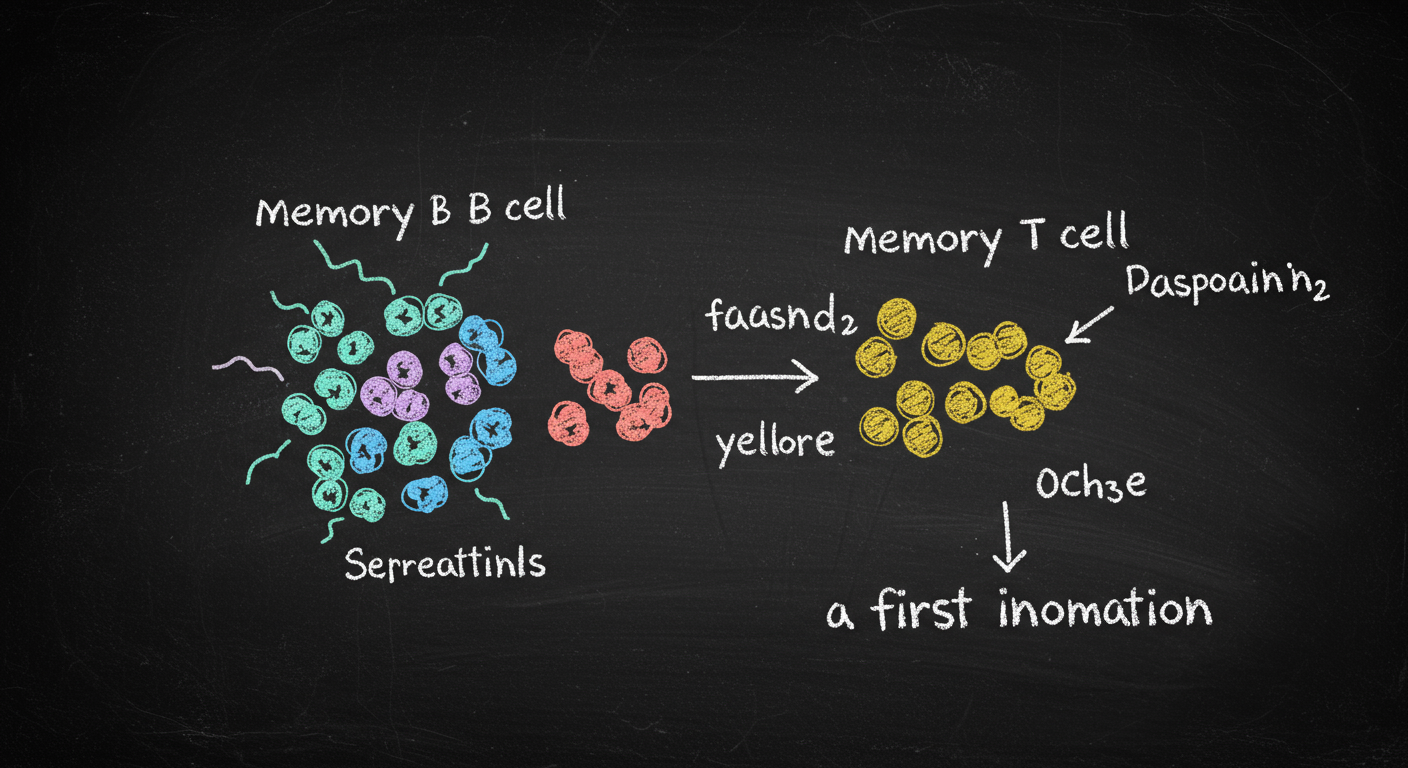
Memory B-cells and memory T-cells remain after an infection ends.

They respond faster during a second exposure, often reducing symptoms or preventing illness altogether.

Chicken pox example

Varicella-zoster virus usually causes chicken pox once because the immune system forms durable memory after the first infection.

Vaccination

Vaccines train immune memory without the risks of the full disease. Different vaccines use different strategies, including inactivated pathogens, live attenuated pathogens, protein subunits, and mRNA instructions.
diagram
illustration
A clear diagram of a memory B cell and memory T cell responding faster during a second infection compared with a first infection
chart · area
Primary vs secondary immune response
Day 0Day 2Day 5Day 8Day 12

5. When immunity goes wrong

note

Autoimmune disease

Autoimmune disease happens when the immune system attacks the body’s own cells and tissues.

Examples include:

  • Type 1 diabetes, where immune cells destroy pancreatic beta cells
  • Rheumatoid arthritis, where joints become inflamed
  • Multiple sclerosis, where myelin is damaged

Why autoimmunity happens

The immune system normally develops tolerance to self. If tolerance fails, self-reactive B-cells or T-cells can cause damage.

diagram
chart · pie
Immune outcomes
Protective responseWeak responseAutoimmune damage
note

Big picture

A healthy immune system balances speed, precision, and restraint.

Speed helps you survive the first hours of infection. Precision clears the specific invader. Memory protects you later. Restraint prevents self-damage.

Final takeaway

Disease fighting is not one mechanism. It is a coordinated system with different cells for detection, signaling, killing, cleanup, and remembering.

Transcript

Welcome to Slate. Today we're looking at How Does Your Immune System Fight Disease?. We'll cover Innate vs. adaptive immunity: two lines of defense, How T-cells and B-cells identify and destroy invaders, Immune memory: why you only get chicken pox once, and Autoimmune disease: when the system attacks itself. Let's get into it.

Your immune system works like a city defense plan. The first line is always on duty. Skin, mucus, stomach acid, and cilia block or trap germs before they enter. If a pathogen gets through, innate immunity responds fast. Neutrophils and macrophages rush in within minutes to hours. They do not need to know the exact germ first. They recognize patterns that many microbes share. That speed matters because a single bacterium can become millions in a day. Here’s the tradeoff. Innate immunity is quick, but it is broad and less precise. Adaptive immunity is slower at first, often taking several days, but it can target one invader with much greater accuracy. The diagram shows these two layers as a checkpoint system. One line slows the intruder. The next line studies its face and builds a custom response. This is why your body does not fight every infection the same way. A splinter with bacteria, a flu virus, and a parasite all trigger different tactics. The big idea is simple. Fast defense buys time. Precise defense finishes the job.

The next step is recognition. B-cells are like factory workers with a very picky quality-control test. Each B-cell carries one kind of receptor on its surface. That receptor fits one shape on a germ, called an antigen. When the right B-cell finds its match, it multiplies. Some of the new cells become plasma cells. Plasma cells can release thousands of antibodies every second. Antibodies are Y-shaped proteins that stick to antigens. They can block a virus from entering cells, tag bacteria for destruction, or clump microbes together so they are easier to clear. A single antibody does not kill anything by itself. Think of it like a bright sticker on a package. It tells other immune cells, “Handle this one.” Different antibody classes do different jobs. IgM appears early. IgG is the most common in blood and lasts longer. IgA protects surfaces like the gut and airways. IgE is involved in allergies and parasite defense. The chart shows why antibody levels rise after exposure. The first response is slower. The second response is faster and stronger because memory B-cells are already waiting.

Some invaders never stay outside the cell. Viruses, and a few bacteria, hide inside your own cells. Antibodies cannot reach them there. That is where T-cells matter. First, an antigen-presenting cell, often a dendritic cell, breaks a germ into pieces and displays one piece on an MHC molecule. MHC stands for major histocompatibility complex. You can think of it as a name tag showing what is happening inside the cell. Helper T-cells, especially CD4 T-cells, inspect that display. If they recognize the antigen, they release signals called cytokines. Those signals help B-cells, macrophages, and other T-cells do their jobs. Cytotoxic T-cells, also called CD8 T-cells, are the direct killers. They look for infected cells showing the right antigen on MHC class I and then trigger apoptosis, a controlled cell death. That is cleaner than bursting the cell open. The sequence diagram shows the handoff clearly. One cell samples the invader. Another cell coordinates the response. A third cell destroys the infected target. This division of labor is why adaptive immunity is so powerful.

The first time your immune system meets a pathogen, it has to build the response from scratch. That takes time. But some B-cells and T-cells become memory cells instead of short-lived soldiers. Memory cells are long-lived and easier to activate later. That is why a second infection often triggers a response that is faster and stronger. Chicken pox is the classic example. Most people get varicella only once because the first infection leaves immune memory. The virus does not vanish from the planet, but your immune system remembers it. Vaccines use the same idea without forcing you to endure the full disease. They show the immune system a harmless version of the target, or a piece of it, so memory cells can form safely. Here’s the pattern in the diagram. First exposure builds memory. Second exposure meets a prepared response. That difference can be dramatic. In a naïve person, antibody levels rise slowly. In a vaccinated or previously infected person, memory B-cells can expand quickly, and memory T-cells help the response ramp up fast. That is why boosters can matter. They remind the immune system what to watch for.

A strong immune system is not the same as a perfect one. Sometimes the response is too weak. Sometimes it is too strong. And sometimes it attacks the wrong target. That last problem is autoimmune disease. In autoimmune disease, the immune system mistakes the body’s own proteins for foreign ones. Type 1 diabetes is one example. Immune cells destroy insulin-producing beta cells in the pancreas. Rheumatoid arthritis is another. The immune system attacks joints, causing pain and swelling. Multiple sclerosis involves immune attack on myelin, the insulation around nerve fibers. These diseases show that specificity matters. If the immune system loses tolerance, the weapons designed for invaders can harm healthy tissue. The chart helps show the balance. Too little response leaves you vulnerable to infection. Too much or misdirected response can damage your own organs. The body normally uses checkpoints and tolerance mechanisms to avoid this. When those controls fail, the defense system becomes a source of disease. So the immune system is not just an army. It is also a carefully trained police force that must know exactly who belongs and who does not.

XLinkedInWhatsApp

Keep going with Slate

Pick up where this left off in your own voice session.

Built with Slate