1. What a memory actually is
0:007:33
Science

How Does Your Brain Store Memories?

Short-term, long-term, procedural, emotional — how neurons encode, store, and retrieve everything you know.

Apr 22, 20268 min listen5 chapters
What you'll learn
  • The three stages: encoding, storage, retrieval
  • How the hippocampus converts short-term to long-term memory
  • Why emotional memories are stronger (the amygdala connection)
  • False memories, memory decay, and why forgetting is useful

1. What a memory actually is

note

How Does Your Brain Store Memories?

Short-term, long-term, procedural, emotional — how neurons encode, store, and retrieve everything you know.

note

Memory is a pattern, not a file

A memory is the brain's ability to re-create a past pattern of activity.

Three big memory systems

  • Working memory: holds information for seconds to minutes
  • Long-term declarative memory: facts and events you can describe
  • Long-term procedural memory: skills and habits you can perform

Core idea

The brain stores information by changing connections between neurons, especially at synapses.

diagram
note

A useful analogy

Working memory is like a whiteboard. Long-term memory is like a library. The whiteboard is fast but temporary. The library is slower to access, but far more durable.

chart · bar
Typical memory timescales
Working memoryShort-term traceLong-term memory

2. Encoding: how experience gets into the brain

note

Encoding

Encoding is the conversion of experience into a neural representation.

What improves encoding

  • Attention
  • Meaningful association
  • Repetition spaced over time
  • Sleep after learning

What the hippocampus does

It binds separate details into one memory episode.

diagram
note

Real-world example

If you study a biology diagram for 20 minutes, then review it tomorrow, then again three days later, each session can strengthen the trace more than one long session. That is the spacing effect.

equation
S=i=1nΔwiS = \sum_{i=1}^{n} \Delta w_i

3. Storage: how memories become long-lasting

note

Storage

Storage is the persistence of learned change in neural circuits.

Important mechanisms

  • Long-term potentiation strengthens synapses
  • New proteins help stabilize long-term changes
  • Structural remodeling can support durable memory

Different memory systems

Declarative memory depends strongly on the hippocampus and cortex. Procedural memory depends more on the basal ganglia and cerebellum.

diagram
note

Example

A person with hippocampal damage may struggle to form new facts, yet still improve at mirror tracing or other motor skills. That shows that not all memory lives in the same system.

python
def consolidate(rehearsals):
    strength = 0
    for r in rehearsals:
        strength += 1
    return "long-term" if strength >= 3 else "fragile"

print(consolidate([1, 1, 1]))

4. Retrieval, emotion, and false memories

note

Retrieval

Retrieval is reconstruction from cues, not playback of a recording.

Why emotion matters

The amygdala helps strengthen memories for emotionally significant events.

Why false memories happen

Memory can be altered by suggestion, expectations, and later information.
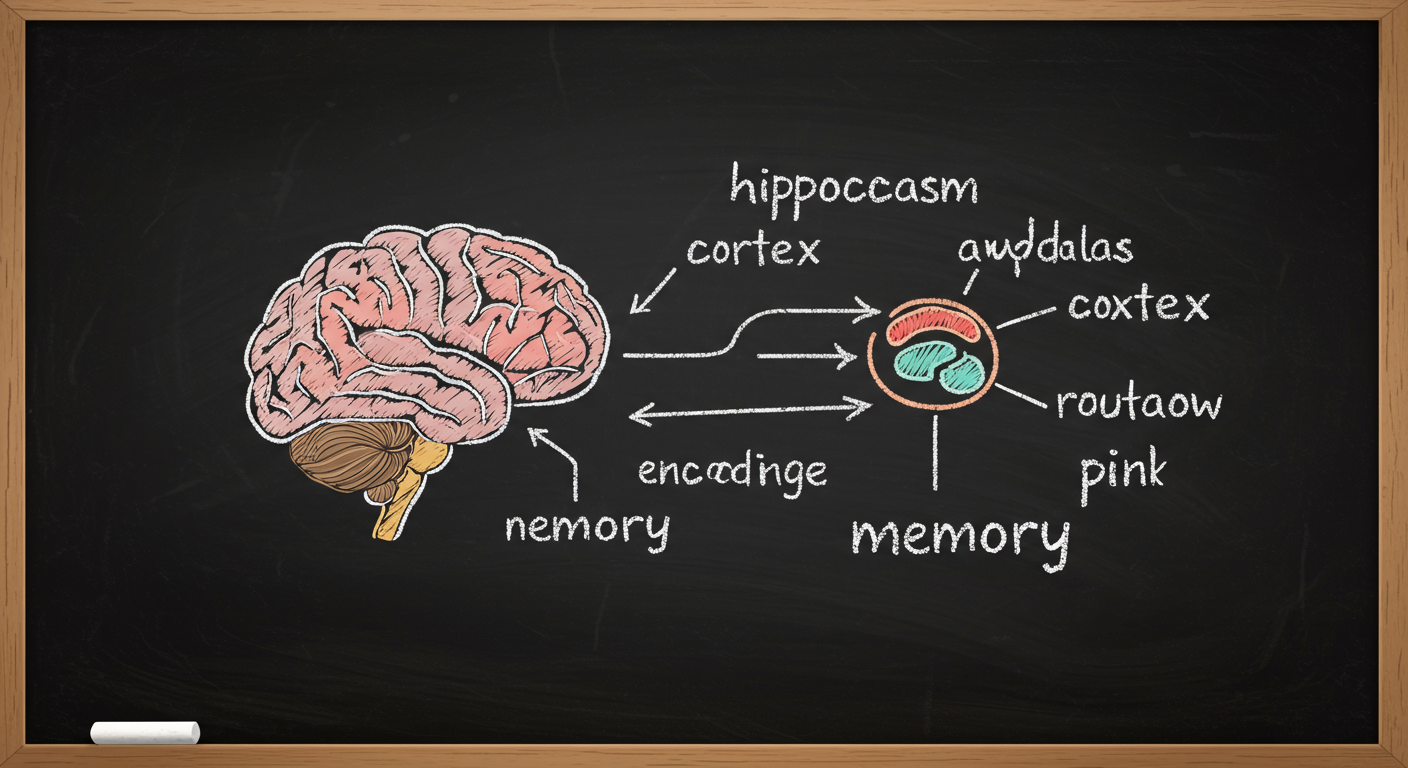
diagram
illustration
A brain diagram showing the hippocampus and amygdala connected to cortex, with arrows for encoding storage and retrieval and a highlighted emotional memory cue
note

False memory example

If someone asks, "Did you see the broken headlight?" after an accident, that question can plant an image that was never actually there. Later recall may include the suggested detail.

5. What forgetting is for

note

Why forgetting helps

Forgetting improves efficiency, reduces interference, and supports new learning.

Main causes of forgetting

  • Decay of unused traces
  • Interference from similar memories
  • Weak cues during retrieval

Takeaway

A good memory system is selective, not perfect.

diagram
chart · line
Memory strength over time
1 hour1 day1 week1 month
note

Final summary

Memory is an active biological process. The hippocampus helps bind new experiences. The cortex supports long-term knowledge. The amygdala strengthens emotional events. The basal ganglia and cerebellum support skills. And forgetting helps the brain stay useful.

Transcript

Welcome to Slate. Today we're looking at How Does Your Brain Store Memories?. We'll cover The three stages: encoding, storage, retrieval, How the hippocampus converts short-term to long-term memory, Why emotional memories are stronger (the amygdala connection), and False memories, memory decay, and why forgetting is useful. Let's get into it.

A memory is not a tiny video file hidden in your head. It is a pattern of activity and change across neurons. When you learn something, some synapses become easier to fire together. That is called synaptic plasticity. The phrase that captures this is from Donald Hebb in 1949: neurons that fire together wire together. Here is the key idea. The brain does not store a memory in one place. It stores pieces of it across networks. The sight of a dog, the sound of barking, and the feeling of fear can live in different circuits. When those circuits reactivate together, the memory comes back. Short-term memory is fragile. It lasts seconds to minutes unless you rehearse it. A classic finding by George Miller in 1956 was that working memory often holds about seven items, plus or minus two. That is why a phone number is hard to keep in mind unless you repeat it. Think of working memory like a whiteboard. It is useful because you can write on it quickly, but it gets erased easily. Long-term memory is different. It depends on lasting changes in synapses and gene expression. Some memories are declarative, like facts and events. Others are procedural, like riding a bike. Those use overlapping but not identical brain systems. The lesson starts here: memory is not storage in a drawer. It is a living pattern that the brain rebuilds each time you remember.

Encoding is the first step. It is the process of turning experience into a neural trace. If you do not encode something well, there is nothing reliable to store later. Attention matters because the brain filters aggressively. You can be in the room and still miss the event if your attention is elsewhere. That is why people often fail to notice a change in a scene unless they are focused on it. The hippocampus is central for new declarative memories, especially facts and episodes. It helps bind separate details into one event. If you remember your first day at a new school, the hippocampus helps connect the place, the people, the time, and your feelings into one episode. A good analogy is a binder clip. The hippocampus does not contain every page. It clips the pages together so the episode can be stored and later found. Encoding improves when you elaborate, compare, or test yourself. Spacing also helps. Learning in several sessions beats cramming because each return gives the brain another chance to strengthen the trace. Sleep matters too. During sleep, especially slow-wave sleep, hippocampal patterns are replayed. That replay helps move some memories toward long-term storage in the cortex. This is one reason a night's sleep after studying often beats a late-night cram session.

Storage is not a vault. It is a set of biological changes that make a pattern easier to re-create later. At the synapse, one important mechanism is long-term potentiation, often shortened to L-T-P, or Long-Term Potentiation. In many cases, repeated activity strengthens the connection between neurons. The NMDA receptor helps detect coincident activity, and calcium entry can trigger cascades that change the synapse. Some changes are fast. Others require new proteins and even structural remodeling of connections. There is a useful distinction between short-term and long-term storage. Short-term changes can last minutes to hours. Long-term changes can last days to years because the brain has physically altered the network. That does not mean a memory is fixed forever. Every retrieval can make it temporarily malleable again. This is called reconsolidation. It is one reason memories can be updated, distorted, or strengthened after you recall them. Procedural memory uses different circuits. Skills like typing or playing piano rely heavily on the basal ganglia and cerebellum. You may not be able to explain every step, but your body knows the sequence. That is why procedural memory can survive even when declarative memory is damaged. Different jobs, different circuits.

Retrieval is the act of rebuilding a memory from partial cues. The brain rarely plays back a perfect recording. It reconstructs. That is why a smell, a song, or a place can bring back a whole event. The cue activates part of the original network, and the rest fills in. Emotion changes the odds of retrieval. The amygdala helps tag events that matter for survival. When something is emotionally intense, stress hormones and amygdala activity can strengthen consolidation in some cases. That is why many people remember where they were during major public events. But stronger is not the same as more accurate. Emotion can sharpen the central details while blurring the background. False memories happen because reconstruction is vulnerable to suggestion, expectation, and later information. Elizabeth Loftus showed this clearly in classic studies on the misinformation effect. If people hear misleading details after an event, their later recall can shift. Think of memory like a witness sketch made from several partial descriptions. It can be useful, but it is not a photograph. Forgetting is not just failure. It helps the brain reduce noise, drop irrelevant details, and make room for what matters. If every experience stayed equally vivid, retrieval would become slower and less useful. A selective memory system is more adaptive than a perfect one.

Forgetting is not a defect. It is part of a healthy memory system. The brain must decide what to keep, what to weaken, and what to ignore. Some forgetting happens because synapses weaken when they are not used. Some happens because similar memories interfere with one another. If you learn two similar phone numbers, the newer one can crowd out the older one. That is interference. The brain also uses forgetting to protect flexibility. If every old association stayed equally strong, learning new information would be harder. A system that prunes connections can adapt better. This is similar to editing a document. You do not keep every draft line forever. You remove what no longer helps the final version. Memory is also shaped by context. Retrieval improves when the cue matches the original learning situation. That is why a test taken in a similar environment can feel easier. But the bigger lesson is this: memory is dynamic. It is built, stabilized, retrieved, updated, and sometimes weakened. The hippocampus, cortex, amygdala, basal ganglia, and cerebellum each contribute their part. So the short version is simple. Encoding gets experience into the system. Storage changes the system so it can last. Retrieval rebuilds the pattern when you need it. And forgetting keeps the whole system efficient enough to use.

XLinkedInWhatsApp

Keep going with Slate

Pick up where this left off in your own voice session.

Built with Slate