How Does Sign Language Work?
It is not mime, not universal, and has its own grammar. ASL, BSL, and the rich linguistics of visual language.
- Why sign languages are full natural languages with complex grammar
- ASL vs. BSL vs. other sign languages — they are not mutually intelligible
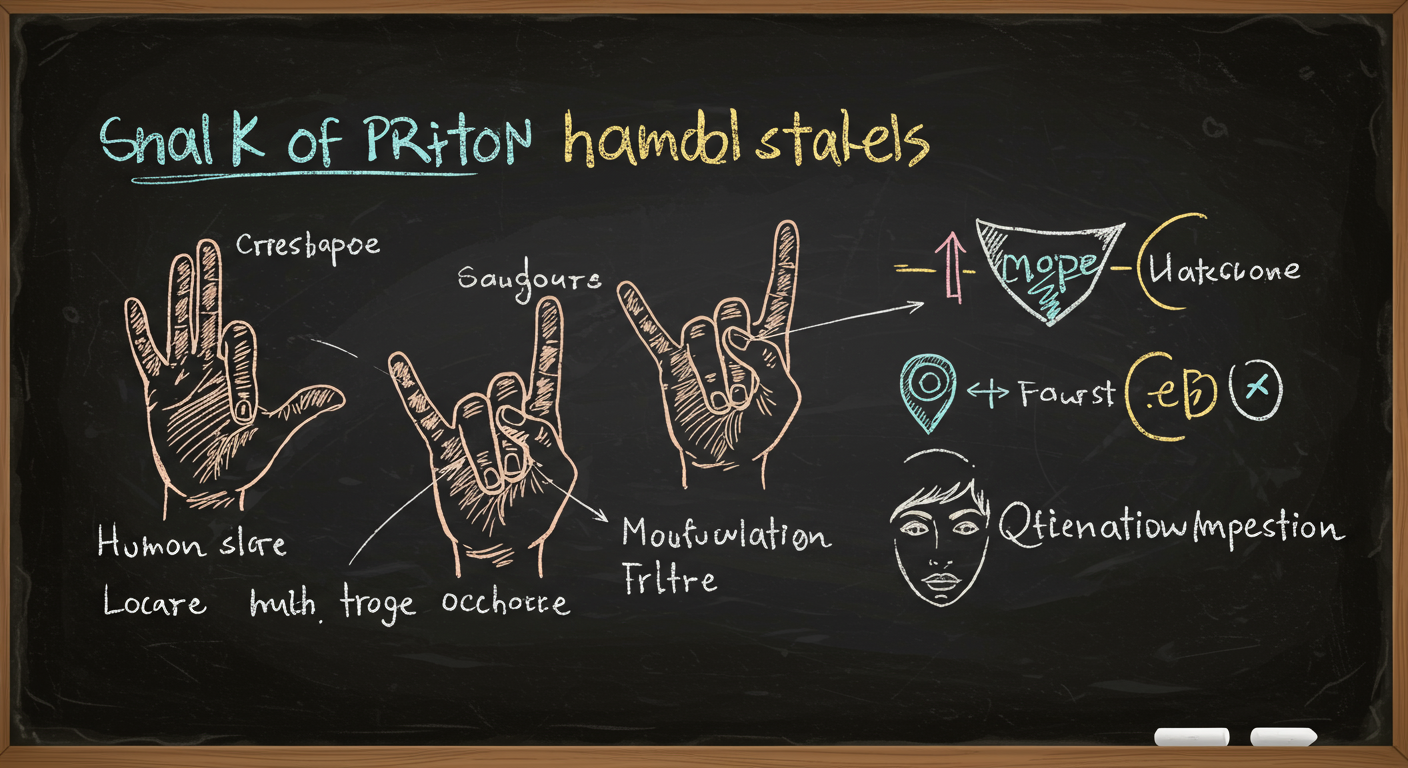
- The five parameters: handshape, movement, location, orientation, expression
- Deaf culture, cochlear implant debates, and language rights
Sign language is a full language, not mime
How Does Sign Language Work?
It is not mime, not universal, and has its own grammar. ASL, BSL, and the rich linguistics of visual language.
Sign language is a natural language
Sign languages are not pantomime, and they are not simplified speech. They are full natural languages with their own grammar.
What makes a language a language?
- A shared vocabulary
- Rules for combining signs into larger units
- Grammar for questions, negation, tense, aspect, and emphasis
- The ability to express abstract ideas, jokes, stories, and technical topics
Why mime is different
Mime tries to visually act out a specific scene. Sign language uses conventional signs that a community learns and shares.
A landmark in linguistics
- In 1960, William Stokoe published work showing that American Sign Language has a real linguistic structure.
- That finding helped establish sign language linguistics as a serious field.
Core insight
Sign languages are visual-spatial languages. They use the eyes, hands, face, and body together.
Why this is not just gesture
A gesture is often tied to a single situation. A sign can be reused across many situations because a community has agreed on its form and meaning.
Example
A person pointing at a cup is a gesture. A sign for a concept like GIVE, THINK, or MAYBE is part of a language system.
Analogy
Gesture is like a sketch made on the spot. Sign language is like a written alphabet with grammar. Both can communicate, but only one can build an entire language system.
The five parameters build every sign
The five parameters of a sign
- Handshape
- Movement
- Location
- Orientation
- Non-manual expression
Why they matter
A small change in one parameter can change meaning.
Examples of what can change
- Handshape: which fingers are extended
- Movement: straight, repeated, circular, or single motion
- Location: face, chest, neutral space, or another body area
- Orientation: palm up, down, in, or out
- Expression: eyebrows, mouth, gaze, and head movement
Linguistic takeaway
Sign languages are built from contrastive units, just like spoken languages are built from distinct sounds and word patterns.
ASL, BSL, and why sign languages are not universal
ASL vs. BSL
American Sign Language
- Used mainly in the United States and parts of Canada
- Historically linked to French Sign Language
- Has its own grammar and vocabulary
British Sign Language
- Used mainly in the United Kingdom
- Developed independently from ASL
- Not mutually intelligible with ASL
Why this surprises people
People often assume the sign language matches the spoken language of the country. It usually does not.
Real-world example
A Deaf person using ASL may need an interpreter to communicate with a Deaf person using BSL.
Not universal
There is no single universal sign language used everywhere.
Why not?
- Deaf communities developed separately in different countries
- Schools for deaf children shaped local sign languages
- Contact with spoken languages and other sign languages differed by region
Analogy
Calling all sign languages one language is like calling all spoken languages one language because they are all spoken with mouths. The modality is shared. The language is not.
Grammar in space: how sign languages build meaning
Grammar in visual space
Sign languages can use space to track people, places, and relationships.
Common grammatical tools
- Indexing and pointing to locations in space
- Directional verbs that move from one location to another
- Classifiers that represent categories of objects or people
- Non-manual markers for questions, negation, and conditionals
Why this matters
Space is not just where signs happen. Space can carry grammar.
Example idea
A signer can assign one location to one person and another location to a different person, then refer back to them efficiently.
Why translation is not word-for-word
A sign language sentence may package information differently from English.
Tradeoff
- Spoken language often relies on word order
- Sign language often relies more on space, movement, and facial markers
That is why a good interpreter translates meaning, not individual signs.
Deaf culture, language rights, and cochlear implant debates
Deaf culture and language rights
Deaf culture
- Shared identity among many Deaf signers
- Visual communication as a normal way of life
- Strong community traditions, storytelling, and humor
Cochlear implants
- Can provide access to sound for some users
- Outcomes vary widely
- Do not replace the need for early language access
The central issue
Children need a language they can fully access early in life.
Why this is a rights issue
- Education
- Family communication
- Social development
- Equal access to information and community life
A practical takeaway for families and schools
A deaf child should not have to wait for one technology to work before getting language.
Better questions to ask
- Can this child access a full language today?
- Is the language visually accessible?
- Is the child learning with fluent adult models?
- Are educational choices protecting long-term language development?
Big idea
Sign language is not a last resort. For many children, it is the clearest route to language, identity, and connection.
Keep going with Slate
Pick up where this left off in your own voice session.