How Does Multimodal AI Work?
Modern AI can see, hear, read, and reason all at once. Find out how models like GPT-4o and Gemini actually process the world.
- How multimodal models process different inputs together
- Key breakthroughs from GPT-4V to Gemini
- Applications in healthcare, creative work, and accessibility
- Where multimodal AI still struggles
What multimodal AI actually is
How Does Multimodal AI Work?
Modern AI can see, hear, read, and reason all at once. Find out how models like GPT-4o and Gemini actually process the world.
Multimodal AI definition
Multimodal AI is a model that can process and combine two or more input types, such as text, images, audio, and video.
Shared representation
The model maps different inputs into a common internal space so it can compare and combine them.
Why this matters
A text-only model can answer questions about text. A multimodal model can answer questions about a diagram, a photo, a waveform, or a spoken command.
Core terms
- Modality: one input type, such as text or image
- Embedding: a numeric representation of content
- Transformer: the neural network architecture used by many modern multimodal systems
- Alignment: making different modalities comparable inside the model
A useful mental model
Imagine a museum guide who can read captions, inspect paintings, and listen to visitors at the same time. The guide does not keep three separate opinions. They combine the clues into one explanation. Multimodal AI tries to do something similar, but with vectors instead of intuition.
How models combine sight and language
The pipeline from pixels to tokens
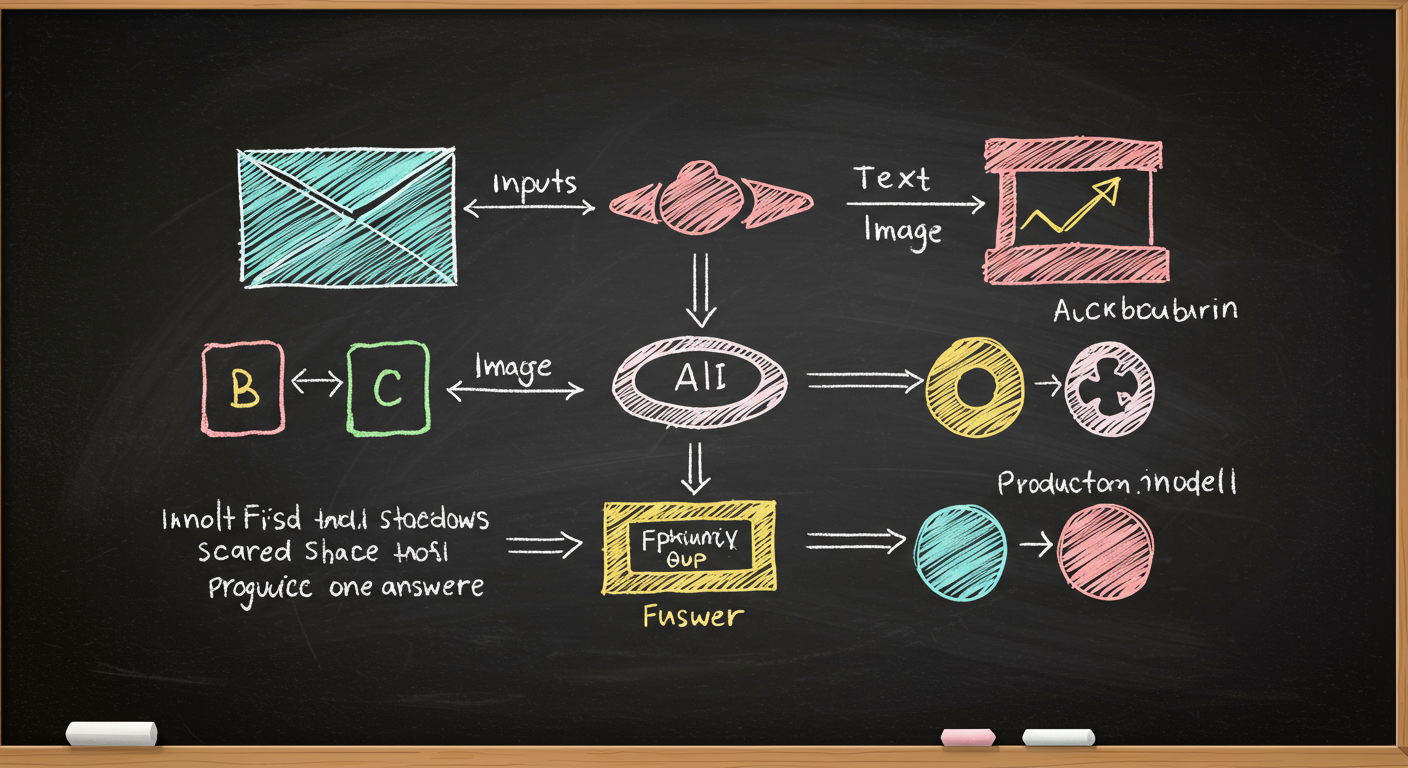
- An encoder turns the raw input into embeddings.
- A connector maps those embeddings into the language model’s space.
- A transformer attends across the combined sequence.
- The decoder produces the response.
Why connectors matter
Connectors reduce the mismatch between modalities. Without them, the model would be trying to mix apples, music, and paragraphs directly.
Real examples
- GPT-4V: OpenAI’s image-capable GPT-4 system, introduced in 2023
- GPT-4o: OpenAI’s multimodal model announced on May 13, 2024
- Gemini 1.0: Google’s natively multimodal model introduced in December 2023
Why this is better than two separate models
Separate models can pass information back and forth, but they often lose detail. A joint model can keep more of the original context alive during reasoning. That matters when the answer depends on exact spatial relationships, chart values, or the sequence of spoken instructions.
# Tiny toy example: combine text and image features
import numpy as np

text_features = np.array([0.2, 0.7, 0.1])
image_features = np.array([0.6, 0.1, 0.3])

# Simple fusion by concatenation
joint = np.concatenate([text_features, image_features])
print(joint)

# A real model would learn a much richer fusion function.Why GPT-4o and Gemini felt different
GPT-4V, GPT-4o, and Gemini
GPT-4V showed that a large language model could answer image questions well.
GPT-4o, announced in May 2024, moved toward real-time multimodal interaction across text, vision, and audio.
Gemini 1.0, announced in December 2023, was described by Google as natively multimodal, meaning the model was designed to handle multiple input types from the start.
The real advance
The advance was not only accuracy. It was latency, synchronization, and better handling of mixed evidence.
What changed in practice
A live assistant can now look at a screen, hear a question, and answer before the user loses the thread. That feels small. It is not. In interactive systems, 300 milliseconds often feels more responsive than 1 second, and 2 seconds can feel sluggish. Lower latency changes the user experience.
Where multimodal AI helps in the real world
High-value applications
Healthcare
- Radiology support
- Clinical note summarization
- Triage assistance
Accessibility
- Image descriptions for blind users
- Screen reading and scene description
- Sign and document interpretation
Creative work
- Design critique
- Asset search across image and video libraries
- Copy generation grounded in visuals
Why these use cases work
They all combine signals that humans already combine naturally.
One concrete accessibility example
A scene-description tool can help a blind traveler find a door, read a sign, and understand whether the path is blocked. The model is not replacing orientation and mobility training. It is extending what the user can perceive in the moment.
Where multimodal AI still fails
Common failure modes
- OCR errors on small or distorted text
- Spatial confusion, such as left versus right
- Hallucinated details in images or video
- Weak performance on rare medical or technical cases
- Sensitivity to noisy audio and background clutter
Why failures happen
The model predicts likely answers from learned patterns. It does not directly inspect the world the way a sensor fusion system in a robot might.
Evaluation is hard
A model can sound right and still be wrong. That is why multimodal benchmarks need exact answers, bounding boxes, transcript checks, and human review. Good demos are not the same as good reliability.
Keep going with Slate
Pick up where this left off in your own voice session.