1. What democracy actually means
0:006:38
Humanities

How Does Democracy Actually Work?

Electoral systems, separation of powers, checks and balances — the mechanics of the system most people never learned in school.

Apr 22, 20267 min listen5 chapters
What you'll learn
  • Direct vs. representative democracy and why we chose the latter
  • First-past-the-post vs. proportional representation vs. ranked choice
  • Separation of powers and why it matters for preventing tyranny
  • How democracies decline: democratic backsliding in the 21st century

1. What democracy actually means

note

How Does Democracy Actually Work?

Electoral systems, separation of powers, checks and balances — the mechanics of the system most people never learned in school.

note

Democracy: the core idea

Democracy is a system in which political power comes from the people.

Two main forms

  • Direct democracy: citizens vote on laws themselves
  • Representative democracy: citizens elect officials to make laws

Why most countries chose representation

  • National governments handle too many decisions for constant public voting
  • Representatives can specialize in policy and negotiation
  • Elections create accountability without requiring everyone to govern full time

The central tradeoff

Democracy needs majority rule, but it also needs limits on majority power.

diagram
note

Direct democracy vs representative democracy

Direct democracy works best when the question is narrow and the group is small. Representative democracy works better when the issues are many, technical, and continuous.

A city referendum on a park renovation is one thing. Running a country of 50 million people that way would be like asking an entire orchestra to decide every note in real time.

note

Why constitutions matter

A constitution is the rulebook for power. It can protect speech, voting rights, due process, and fair elections even when a temporary majority wants otherwise.

That is the difference between rule by majority and liberal democracy: liberal democracy adds rights and limits to majority rule.

2. How votes turn into power

note

Three common electoral systems

First-past-the-post

The candidate with the most votes wins the district.

Proportional representation

Seats are allocated roughly in proportion to vote share.

Ranked choice voting

Voters rank candidates. Lowest candidates are eliminated until someone has majority support.

Why the system matters

Electoral rules shape party systems, campaign strategy, and whether voters feel their ballots count.

chart · bar
Votes vs seats in different systems
Party A votesParty B votesParty C votesSeats under FPTPSeats under PR
diagram
note

Real-world effects

First-past-the-post often pushes politics toward two big parties. The United Kingdom and the United States are the classic examples.

Proportional representation is common in Germany, Sweden, and the Netherlands. It usually produces multiparty coalitions.

Ranked choice is used in places including Australia for the House of Representatives and in some U.S. cities and states. It is designed to make winners acceptable to more voters, not just plurality winners.

3. Why power is split on purpose

diagram
note

Separation of powers

Power is divided so that no single institution controls lawmaking, enforcement, and judgment at the same time.

Checks and balances

Each branch has tools to limit the others:

  • Vetoes
  • Judicial review
  • Budget control
  • Confirmation hearings
  • Investigations and impeachment

Why this matters

The goal is not efficiency alone. It is preventing tyranny, corruption, and permanent rule by one faction.
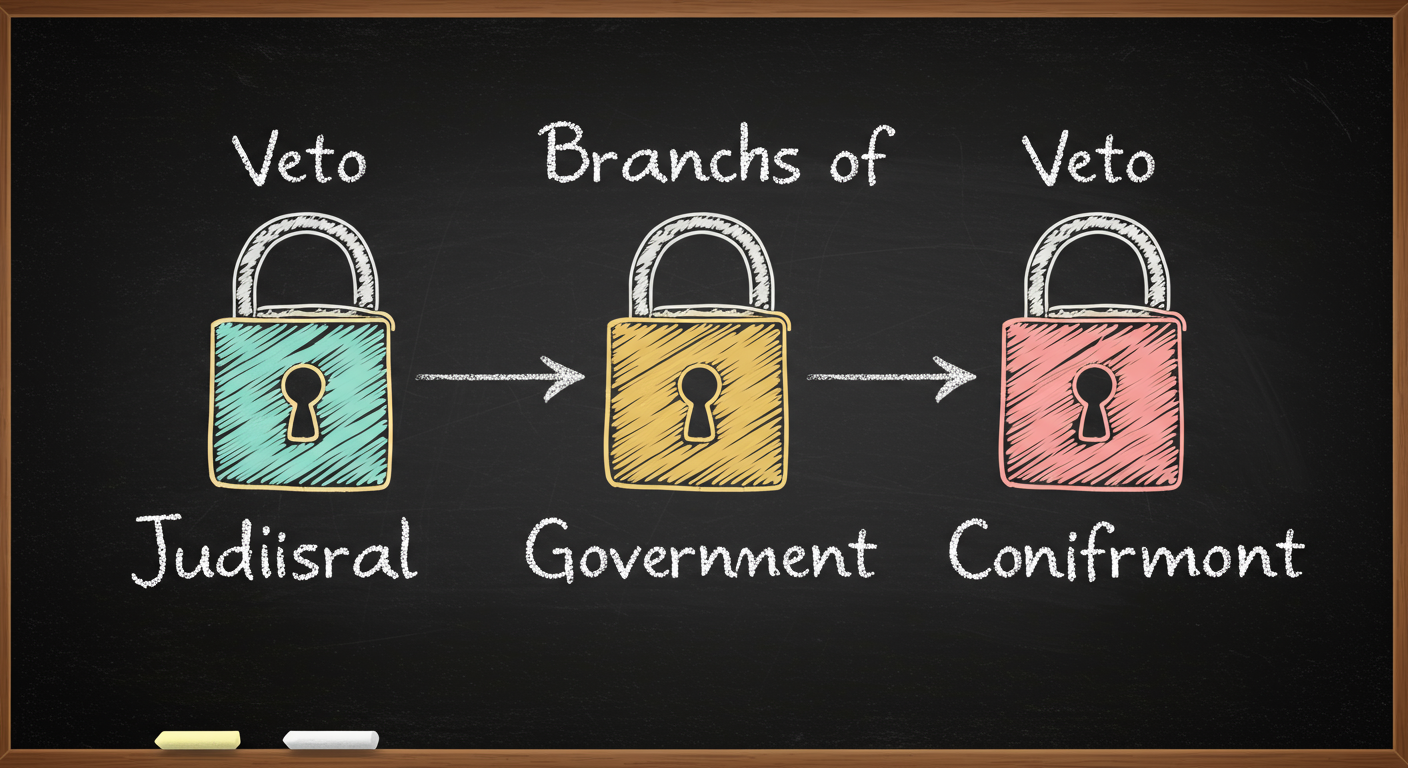
illustration
three branches of government shown as connected locks on a door with arrows showing veto judicial review and confirmation
note

The U.S. model is not the only model

Parliamentary systems usually fuse the executive and legislature more tightly. The prime minister comes from the parliamentary majority. That can make lawmaking faster, but it also means one election can give one party broad control.

Presidential systems, like the United States, separate the executive and legislature more sharply. That can protect against concentration of power, but it can also create deadlock.

4. How democracies weaken

note

Democratic backsliding

Democratic backsliding is the slow weakening of democratic institutions from within.

Common warning signs

  • Attacks on judges and courts
  • Pressure on journalists and media outlets
  • Manipulation of election rules
  • Harassment of opposition parties
  • Politicizing civil service and election administration

Why it is hard to spot

Backsliding often uses legal procedures, so it can look legitimate while eroding competition and accountability.

chart · line
Autocratization cases in the 21st century
200020052010201520202024
diagram
note

Why free elections are not enough

A country can hold elections and still be undemocratic if voters cannot access independent information, if courts cannot enforce rights, or if opposition parties cannot compete on equal terms.

Democracy survives when the losers of today can realistically become the winners of tomorrow.

5. How the pieces fit together

diagram
note

The three questions to ask about any democracy

  1. Who can vote and run?
  2. How do votes become seats or offices?
  3. What institutions can stop abuse of power?

What healthy democracy requires

  • Free and fair elections
  • Independent courts
  • Free press
  • Real opposition
  • Peaceful transfer of power
equation
Democratic legitimacy=free elections+equal competition+institutional limits \text{Democratic legitimacy} = \text{free elections} + \text{equal competition} + \text{institutional limits}
note

Quick comparison

  • Direct democracy: highest citizen control, hardest to scale
  • Representative democracy: practical for large states, depends on accountability
  • First-past-the-post: simple, often distorts seat totals
  • Proportional representation: fairer seat share, often coalition government
  • Ranked choice: reduces spoiler effects, encourages broader appeal

Transcript

Welcome to Slate. Today we're looking at How Does Democracy Actually Work?. We'll cover Direct vs. representative democracy and why we chose the latter, First-past-the-post vs. proportional representation vs. ranked choice, Separation of powers and why it matters for preventing tyranny, and How democracies decline: democratic backsliding in the 21st century. Let's get into it.

Democracy means rule by the people, but that phrase hides a big design choice. If every citizen votes on every law, that is direct democracy. Ancient Athens used a version of that, though only free adult men counted. Modern countries mostly use representative democracy instead. We elect people to make decisions for us because national governments handle too many laws, too much data, and too many tradeoffs for everyone to vote on every week. Think of it like choosing a pilot instead of asking every passenger to grab the controls. The passengers still set the destination through elections, but the pilot handles the flight. The key promise is accountability. Representatives can be removed at the next election. They are supposed to reflect voters, but also to study issues, negotiate, and make compromises. That is why constitutions matter. They limit what any majority can do in the moment. A majority vote can be fair in an election and dangerous in policy if it strips rights from a minority. Here’s the basic tension. Democracy needs popular control. It also needs rules that keep power from concentrating. Most modern systems try to balance both at once.

Elections are not all the same. The voting rule changes who gets power, which changes how parties behave. In first-past-the-post, the candidate with the most votes wins, even without a majority. In a district with 100,000 voters, someone can win with 38,000 votes if the other votes split among rivals. That system is simple, but it often exaggerates winners and punishes smaller parties. Proportional representation works differently. If a party wins 30 percent of the vote, it should get about 30 percent of the seats. That sounds more mathematical because it is. It usually gives smaller parties a fairer chance and makes legislatures look more like the electorate. But it can produce coalition governments, which means parties must bargain after the election. Ranked choice voting asks voters to rank candidates. If no one gets a majority, the last-place candidate is eliminated and those ballots move to their next choice. It reduces the spoiler problem. Here’s the pattern on the board: first-past-the-post rewards the largest pile, proportional representation mirrors the vote, and ranked choice tries to find a broader winner. Each system changes strategy, not just results.

If one person or one party controls everything, elections stop being a real check on power. That is why many democracies divide authority among branches. The legislature writes laws. The executive carries them out. The judiciary interprets them and resolves disputes. This is separation of powers. A useful analogy is a three-lock door. One lock alone is easy to open. Three different locks, held by different people, are much harder to force. That is the point: no branch should be able to act alone on every major decision. Checks and balances are the tools each branch has to restrain the others. A president can veto a bill. A legislature can override a veto with enough votes. Courts can strike down laws that violate the constitution. Legislatures approve budgets and can investigate executives. The executive appoints officials, but often needs legislative confirmation. This does not make government slow by accident. It makes it harder to abuse power. The tradeoff is real: democracies can become gridlocked. But gridlock is often safer than speed when the alternative is arbitrary rule. The system is designed to force bargaining, evidence, and public scrutiny before power moves too far.

Democratic backsliding usually does not begin with tanks in the street. It begins with legal-looking moves. Leaders attack judges, weaken election administrators, pressure the press, and rewrite rules so opponents cannot win fairly. The danger is gradual. Each step can look small on its own. The V-Dem Institute, based at the University of Gothenburg, has tracked a rise in autocratization in recent years. Its 2024 report said 42 countries were undergoing autocratization, affecting about 2.8 billion people. That is not a collapse of democracy everywhere, but it is a serious warning. Backsliding often follows the same script. First, a leader claims only they can fix the country. Then they discredit independent institutions. Then they tilt the electoral field. Finally, elections remain, but the competition is no longer fair. That is why free elections are necessary but not sufficient. Democracy needs independent courts, a free press, opposition rights, and rules that leaders cannot rewrite whenever they feel threatened. Here’s the pattern to notice: a democracy can keep the vote and still lose the substance of self-government.

Now put the system together. Democracy starts with citizens choosing rulers, but it does not end there. Electoral rules decide how votes become seats. Separation of powers decides how those winners are constrained. Checks and balances decide whether any branch can dominate the rest. And democratic institutions decide whether losing today still leaves a real chance tomorrow. If you want one sentence for the whole lesson, use this: democracy is not just voting, it is organized disagreement under rules. That is why the details matter so much. A small change in district lines, court power, election administration, or media freedom can change whether citizens really control government. The healthiest democracies do three things at once. They let people choose leaders. They make those leaders answerable. And they stop any one group from turning a temporary win into permanent control. That balance is messy. It is also the reason democracy can survive conflict without becoming dictatorship. When you hear someone say a country is democratic, ask three questions. Who gets to vote? How are votes translated into power? And who can stop the winners from overreaching? Those three questions reveal how the system actually works.

XLinkedInWhatsApp

Keep going with Slate

Pick up where this left off in your own voice session.

Built with Slate