How Does Coffee Affect Your Brain?
Adenosine blocking, cortisol interaction, and the half-life problem — the neuroscience of the world's most popular drug.
- How caffeine blocks adenosine receptors to prevent sleepiness
- The cortisol interaction: why timing your coffee matters
- Caffeine's 5-hour half-life and why afternoon coffee ruins sleep
- Tolerance, withdrawal, and the optimal caffeine strategy
1. Caffeine and adenosine: why coffee makes you feel awake
How Does Coffee Affect Your Brain?
Adenosine blocking, cortisol interaction, and the half-life problem — the neuroscience of the world's most popular drug.
Caffeine blocks adenosine receptors
Adenosine is a neuromodulator that builds up during wakefulness and promotes sleep pressure. Caffeine is a competitive antagonist at adenosine receptors, especially A1 and A2A receptors. It does not create energy. It reduces the brain's sense of fatigue.
What that means in practice
- More wakefulness, not more sleep removed
- Better reaction time and vigilance
- Less subjective sleepiness
- A possible rebound crash when caffeine wears off
Real-world dose examples
- Brewed coffee: about 95 mg caffeine per 8 oz cup
- Espresso: about 63 mg per 1 oz shot
- Black tea: about 47 mg per 8 oz cup
- Cola: about 35 mg per 12 oz can
Why this feels like energy
A good analogy is a smoke alarm with the battery removed. The alarm is still there, but the warning signal cannot get through. Caffeine does something similar to the adenosine signal. It does not fix the tired brain. It hides the message for a while.
Important edge case
If you are severely sleep deprived, caffeine can sharpen attention, but it cannot restore normal performance. A person who slept 4 hours still performs worse than a well-rested person, even after coffee.
2. Cortisol and timing: why morning coffee is not the same as afternoon coffee
Cortisol interaction and coffee timing
Cortisol is not the same as stress. It is a normal hormone that helps regulate wakefulness, glucose, and blood pressure. In many adults, the cortisol awakening response peaks 30 to 45 minutes after waking.
Practical takeaway
- Early morning coffee may feel weaker because natural cortisol is already high
- Waiting 60 to 120 minutes after waking often improves the perceived effect
- Late-day caffeine can feel stronger, but it also carries more sleep risk
Why timing changes the experience
Think of caffeine like turning up a radio. If the room is already loud, the change is less obvious. If the room is quiet, the same twist on the knob feels dramatic.
A useful rule
If coffee makes you jittery, anxious, or nauseated first thing in the morning, the dose may be too high for your current hormonal state. Smaller doses, around 50 to 100 mg, often work better than a large mug.
3. The half-life problem: why afternoon coffee can wreck sleep
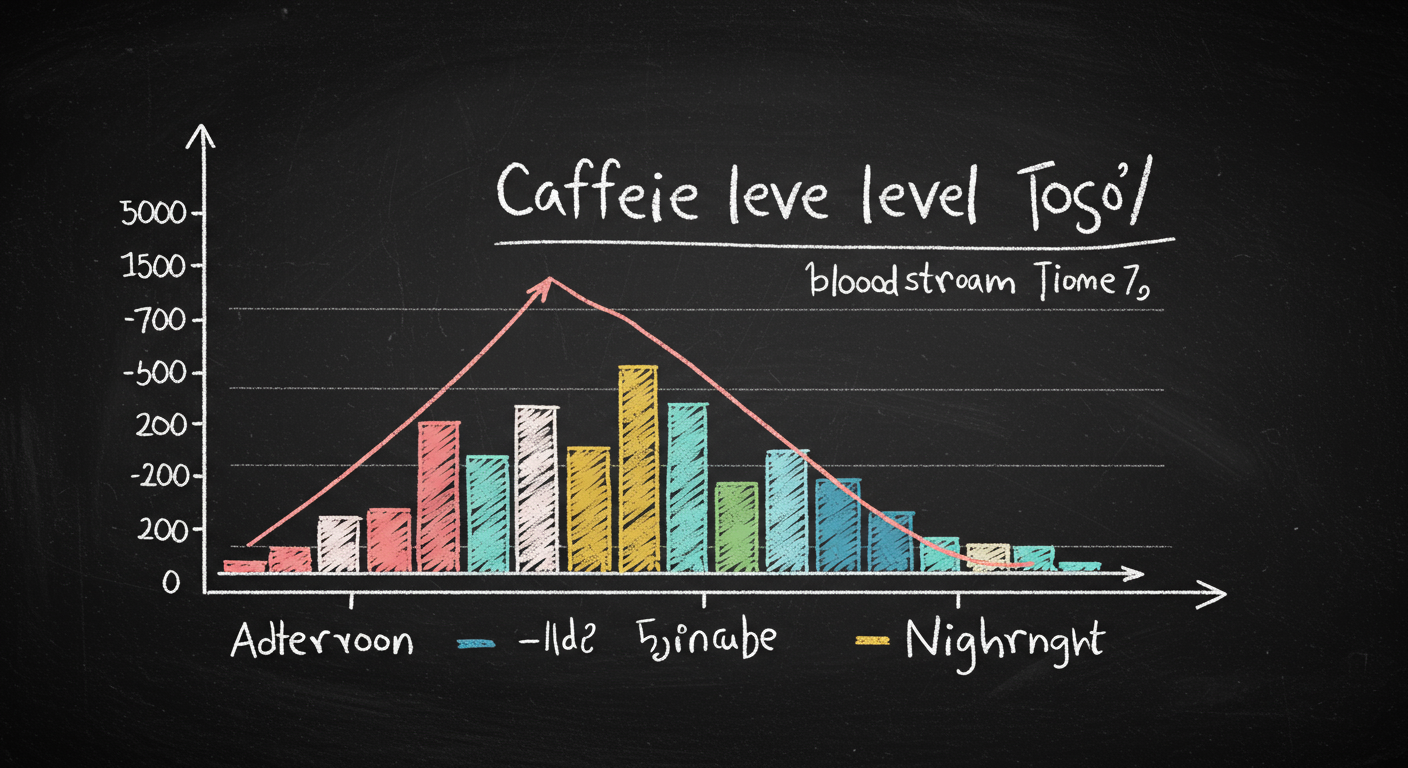
Caffeine half-life and sleep
Average caffeine half-life in healthy adults: about 5 hours.
That means the body clears caffeine slowly. A late dose can still be active at bedtime.
Why this matters
- Delayed sleep onset
- Shorter total sleep time
- Reduced sleep quality in sensitive people
- Greater impact in slow metabolizers and during pregnancy
The sleep cutoff rule
A practical cutoff is 8 to 10 hours before bedtime.
Examples
- Bedtime 10 p.m. --> last caffeine by noon to 2 p.m.
- Bedtime 11 p.m. --> last caffeine by 1 p.m. to 3 p.m.
- Bedtime 1 a.m. --> last caffeine by 3 p.m. to 5 p.m.
This is not perfect for every person, but it is a strong starting point.
4. Tolerance and withdrawal: why coffee stops feeling magical
Tolerance and withdrawal
Repeated caffeine use produces tolerance to some effects. The brain adapts to regular adenosine blockade.
Withdrawal timeline
- Starts: 12 to 24 hours after stopping
- Peaks: about 20 to 51 hours
- Often resolves: within 2 to 7 days
Common withdrawal symptoms
- Headache
- Fatigue
- Irritability
- Low mood
- Difficulty concentrating
Why the cycle happens
A useful analogy is a thermostat that keeps being fooled. If the room keeps getting artificially warmed, the system adjusts. Remove the heat source, and the room feels colder than before.
Important distinction
Tolerance is strongest for the subjective buzz and some performance effects. It is less complete for all effects. Caffeine can still affect sleep, heart rate, and anxiety even in regular users.
5. The optimal caffeine strategy: get the benefits without paying for them at night
A practical caffeine strategy
Good starting points for many adults
- Dose: 50 to 200 mg per serving
- Daily total: often under 400 mg
- Timing: morning to early afternoon
- Cutoff: 8 to 10 hours before bedtime
Use caffeine for
- High-focus work
- Long drives
- Early training sessions
- Short-term alertness boosts
Avoid caffeine as
- A substitute for sleep
- An all-day sipping habit
- A late-afternoon rescue when sleep matters tonight
Bottom line
Coffee works because it blocks adenosine, not because it creates energy. Morning timing matters because cortisol is already high after waking. Afternoon coffee lingers because caffeine clears slowly. Daily use builds tolerance, and sudden stopping can trigger withdrawal.
The best strategy is simple: use less than you think, use it earlier than you think, and protect sleep as the main event.
Keep going with Slate
Pick up where this left off in your own voice session.