What 3D printing actually is
0:006:47
Engineering

How Does 3D Printing Work?

Layer by layer — from plastic toys to titanium jet parts to human organs. The technology reshaping manufacturing.

Apr 22, 20267 min listen5 chapters
What you'll learn
  • FDM, SLA, SLS: the main 3D printing technologies compared
  • From CAD file to physical object: the full workflow
  • Materials: plastics, metals, ceramics, and bioprinting
  • Real applications: aerospace, medicine, construction, and prosthetics

What 3D printing actually is

note

How Does 3D Printing Work?

Layer by layer — from plastic toys to titanium jet parts to human organs. The technology reshaping manufacturing.

note

Additive manufacturing: the core idea

3D printing is a family of manufacturing methods that create parts by adding material in layers.

Why engineers use it

  • Complex internal channels are possible
  • Custom parts are easy to change
  • Small batches are economical
  • Prototypes can be made fast

The main tradeoff

  • More design freedom than subtractive manufacturing
  • Usually slower per part than molding for high volumes
  • Surface finish and mechanical strength depend on the process
diagram
equation
Number of layers=part heightlayer height\text{Number of layers} = \frac{\text{part height}}{\text{layer height}}
note

A simple comparison with traditional manufacturing

Think of subtractive manufacturing like sculpting from marble. 3D printing is more like building with stacked sheets of dough. One removes material. The other adds it.

That difference matters when the shape has internal lattices, deep channels, or one-off geometry. A fuel nozzle, a medical implant, or a custom bracket may be much easier to print than to machine.

The three main printing technologies

diagram
note

FDM, SLA, and SLS compared

ProcessMaterial formBest strengthBest detailTypical uses
FDMMelted filamentMediumLow to mediumPrototypes, fixtures, hobby parts
SLALiquid resinMediumVery highDental models, miniatures, molds
SLSPowderHighMediumFunctional nylon parts, aerospace prototypes

Why the differences matter

FDM parts are often anisotropic, meaning they are weaker between layers than within a layer. SLA can capture tiny features, but many resins are more brittle than engineering thermoplastics. SLS parts are usually more isotropic than FDM parts because the powder bed supports the build more evenly.

chart · bar
Typical feature size by process
FDMSLASLS
note

A useful rule of thumb

If you want cheap and fast, start with FDM.

If you want fine detail, choose SLA.

If you want durable nylon parts with complex shapes, choose SLS.

From file to finished part

diagram
note

Slicing decisions that change the result

  • Orientation changes strength and surface quality
  • Layer height changes detail and build time
  • Supports prevent overhang collapse
  • Infill affects weight, cost, and stiffness
  • Wall thickness often matters more than infill for strength

Real example

A 100 millimeter tall part printed at 0.2 millimeter layers needs about 500 layers. At 0.1 millimeter layers, it needs about 1,000 layers. The second print can look smoother, but it usually takes longer because the printer must place twice as many layers.

equation
Infill percentagestrengthsolid strength\text{Infill percentage} \neq \frac{\text{strength}}{\text{solid strength}}
note

Common failure points

  • Warping from uneven cooling
  • Layer separation from poor temperature control
  • Resin parts remaining sticky without full post-cure
  • Support scars on visible surfaces
  • Dimensional drift if the machine is not calibrated

Materials: plastics, metals, ceramics, and living tissue

note

Materials used in 3D printing

Plastics

  • PLA for easy prototyping
  • ABS for tougher consumer parts
  • PETG for a balance of strength and printability
  • Nylon for functional mechanical parts

Metals

  • Titanium alloys for aerospace and implants
  • Stainless steel for tooling and durable parts
  • Inconel for high-temperature environments

Ceramics

  • Dental crowns and restorations
  • Heat-resistant components

Bioprinting materials

  • Living cells
  • Hydrogels
  • Bioinks that support cell growth
chart · pie
Common material families
PlasticsMetalsCeramicsBioprinting
diagram
note

Why metal printing is hard

Metal powder can be dangerous if mishandled. The process also creates residual stress because one tiny region cools while the next one is still hot. That is why engineers often combine printing with post-build heat treatment and inspection.

Where 3D printing is already changing real work
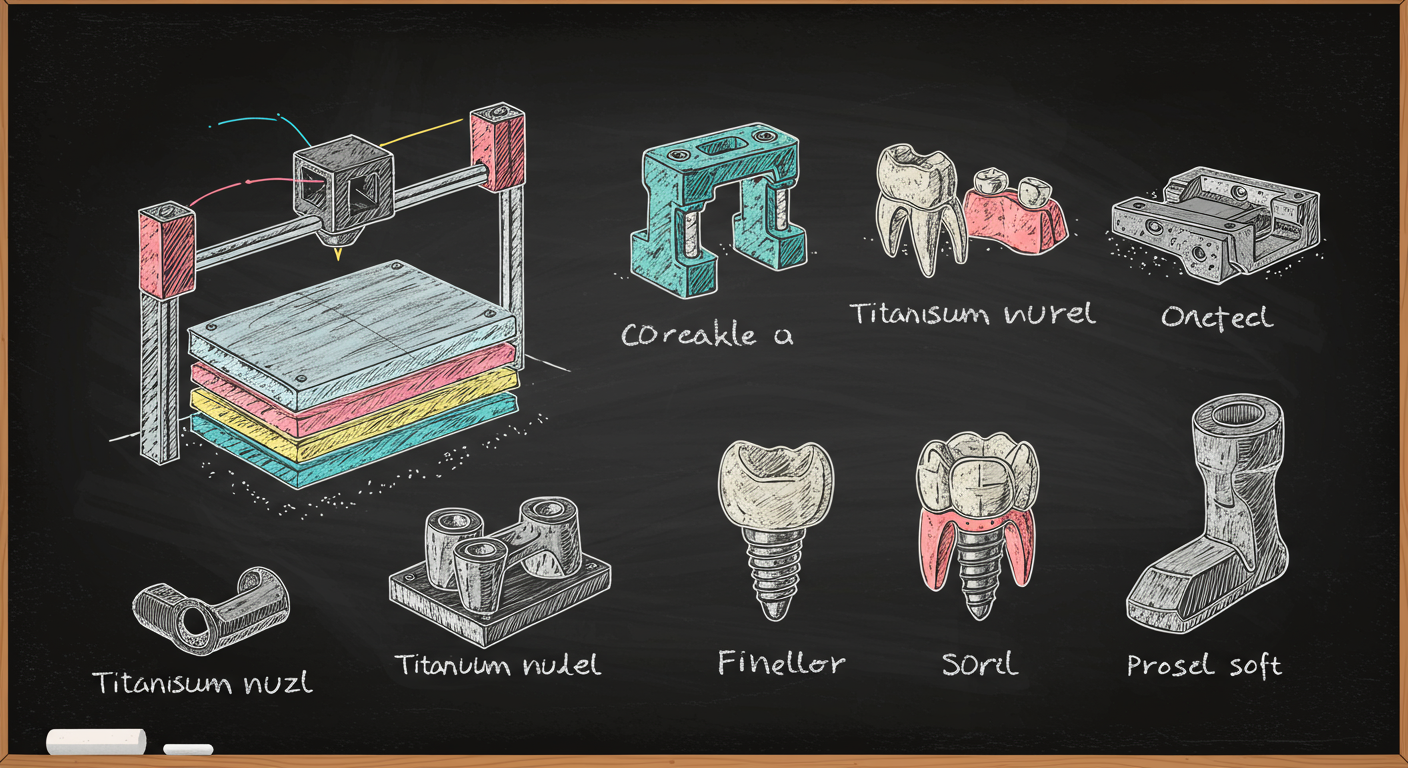
illustration
A cross section view of a 3D printer making layers beside finished parts including a plastic toy, a titanium aerospace nozzle, a dental implant model, and a prosthetic socket
diagram
note

Real applications and why they work

FieldWhat gets printedWhy printing helps
AerospaceFuel nozzles, brackets, ductsWeight reduction and complex geometry
MedicineDental models, implants, guidesPatient-specific fit
ConstructionWalls, forms, structural elementsLarge-scale fabrication
ProstheticsSockets, hands, bracesCustom anatomy and lower cost

The engineering principle

3D printing wins when the shape is the challenge. If the part needs internal channels, lattice structures, or one-off fit, additive manufacturing can beat traditional methods.

note

What to remember

3D printing is not one process. It is a family of processes.

The machine, the material, and the post-processing steps all shape the final part.

That is why the same digital model can become a toy, a jet-engine component, or a medical device, depending on how it is made.

Transcript

Welcome to Slate. Today we're looking at How Does 3D Printing Work?. We'll cover FDM, SLA, SLS: the main 3D printing technologies compared, From CAD file to physical object: the full workflow, Materials: plastics, metals, ceramics, and bioprinting, and Real applications: aerospace, medicine, construction, and prosthetics. Let's get into it.

3D printing builds objects by adding material, one thin layer at a time. That is why engineers call it additive manufacturing. The key idea is simple: instead of carving a shape out of a block, the machine stacks the shape upward, like making a sculpture with a very precise glue gun or a tiny laser cutter, depending on the process. In the first diagram, notice the shared workflow. A digital model becomes machine instructions. The printer makes the part. Then the part is cleaned and finished. The digital model usually starts in computer-aided design, or C-A-D, software. Engineers export it as an S-T-L or 3-M-F file. Those files describe the object as a mesh of triangles or as richer geometry with color and material data. Slicing software then cuts the model into many horizontal layers. A part that is 100 millimeters tall might be split into 200 layers at 0.5 millimeters each, or into 500 layers at 0.2 millimeters each. Thinner layers usually improve surface quality, but they take longer. This is the big tradeoff in 3D printing. You gain geometric freedom. You lose some speed and often some surface finish compared with injection molding or machining. That is why 3D printing is strongest when the design is complex, customized, or low volume.

The three most common processes are fused deposition modeling, stereolithography, and selective laser sintering. Here is the pattern. F-D-M melts plastic. S-L-A cures liquid resin with light. S-L-S fuses powder with a laser. The names sound technical, but each one answers the same question in a different way: how do we turn a digital layer into a solid layer? F-D-M is the desktop workhorse. A heated nozzle pushes out thermoplastic filament such as polylactic acid, or P-L-A, and acrylonitrile butadiene styrene, or A-B-S. The nozzle can be 0.2 to 0.8 millimeters wide, and common layer heights are 0.1 to 0.3 millimeters. It is affordable and easy to use, but visible layer lines are normal. S-L-A uses a laser or projected light to cure liquid photopolymer resin. It can produce very fine detail and smooth surfaces, which is why dentists and jewelers use it. S-L-S spreads a thin bed of powder, often nylon, and a laser fuses only the cross-section that should become solid. The surrounding powder supports the part, so complex shapes are possible without support structures. That makes S-L-S especially useful for strong functional parts.

The workflow is where many beginners lose precision. A good print starts before the printer ever moves. First, the CAD model must be watertight. That means no holes in the surface mesh, no flipped normals, and no self-intersections. If the model has errors, the slicer may generate broken toolpaths or missing walls. Next comes orientation. This is not cosmetic. It changes strength, support use, and print time. A bracket printed standing up may be weaker at the layer lines than the same bracket printed flat. A tall, thin part may wobble if printed too quickly. Then the slicer chooses layer height, infill, wall thickness, support structures, and speed. A 20 percent infill does not mean the part is 20 percent as strong. It only means 20 percent of the interior volume is filled with a chosen pattern. After printing, many parts need post-processing. FDM parts may need support removal and sanding. SLA parts need washing in isopropyl alcohol and ultraviolet post-curing. Metal parts often need heat treatment and machining. This last step matters because 3D printing often makes the near-final shape, not the final certified part.

Material choice decides what a printed part can survive. Plastics are still the most common because they are easy to process and relatively cheap. PLA prints cleanly and is popular for prototypes. ABS tolerates more heat but can warp. PETG sits between them in toughness and ease of printing. Nylon is strong and wear resistant, so it is common in functional parts. Metals are a different world. In powder-bed fusion, a laser or electron beam melts metal powder layer by layer. Titanium alloys, especially Ti-6Al-4V, are used in aircraft and medical implants because they combine high strength with low weight and good corrosion resistance. Nickel superalloys such as Inconel 718 handle high temperatures in jet engines. Metal printing often requires hot isostatic pressing, heat treatment, and machining to reach final properties. Ceramics can withstand heat and wear, which makes them useful in dental restorations and high-temperature components. Bioprinting goes further. It uses cells, hydrogels, and growth factors to print tissue-like structures. Researchers have printed skin, cartilage, and vascular scaffolds, but fully functional organs are still a research problem because living tissue needs blood supply, mechanical support, and precise cell organization.

The strongest use cases are not novelty objects. They are parts that benefit from complexity, customization, or low-volume production. In aerospace, GE Aviation certified the LEAP fuel nozzle after moving from many assembled pieces to one printed part. The famous nozzle is produced by additive manufacturing and is much lighter and more durable than the older assembled design. In medicine, 3D printing is used for dental aligners, surgical guides, hearing aids, and patient-specific implants. A CT scan can become a custom model that helps surgeons plan an operation. In construction, large printers can extrude concrete-like material to form walls or structural elements. The advantage is speed and reduced labor for certain shapes, though reinforcement and code compliance remain major challenges. Prosthetics are another strong fit. A socket or limb component can be customized to a person’s anatomy at lower cost than traditional custom fabrication. The future is not one printer that does everything. It is a toolbox. FDM for quick prototypes. SLA for detail. SLS for durable nylon. Metal printing for high-performance parts. Bioprinting for research. The right process depends on the job, just like choosing a wrench, a mill, or a microscope.

XLinkedInWhatsApp

Keep going with Slate

Pick up where this left off in your own voice session.

Built with Slate