1. The immune system learns by rehearsal
0:007:05
Science

How Do Vaccines Train Your Immune System?

mRNA, live-attenuated, viral vector — how vaccines teach your body to fight diseases it has never seen.

Apr 22, 20267 min listen5 chapters
What you'll learn
  • The core principle: showing the immune system a harmless preview
  • mRNA vaccines vs. traditional approaches — how they differ
  • Herd immunity and why vaccination rates matter
  • How vaccine development was accelerated (and what that means for safety)

1. The immune system learns by rehearsal

note

How Do Vaccines Train Your Immune System?

mRNA, live-attenuated, viral vector — how vaccines teach your body to fight diseases it has never seen.

note

Vaccine immunology in one sentence

A vaccine exposes the immune system to an antigen so it can build immune memory without causing the disease itself.

Core terms

Antigen: a molecule the immune system can recognize, often a protein from a virus or bacterium.

Antibody: a Y-shaped protein made by B cells that binds a matching antigen.

Memory B cell: a long-lived B cell that helps the body respond faster next time.

Memory T cell: a long-lived T cell that helps coordinate or kill infected cells on re-exposure.

Why memory matters

The first immune response is slower because the body has to identify the target, activate the right cells, and expand them. The second response is faster because the body has already done that selection work.

diagram
note

A useful analogy

Think of immune training like fire drills in a school. The alarm is real enough to trigger practice, but nobody wants an actual fire. A vaccine is the drill. The disease is the real emergency.

What vaccines are trying to avoid

Natural infection can train immunity too, but it does so by risking fever, inflammation, organ damage, or death. Vaccination aims to teach the same lesson with far less danger.

chart · line
Immune response over time
First exposureDay 3Day 7Day 14Second exposure

2. mRNA, live-attenuated, and viral vector vaccines

note

Three major vaccine platforms

mRNA vaccines deliver genetic instructions for a single antigen.

Live-attenuated vaccines use a weakened form of the pathogen.

Viral vector vaccines use another virus to deliver antigen instructions.

Real examples

mRNA: Pfizer-BioNTech BNT162b2 and Moderna mRNA-1273.

Live-attenuated: measles, mumps, and rubella; varicella; yellow fever.

Viral vector: Oxford-AstraZeneca ChAdOx1 nCoV-19; Johnson and Johnson Ad26.COV2.S.

Why platform choice matters

Live-attenuated vaccines can mimic infection very well, but they are not ideal for every patient.

mRNA vaccines can be designed quickly once the genetic sequence is known.

Viral vectors are useful, but prior immunity to the vector can sometimes reduce how well they work.

diagram
python
vaccine_types = {
    "mRNA": "Instructions to make one antigen",
    "Live-attenuated": "Weakened whole pathogen",
    "Viral vector": "Harmless carrier virus delivers gene"
}

for name, mechanism in vaccine_types.items():
    print(f"{name}: {mechanism}")
note

The big difference in one line

mRNA vaccines teach by sending a recipe.

Live-attenuated vaccines teach by sending a weakened actor.

Viral vector vaccines teach by sending the recipe inside a delivery truck.

Safety logic

None of these vaccines is supposed to cause the disease they prevent. Their job is to present enough of a target to train immunity, but not enough to let the full pathogen run wild.

3. Herd immunity and why coverage matters

note

Herd immunity

Herd immunity happens when enough people are immune that a pathogen has trouble finding new hosts.

Why this is not just about individual choice

Infants too young for some vaccines, people with certain cancers, transplant recipients, and others with immune suppression may depend on high community coverage for protection.

Measles as the classic example

Measles spreads so efficiently that public health agencies often use about 95 percent two-dose coverage as a practical target.

Important nuance

Herd immunity is not a magic shield. It depends on the disease, the vaccine, and where immunity is clustered.

diagram
chart · bar
Illustrative coverage and risk
95% coverage90% coverage85% coverage80% coverage
note

A simple example

If a disease can spread very easily, each infected person creates many more opportunities for the next case. Vaccination reduces the number of people who can catch it, so the chain runs out of fuel.

The public health lesson

Vaccines are personal protection and community protection at the same time.

4. How vaccine development got faster without becoming careless

note

Why COVID-19 vaccines moved quickly

Researchers already knew the coronavirus spike protein was a strong target.

The SARS-CoV-2 genome was shared on 10 January 2020.

mRNA design can begin as soon as the sequence is known.

Manufacturing and trials overlapped to save time.

What did not get skipped

Preclinical testing.

Phase 1, phase 2, and phase 3 trials.

Regulatory review.

Post-authorization safety monitoring.

Real trial sizes

Pfizer-BioNTech: about 43,000 participants.

Moderna: about 30,000 participants.

diagram
note

Safety is a process, not a slogan

A faster timeline can still be rigorous if the steps overlap instead of disappear.

What safety monitoring looks for

Rare side effects that are too uncommon to detect in a trial.

Patterns that appear only after millions of doses.

Differences by age, sex, or medical history.

Why rare events still matter

A trial of 30,000 people can detect common side effects, but not every event that occurs once in a million doses. That is why surveillance continues after rollout.

chart · line
Development timeline in 2020
Jan 10 genome sharedMarch trials beginJuly phase 3 ongoingDec first authorizations

5. What vaccines can and cannot do

note

What vaccines do well

Reduce the chance of infection.

Reduce the chance of severe disease.

Reduce hospitalization and death.

What vaccines cannot promise

Perfect protection for every person.

Permanent high antibody levels without boosters.

The same performance in every pathogen or every age group.

Why boosters exist

Immune memory can fade.

Pathogens can evolve.

A booster can raise antibody levels and improve protection again.
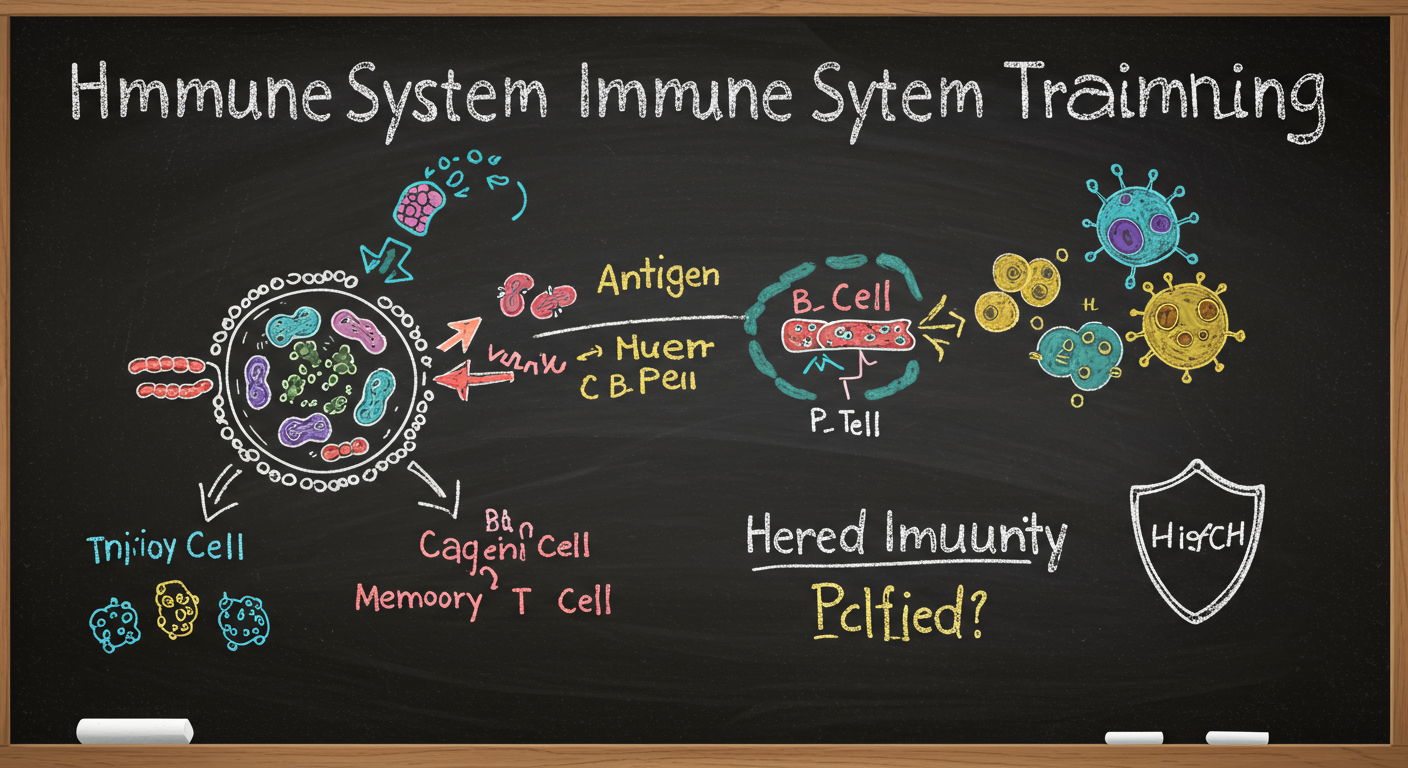
diagram
illustration
An immune system training scene with a vaccine particle entering a cell, antigen presentation to B cells and T cells, memory cells forming, and a community shield showing herd immunity
note

The takeaway

Vaccines teach the immune system with a harmless preview.

mRNA, live-attenuated, and viral vector vaccines use different teaching methods.

High vaccination coverage protects vulnerable people by slowing spread.

Fast vaccine development can still be safe when science, trials, regulation, and monitoring all stay in place.

Transcript

Welcome to Slate. Today we're looking at How Do Vaccines Train Your Immune System?. We'll cover The core principle: showing the immune system a harmless preview, mRNA vaccines vs. traditional approaches — how they differ, Herd immunity and why vaccination rates matter, and How vaccine development was accelerated (and what that means for safety). Let's get into it.

Your immune system does not wait for a real invasion to start learning. A vaccine gives it a safe rehearsal. The body sees a harmless version of a germ, or a single piece of it, and starts building memory. That memory comes from B cells and T cells. B cells can make antibodies. T cells help coordinate the response and destroy infected cells. The idea is simple: show the immune system a wanted poster before the criminal arrives. Then, when the real pathogen shows up, the body reacts much faster. Here is the key distinction. A vaccine does not usually make you immune overnight. It gives your immune system time to train. After that training, memory cells can stick around for months, years, and sometimes much longer. That is why a second exposure often leads to a faster, stronger response than the first. The visual on the canvas shows this sequence. First, the vaccine enters. Then antigen-presenting cells pick up the material and display it. Then B cells and T cells activate. Then memory cells remain behind. That memory is the whole point. Without it, your immune system is like a security team seeing a burglar for the first time at 2 a.m. With it, the team has already studied the face, the route, and the pattern.

Different vaccines teach the immune system in different ways. The goal is the same. The method is not. Messenger Ribonucleic Acid, or mRNA, vaccines give your cells instructions to make one harmless viral protein, often the spike protein from SARS-CoV-2. Your cells read the message, make the protein briefly, and then break down the mRNA. The immune system sees the protein and learns from it. The Pfizer-BioNTech and Moderna COVID-19 vaccines use this approach. Live-attenuated vaccines use a weakened version of the germ itself. The measles, mumps, and rubella vaccine, often called M-M-R, is a classic example. Because the germ can still replicate a little, these vaccines often produce strong, broad immunity. But they are not used in every situation, especially for people with severely weakened immune systems. Viral vector vaccines use a different harmless virus as a delivery vehicle. The vector carries genetic instructions for one antigen from the target pathogen. The Oxford-AstraZeneca and Johnson and Johnson COVID-19 vaccines used this strategy. The vector is like a delivery truck. It is not the package. It just brings the package to the right address. Each platform has tradeoffs in speed, storage, immune strength, and suitability for different populations.

Vaccination protects more than one person at a time. When enough people are immune, chains of transmission have a harder time moving through a community. That is herd immunity, also called community immunity. The exact threshold depends on how contagious the disease is. Measles is one of the most contagious human viruses known. Its basic reproduction number, or R-naught, is often estimated between 12 and 18. That means one infected person can, on average, infect 12 to 18 others in a fully susceptible population. For a disease that contagious, the vaccination rate has to be very high to block spread. In practice, measles often requires around 95 percent coverage with two doses to maintain strong population protection. This is why small drops in coverage matter. A community is not protected by averages alone. Protection depends on how immunity is distributed. If many unvaccinated people live in the same area, outbreaks can ignite there even when the overall national rate looks decent. The visual here shows the pattern. When coverage is high, transmission chains break. When coverage falls, the chain keeps going. Think of it like closing doors in a hallway. If enough doors are shut, the fire cannot move far. If too many are open, it spreads room to room.

The speed of COVID-19 vaccine development surprised many people, but the process did not begin from zero. Scientists had already studied coronaviruses for years. The genetic sequence of SARS-CoV-2 was published on 10 January 2020. That let researchers design vaccine candidates quickly. Speed came from several places. mRNA platforms could be built from a digital sequence. Large trials could run while manufacturing started at risk. Regulators reviewed data continuously instead of waiting for the end. And funding removed many of the usual financial delays. Fast development does not mean shortcuts on safety. Tens of thousands of volunteers still enrolled in phase 3 trials. For example, the Pfizer-BioNTech trial included about 43,000 participants, and the Moderna trial about 30,000. Those studies still had to show efficacy and track side effects. After authorization, safety monitoring continued through systems such as the Vaccine Adverse Event Reporting System in the United States and similar monitoring systems elsewhere. The analogy is a race car built in a better garage, not a car built without brakes. The engineering was faster because the tools were ready, the data were ready, and the funding was ready. The safety checks still mattered.

A vaccine is a training tool, not a force field. It lowers risk. It does not guarantee zero infections, zero symptoms, or zero transmission. That is why scientists talk about effectiveness, not perfection. Some vaccines prevent infection very well. Others are especially good at preventing severe disease, hospitalization, or death. Those are not small wins. During the first year of COVID-19 vaccination in the United States, studies estimated that vaccines prevented hundreds of thousands of deaths and millions of hospitalizations. That is the scale at which immunization works. Immunity can also change over time. Antibody levels may fall, and new variants can partly dodge prior immunity. That is why boosters are sometimes recommended. A booster is like a refresher course. It reminds the immune system of the target and can sharpen the response again. The final visual ties everything together. The vaccine gives the preview. The immune system builds memory. High coverage protects the community. Faster development can still be safe when testing and monitoring stay in place. That is the real story of vaccines: not magic, but careful biological training with measurable public health impact.

XLinkedInWhatsApp

Keep going with Slate

Pick up where this left off in your own voice session.

Built with Slate