Orbit is controlled falling
0:006:53
Engineering

How Do Satellites Stay in Orbit?

They are constantly falling and missing the ground. Orbital mechanics, gravity, and the physics of not falling down.

Apr 22, 20267 min listen5 chapters
What you'll learn
  • Why orbiting is really just falling and missing the ground
  • LEO, MEO, GEO: different altitudes for different purposes
  • How satellites are launched, positioned, and maintained
  • Space debris: the growing problem of orbital junk

Orbit is controlled falling

note

How Do Satellites Stay in Orbit?

They are constantly falling and missing the ground. Orbital mechanics, gravity, and the physics of not falling down.

note

Orbit means falling without hitting the ground

A satellite stays up because its forward speed matches Earth’s curve.

Key idea

Gravity pulls inward all the time. The satellite keeps moving sideways fast enough that the surface falls away beneath it.

A useful number

A typical low Earth orbit speed is about 7.8 km/s, which is roughly 28,000 km/h.

Why this matters

If speed drops too much, the orbit decays and the satellite reenters.

diagram
equation
v=GMrv = \sqrt{\frac{GM}{r}}
note

What the equation says

Orbital speed depends on Earth’s mass, the gravitational constant, and distance from Earth’s center.

The larger the orbit radius r, the lower the circular speed needed. That is why geostationary satellites move much more slowly than satellites in low Earth orbit.

LEO, MEO, and GEO

note

Orbit classes and what they are good for

Low Earth Orbit, LEO

160 to 2,000 km. Good for imaging, crewed missions, and low-latency communications.

Medium Earth Orbit, MEO

About 2,000 to 35,786 km. Good for navigation and timing.

Geostationary Orbit, GEO

35,786 km above the equator. Good for weather monitoring and broadcast coverage.

The tradeoff

Closer means stronger detail and lower delay. Farther means wider coverage and fewer satellites.

chart · bar
Typical orbit altitudes
LEO 400 kmMEO 20200 kmGEO 35786 km
diagram
note

Why GEO looks stationary

A GEO satellite orbits in the same direction and at the same angular rate as Earth rotates. That is why it hangs over one longitude instead of drifting across the sky.

How satellites get to orbit

note

Launch is about building horizontal speed

The rocket first fights drag and gravity. Then it turns sideways to create orbit velocity.

Transfer orbit

Many satellites are released into an intermediate orbit and use onboard propulsion to reach their final altitude.

Station keeping

Tiny burns keep satellites in their assigned orbital slot.

diagram
python
import math

mu = 3.986004418e14  # Earth's gravitational parameter, m^3/s^2
r = 6_371_000 + 400_000
v = math.sqrt(mu / r)
print(round(v, 1), 'm/s')
note

Worked example

At about 400 km altitude, the circular orbital speed comes out near 7,670 m/s. That is close to 7.8 km/s, the standard low Earth orbit figure.

Why rockets stage

Dropping empty tanks makes the vehicle lighter, so the remaining engines can accelerate the payload more efficiently.

Keeping satellites alive in orbit

note

Orbital maintenance

Satellites need periodic corrections because real space is messy.

Main disturbances

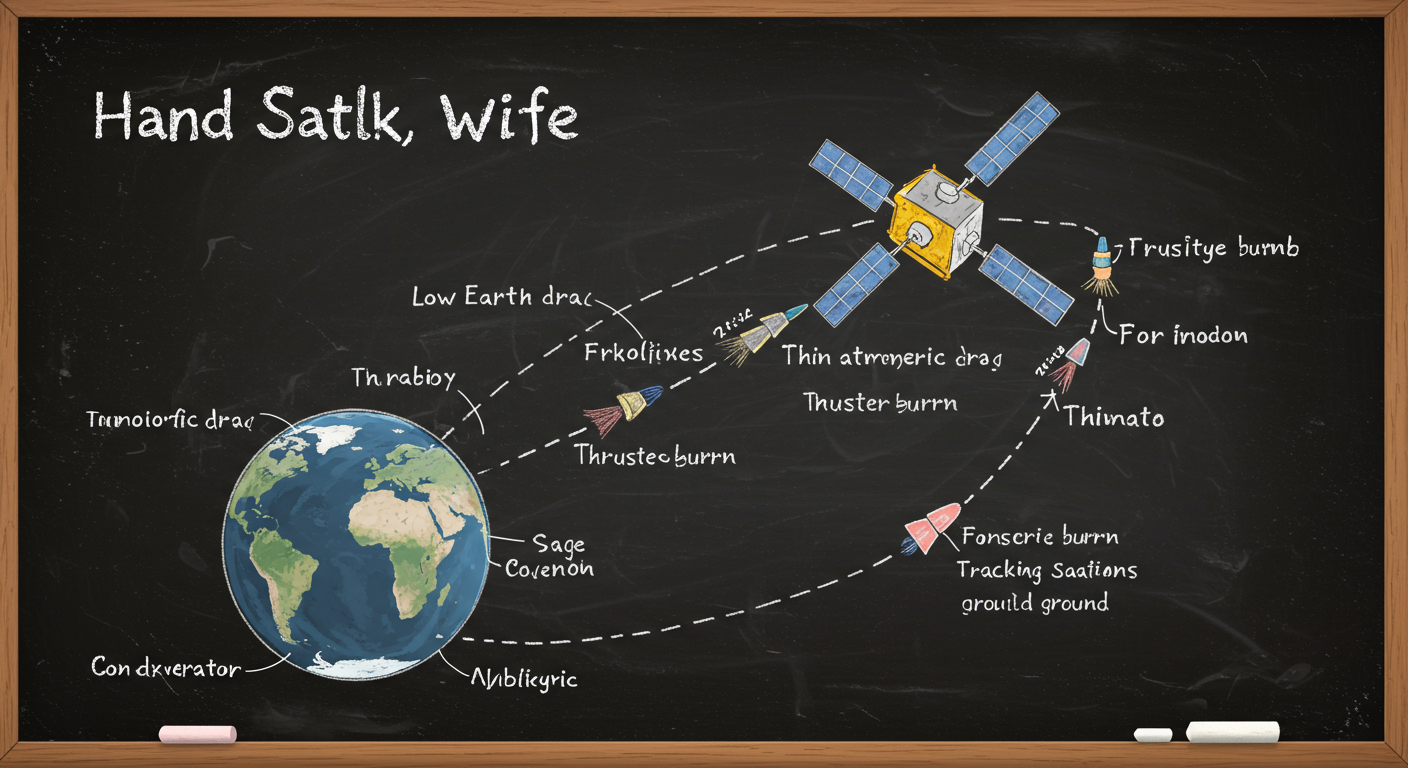
Atmospheric drag in low Earth orbit, solar radiation pressure, lunar and solar gravity, and Earth’s nonuniform gravity field.

Real example

The International Space Station, at roughly 420 km altitude, regularly needs reboosts to stay in orbit.
illustration
A satellite in low Earth orbit with Earth below, thin atmospheric drag, small thruster burns, tracking stations on the ground, and labeled forces acting on the orbit
diagram
note

Why fuel matters

Every correction uses propellant. When fuel runs out, a satellite may drift, fail to keep its slot, or be moved to a disposal orbit.

Space debris and orbital cleanup

note

Space debris is orbital junk with high energy

Even tiny fragments can destroy spacecraft because relative speeds are so high.

Real collision data

The 2009 Iridium 33 and Cosmos 2251 collision produced thousands of trackable fragments.

Kessler syndrome

A collision cascade where debris creates more debris, raising the risk of future collisions.

chart · line
Debris risk grows with collisions
1 collision2 collisions3 collisions4 collisions5 collisions
diagram
note

How engineers reduce debris

Controlled reentry in low Earth orbit.

Graveyard orbits for geostationary satellites.

Passivation to remove leftover stored energy.

Designing for fewer breakups and easier disposal.

Transcript

Welcome to Slate. Today we're looking at How Do Satellites Stay in Orbit?. We'll cover Why orbiting is really just falling and missing the ground, LEO, MEO, GEO: different altitudes for different purposes, How satellites are launched, positioned, and maintained, and Space debris: the growing problem of orbital junk. Let's get into it.

Picture a ball thrown sideways from a mountain. Throw it faster, and it lands farther away. Throw it fast enough, and Earth curves away beneath it as the ball falls. That is orbit. A satellite is always falling toward Earth, but it keeps missing because it has enough sideways speed. The diagram shows this balance as gravity pulling inward while motion carries the craft forward. Isaac Newton described this idea in the 1680s. His cannonball thought experiment is still the cleanest way to see it. A low Earth orbit satellite moves about 7.8 kilometers per second. At that speed, it circles Earth in about 90 minutes. Gravity at 400 kilometers up is still strong, about 90 percent of the surface value, so orbit is not a place with weak gravity. It is a place where the satellite is moving fast enough that falling becomes a loop. Think of a car on a track banked just right. The track keeps it from sliding inward. In orbit, gravity is the track. If the speed is too low, the satellite drops. If the speed is too high, it escapes. The exact path depends on altitude, speed, and direction, which is why orbital mechanics is really the art of balancing motion and gravity.

Different missions need different orbital neighborhoods. Low Earth orbit, or L-E-O, sits roughly from 160 to 2,000 kilometers above Earth. It is close, so communication delay is small and images are sharp. The International Space Station orbits at about 420 kilometers. Earth observation satellites, many internet constellations, and crewed missions use this region. Medium Earth orbit, or M-E-O, is farther out, around 2,000 to 35,786 kilometers. The best-known residents are navigation satellites like G-P-S, which orbit at about 20,200 kilometers. They trade a little more delay for broad coverage and stable timing. Geostationary orbit, or G-E-O, sits at 35,786 kilometers above the equator. There a satellite circles Earth once every sidereal day, 23 hours, 56 minutes, and 4 seconds, so it appears fixed over one point on the ground. That is why weather satellites and many television relays live there. Here’s the key tradeoff: lower orbits give faster links and finer detail, but they move quickly across the sky and need constellations. Higher orbits cover more ground with fewer satellites, but signals take longer to travel. The map-like diagram makes this easy to compare.

A rocket does not fly a satellite to orbit the way a plane flies to another city. It builds speed in stages. First, it climbs through the thick lower atmosphere, where drag is intense. Then it pitches over to build horizontal velocity. That sideways speed is the real prize. A satellite in low Earth orbit needs about 7.8 km/s of orbital speed, and the rocket must also overcome gravity losses and air drag. The launch vehicle usually leaves the satellite in a transfer orbit, not the final one. From there, the satellite uses its own propulsion to circularize, raise altitude, or change plane. The diagram shows the sequence: launch, staging, coast, burn, and insertion. A common example is a geostationary satellite. Rockets often place it into a highly elliptical transfer orbit. The satellite then fires an apogee motor or electric thrusters near the high point to raise the low point and settle into GEO. This is like climbing a hill in steps rather than trying to jump straight to the top. Once in orbit, satellites do not stay perfectly placed on their own. Small nudges called station-keeping burns correct drift caused by lunar gravity, solar pressure, and Earth’s uneven gravity field. Without those corrections, a GEO satellite would slowly wander.

A satellite’s job is never finished after launch. It must survive temperature swings, radiation, and the slow drag of the upper atmosphere. In low Earth orbit, the atmosphere is thin but not zero. At around 400 kilometers, drag is enough to pull the International Space Station downward, so it needs regular reboosts. The station loses altitude over time and must be pushed back up by visiting spacecraft or its own propulsion system. In even lower orbits, satellites can reenter naturally in weeks to years if they are not raised. Higher up, drag is tiny, so other forces matter more. Sunlight exerts pressure, and the Moon and Sun tug on the orbit. Earth’s gravity is not perfectly round either; it bulges at the equator, which shifts orbital paths. The visual here helps show that “stable” does not mean “unchanging.” Engineers track position with radar, optical telescopes, and onboard GPS receivers. They plan maneuvers to avoid collisions and to keep antennas, solar panels, and sensors pointed correctly. A satellite is a machine in a very precise dance. It needs fuel, software, and constant navigation to keep the steps clean.

Every satellite, rocket stage, paint chip, and fragment of metal can become debris. In orbit, even a small object is dangerous because impact speed is enormous. Two objects meeting head-on in low Earth orbit can strike at about 10 kilometers per second or more. At that speed, a one-centimeter fragment can disable a spacecraft. The debris population grew quickly after decades of launches, explosions, and collisions. The 2009 collision between the active Iridium 33 satellite and the defunct Russian satellite Cosmos 2251 showed how one crash can create thousands of fragments. The 2007 Chinese anti-satellite test added many more. Here’s the problem: more debris raises the chance of more collisions, and more collisions create more debris. That loop is called the Kessler syndrome, named after NASA scientist Donald J. Kessler, who described it in 1978. Engineers reduce the risk with passivation, which removes leftover energy from tanks and batteries, with controlled reentry for low-orbit satellites, and with graveyard orbits for GEO spacecraft. The final diagram shows the chain clearly: launch, operations, failure, fragments, and future collision risk. Keeping orbit usable is now part of satellite design, not an afterthought.

XLinkedInWhatsApp

Keep going with Slate

Pick up where this left off in your own voice session.

Built with Slate