How Do Black Holes Actually Work?
Event horizons, spaghettification, Hawking radiation — what we know (and don't know) about the strangest objects in space.
- How a black hole forms from a dying star
- What the event horizon is and why nothing escapes it
- Spaghettification, time dilation, and what falling in would feel like
- Hawking radiation and the information paradox
1. From dying star to black hole
How Do Black Holes Actually Work?
Event horizons, spaghettification, Hawking radiation — what we know (and don't know) about the strangest objects in space.
How a black hole forms
A black hole is what can happen when a very massive star runs out of fuel and its core collapses.
The sequence
- A star spends most of its life fusing hydrogen into helium.
- Later stages fuse heavier elements, building an iron core.
- Iron fusion does not release energy, so the inward pull is no longer balanced.
- The core collapses.
- If the remnant core is heavy enough, no known pressure can stop the collapse.
The mass threshold
- A neutron star can usually support itself up to about 2 to 3 solar masses.
- Above that range, collapse can continue toward a black hole.
Real examples
- Cygnus X-1 is one of the best-known stellar black hole candidates, with a mass of about 21 solar masses.
- The first gravitational-wave detection, GW150914, announced in 2016, came from two black holes of about 36 and 29 solar masses merging.
Why this matters
A black hole is not a cosmic vacuum cleaner. It forms only when enough mass is packed into a small enough region. Distance still matters. Far away, the gravity of a black hole can behave like the gravity of any object with the same mass.
2. The event horizon and the point of no return
Event horizon: the boundary of no return
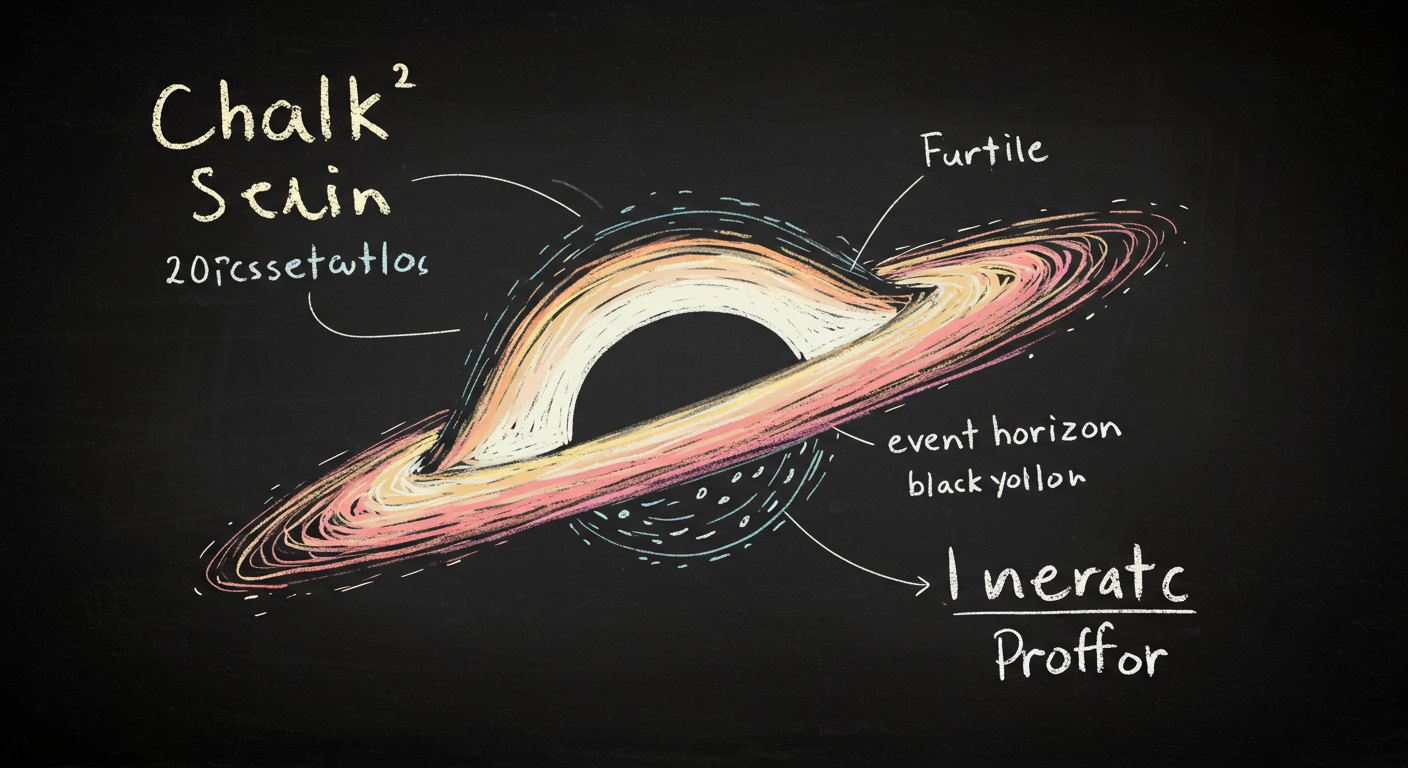
The event horizon is the surface where escape becomes impossible, even for light.
Key properties
- It is not a physical wall.
- Nothing special has to happen locally at the horizon for a large black hole.
- For a distant observer, infalling clocks appear to slow down.
- For the falling observer, crossing the horizon can feel ordinary if the black hole is large enough.
Schwarzschild radius
For a non-rotating black hole:
r_s = 2GM / c^2
That is the radius of the event horizon.
Concrete numbers
- Sun mass black hole: about 3 kilometers
- Earth mass black hole: about 9 millimeters
Why the horizon matters
The horizon is not where gravity becomes infinite. The real singularity, in the classical theory, is deeper inside. The horizon is where the escape route disappears.
3. Spaghettification, tidal forces, and time dilation
Spaghettification and time dilation
Spaghettification
This is tidal stretching. Gravity pulls harder on the near side of an object than the far side.
Why the effect changes with black hole mass
- Smaller black holes have stronger tidal forces near the horizon.
- Larger black holes have gentler tides at the horizon, but the forces still grow deeper inside.
Time dilation
Clocks closer to a black hole run slower relative to clocks far away.
Example
Sagittarius A*, the black hole at the center of the Milky Way, has a mass of about 4 million Suns. Its horizon is large enough that crossing it would not necessarily feel dramatic at the instant of crossing.
Analogy
Tidal forces are like a team holding a long rope. If one end is pulled much harder than the other, the rope stretches. A body near a black hole is that rope.
4. Hawking radiation and evaporation
Hawking radiation
In 1974, Stephen Hawking showed that black holes should emit thermal radiation.
The consequence
- Black holes can lose mass over time.
- Very large black holes lose mass extremely slowly.
- Small black holes would evaporate much faster.
Real temperature example
A one-solar-mass black hole has a Hawking temperature of about 60 nanokelvin. That is much colder than the 2.725 kelvin cosmic microwave background.
Why we have not seen it directly
For astrophysical black holes, the radiation is far too weak to detect with current instruments.
Analogy
Hawking radiation is like a faint leak in a sealed tank. The leak is real, but for a huge tank it is so tiny that you need extraordinary patience to notice it.
5. The information paradox and what we still do not know
The black hole information paradox
The problem
- Quantum mechanics says information should not be destroyed.
- Hawking radiation looks thermal, which seems to erase detail.
- If a black hole evaporates completely, the original information appears to vanish.
The Bekenstein-Hawking result
Black hole entropy is proportional to horizon area:
S = k_B A / (4 l_P^2)
This suggests the horizon stores far more information than its size would naively imply.
Main ideas researchers study
- Holography
- Black hole complementarity
- Quantum gravity
- Entanglement-based explanations
Bottom line
We have strong evidence for black hole behavior from relativity and astronomy. We do not yet have a full, tested answer for how information survives evaporation.
What we know and what remains open
Well supported
- Black holes form from massive stellar collapse.
- Event horizons are real in general relativity.
- Gravitational waves from black hole mergers were detected by LIGO beginning on September 14, 2015.
Still open
- The exact microscopic origin of black hole entropy.
- How information escapes during evaporation.
- How to combine quantum mechanics and gravity in a complete theory.
Takeaway
Black holes are not just objects with strong gravity. They are tests of the deepest rules of physics.
Keep going with Slate
Pick up where this left off in your own voice session.