What the Big Bang Actually Means
0:006:55
Science

How Did the Universe Begin? The Big Bang Explained

13.8 billion years ago, everything was a single point. Cosmic inflation, the CMB, and the first moments of existence.

Apr 22, 20267 min listen5 chapters
What you'll learn
  • What the Big Bang actually says (and what it doesn't)
  • Cosmic inflation: the first fraction of a second
  • The cosmic microwave background: the oldest light in the universe
  • Open questions: what came before? Why is there something rather than nothing?

What the Big Bang Actually Means

note

How Did the Universe Begin? The Big Bang Explained

13.8 billion years ago, everything was a single point. Cosmic inflation, the CMB, and the first moments of existence.

note

The Big Bang model

The Big Bang is the idea that the universe has been expanding and cooling from an earlier hot, dense state.

What it says

  • Space itself expands.
  • Distant galaxies recede because the fabric of space stretches.
  • The early universe was much hotter than today.

What it does not say

  • It was not an explosion into empty space.
  • It does not identify a first cause.
  • It does not automatically answer what happened at time zero.

Why scientists trust it

Three pillars support the model:

  • Galaxy redshifts, first measured by Edwin Hubble in 1929
  • The cosmic microwave background, discovered by Arno Penzias and Robert Wilson in 1965
  • The observed abundance of light elements such as hydrogen, helium, and lithium
diagram
equation
1+z=λobservedλemitted1 + z = \frac{\lambda_{\text{observed}}}{\lambda_{\text{emitted}}}
note

Redshift in one sentence

When light stretches as space expands, its wavelength gets longer. That is redshift. It is one of the clearest signs that the universe is expanding.

Inflation: A Tiny Fraction of a Second That Changed Everything

note

Cosmic inflation

Inflation is a proposed burst of extremely rapid expansion in the early universe.

Typical timescale

Many models place inflation between about 10^-36 and 10^-32 seconds after the beginning.

Why inflation was proposed

  • Horizon problem: distant regions of the CMB have nearly the same temperature
  • Flatness problem: the universe looks very close to geometrically flat
  • Relic problem: some predicted particles, such as magnetic monopoles, have not been observed

Big idea

Quantum fluctuations during inflation were stretched across huge distances. Those tiny variations became the blueprint for later structure.

diagram
chart · line
Temperature and expansion in the early universe
10^-36 s10^-32 s1 s380000 y13.8 Gyr
note

A useful caution

Inflation is not proven in the same way that redshift is. It is a leading framework because it explains multiple observations at once, but researchers still test many versions of it.

The Cosmic Microwave Background: The Oldest Light We Can See
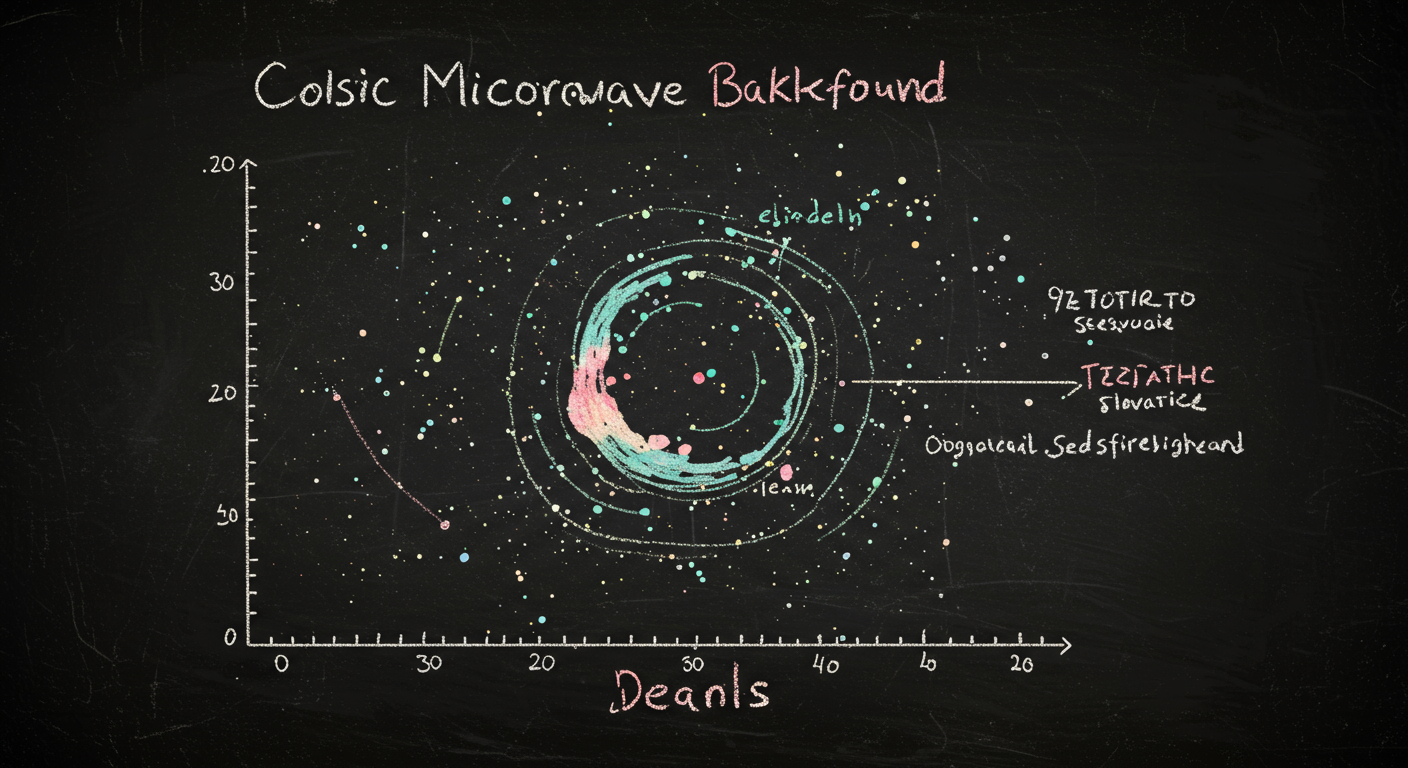
illustration
all-sky cosmic microwave background map with tiny temperature variations and a subtle color scale
note

Cosmic microwave background

The CMB is the oldest light we can observe directly.

Key facts

  • Released about 380,000 years after the Big Bang
  • Present temperature: 2.725 K
  • First detected accidentally by Arno Penzias and Robert Wilson in 1965
  • Measured in detail by COBE, WMAP, and Planck

Why it matters

The CMB gives us a snapshot of the universe before stars existed. Its tiny variations are the initial conditions for galaxy formation.

diagram
equation
ΔT/T105\Delta T / T \approx 10^{-5}

From Tiny Ripples to Galaxies

note

From fluctuations to structure

Tiny density ripples in the early universe became the seeds of cosmic structure.

Why gravity matters

Gravity amplifies small differences over very long times.

Dark matter's role

Dark matter provides extra gravitational pull, helping galaxies form earlier and more efficiently than ordinary matter alone would allow.

Observable outcome

The result is the cosmic web: filaments, clusters, and vast voids.

diagram
chart · scatter
Tiny early ripples versus later structure
note

Why simulations matter

Cosmologists run computer models that start with CMB-like fluctuations and let gravity evolve them forward. When the simulated universe looks like the real one, that is a strong consistency check.

What We Still Do Not Know

note

Open questions in cosmology

What came before?

We do not know. The standard model of cosmology does not yet describe a confirmed pre-Big-Bang phase.

Why is there something rather than nothing?

This is a philosophical and physical question. Physics can test some origin models, but it does not yet deliver a final answer.

What happens near the Planck time?

At about 10^-43 seconds, quantum effects of gravity should matter. We need a theory of quantum gravity to go further.

diagram
note

Major candidate ideas

  • Big Bounce models
  • Eternal inflation
  • No-boundary proposals
  • Quantum creation models

Status

These are active research ideas, not settled facts.

equation
tPlanck5.39×1044 st_{\text{Planck}} \approx 5.39 \times 10^{-44} \text{ s}

Transcript

Welcome to Slate. Today we're looking at How Did the Universe Begin? The Big Bang Explained. We'll cover What the Big Bang actually says (and what it doesn't), Cosmic inflation: the first fraction of a second, The cosmic microwave background: the oldest light in the universe, and Open questions: what came before? Why is there something rather than nothing?. Let's get into it.

The Big Bang is not an explosion that happened in empty space. It is the expansion of space itself. Here is the key idea: if you run the cosmic movie backward, galaxies get closer, temperatures rise, and the universe becomes denser and hotter. About 13.8 billion years ago, the observable universe was in an extremely hot, dense state. That number comes from measurements of the cosmic microwave background, galaxy expansion, and the ages of the oldest stars. A good analogy is a rising loaf of raisin bread. Each raisin sees every other raisin moving away, not because one raisin is the center, but because the dough is stretching. In the universe, the “dough” is space-time. What the Big Bang does not say is just as important. It does not describe a blast from a single point into preexisting space. It does not tell us the ultimate cause. And it does not mean the universe began from absolute nothing in a way physics can already explain. The theory begins when the universe is already hot and expanding. The earliest fractions of a second are where we need inflation and high-energy physics to go further.

The first tiny slice of time is where the story gets dramatic. Inflation is the idea that, very early on, the universe expanded extraordinarily fast for a brief moment. In many models, this happened around 10 to the minus 36 to 10 to the minus 32 seconds after the beginning. During that stretch, a region smaller than an атом nucleus could have grown enormously. Why introduce inflation at all? Because it helps explain three puzzles. First, the horizon problem: the cosmic microwave background has nearly the same temperature in directions that should not have had time to exchange heat. Second, the flatness problem: the universe today is very close to geometrically flat. Third, the absence of certain relics, like magnetic monopoles, which some particle theories predict but we have not found. Think of inflation like stretching a small wrinkle out of a balloon. A tiny patch can become so large that, on the scale we observe, it looks smooth and nearly flat. Quantum fluctuations during inflation were not erased. They were stretched to cosmic size, and those tiny ripples became the seeds of galaxies. Inflation is strongly supported, but not finished science. We do not yet know the exact mechanism or the field that drove it.

The cosmic microwave background, or C-M-B, is the afterglow of the early universe. Here is the visual story. At first, the universe was a hot plasma of electrons, protons, and photons. Light kept scattering off free electrons, so the universe was opaque, more like fog than clear air. Then, about 380,000 years after the Big Bang, the universe cooled enough for electrons and protons to combine into neutral hydrogen. That event is called recombination, and it let photons travel freely for the first time. Those photons are still here. Today they fill all of space as microwave radiation at a temperature of 2.725 kelvin, measured with great precision by missions including COBE in the 1990s and later WMAP and Planck. The spectrum is almost a perfect blackbody, one of the strongest pieces of evidence that the early universe was hot and dense. The C-M-B is not just leftover light. It is a snapshot of the universe when it was young. Tiny temperature differences, only about one part in 100,000, show the seeds of later structure. Think of it like a baby picture that also reveals the wrinkles where galaxies would eventually grow.

The early universe was not perfectly smooth. It had tiny density differences, and gravity did the rest. Denser regions pulled in more matter. Over time, that matter collapsed into stars, then galaxies, then clusters and filaments. This is why the universe today looks like a cosmic web. The important point is scale. A fluctuation of about one part in 100,000 in the cosmic microwave background sounds tiny. But gravity has billions of years to work. That is enough time to turn a slight bump into a galaxy. A useful analogy is a snowball rolling downhill. A small advantage at the start becomes a much bigger difference later. We can test this story with simulations and observations. Large surveys of galaxies, such as the Sloan Digital Sky Survey, map the web-like pattern we expect from early fluctuations. The match between the CMB and later galaxy structure is one reason cosmologists are confident that the early-universe picture is broadly correct. There is still room for detail. Dark matter helps structure grow faster, because it adds gravity without emitting light. Ordinary matter alone cannot explain how galaxies formed as quickly as they did.

The most honest answer to the question “What came before the Big Bang?” is that we do not yet know. The standard Big Bang model describes the universe from a very early hot state onward, but it does not by itself explain the ultimate origin. Near the Planck time, about 10 to the minus 43 seconds, our current theories of gravity and quantum physics are not yet unified. That is where we need a theory of quantum gravity. There are several serious ideas. Some models propose a bounce, where a previous universe contracted before ours expanded. Others suggest eternal inflation, where our observable universe is one bubble in a much larger multiverse. Some approaches, like Hartle and Hawking’s no-boundary proposal from 1983, try to describe the beginning without a sharp starting edge. None of these ideas is confirmed. The question “Why is there something rather than nothing?” is partly physics and partly philosophy. Physics can describe how matter, radiation, and space-time evolved after the earliest moments we can model. It may eventually explain more. But the deepest origin question is still open. That uncertainty is not a weakness. It is where the frontier is.

XLinkedInWhatsApp

Keep going with Slate

Pick up where this left off in your own voice session.

Built with Slate