What a generation is, and what it is not
0:006:34
Humanities

Gen Z vs Millennials vs Boomers: What the Data Says

Beyond the stereotypes — what actually shapes generational behavior and why most takes about generations are wrong.

Apr 22, 20267 min listen5 chapters
What you'll learn
  • What actually shapes a generation (hint: not birth year alone)
  • Digital nativity and how it rewires communication styles
  • Workplace expectations across generations
  • Why generational stereotypes are mostly wrong — and what is real

What a generation is, and what it is not

note

Gen Z vs Millennials vs Boomers: What the Data Says

Beyond the stereotypes — what actually shapes generational behavior and why most takes about generations are wrong.

note

Generational cohorts are historical, not biological

A generation is a group of people born in a similar period who were shaped by the same broad events.

Common U.S. cohort ranges used by Pew Research Center:

  • Baby Boomers: 1946 to 1964
  • Generation X: 1965 to 1980
  • Millennials: 1981 to 1996
  • Generation Z: 1997 to 2012

Those labels are useful for studying social change. They are not a substitute for evidence about any one person.

diagram
note

What shapes a generation

The strongest influences are usually:

  • technology available during adolescence
  • major economic shocks
  • family structure and schooling
  • wars, pandemics, and political trust
  • local class, race, and geography

That is why two people in the same cohort can still behave very differently.

equation
Observed behavior=f(birth cohort, economic conditions, technology, institutions, local culture)\text{Observed behavior} = f(\text{birth cohort},\ \text{economic conditions},\ \text{technology},\ \text{institutions},\ \text{local culture})
note

The core mistake

People often confuse a cohort effect with an age effect.

An age effect is about life stage. A 22-year-old usually has less money and less power than a 52-year-old.

A cohort effect is about the era you grew up in. A person who learned to socialize through text, group chats, and feeds will use communication differently from someone who learned through landlines and face-to-face plans.

Digital nativity and communication style

note

Digital nativity

Digital nativity means growing up with digital tools as part of everyday life.

It does not mean:

  • everyone is equally skilled
  • younger people automatically understand privacy
  • older people cannot learn new tools

A 2023 Pew Research Center report found that 95% of U.S. teens had access to a smartphone. That is a major shift in the communication environment.

diagram
note

How communication changes

Younger cohorts often normalize:

  • fast replies without full sentences
  • group chats instead of one-to-one calls
  • reactions, stickers, and emojis as tone markers
  • voice notes for convenience

Older cohorts often value:

  • directness
  • scheduled conversations
  • longer-form messages for clarity
  • fewer channels at once

These are tendencies, not rules.

note

Why the medium matters

When a message arrives in a group chat, the social pressure is different from a phone call. The medium changes the pace, the tone, and the expectation of response. That is why communication style is partly learned behavior, not just personality.

Workplace expectations across generations

note

Workplace expectations are shaped by conditions

Different cohorts often bring different assumptions about:

  • loyalty and tenure
  • feedback speed
  • remote work and flexibility
  • authority and titles
  • work-life boundaries

These differences are often responses to the labor market they entered.

diagram
note

A few real patterns

Millennials were hit hard by the Great Recession. The U.S. unemployment rate peaked at 10.0 percent in October 2009.

Gen Z came of age during a period of high digital communication and, later, pandemic disruption.

Boomers often built careers in more stable internal labor markets, where promotions inside a company were more common than they are now.

note

What managers get wrong

A manager may call a request for flexibility “entitlement.” But if a worker has seen layoffs, low wages, and expensive housing, flexibility can be a rational response to risk.

A worker may call a manager “out of touch.” But if the manager learned professionalism through punctual calls and formal memos, short chat messages can feel incomplete.

What stereotypes miss, and what data can actually show

note

Why stereotypes fail

Generational stereotypes usually ignore:

  • age and life stage
  • income and class
  • race and ethnicity
  • region and urban versus rural setting
  • education level

A stereotype may describe a visible subgroup and then get wrongly expanded to millions of people.
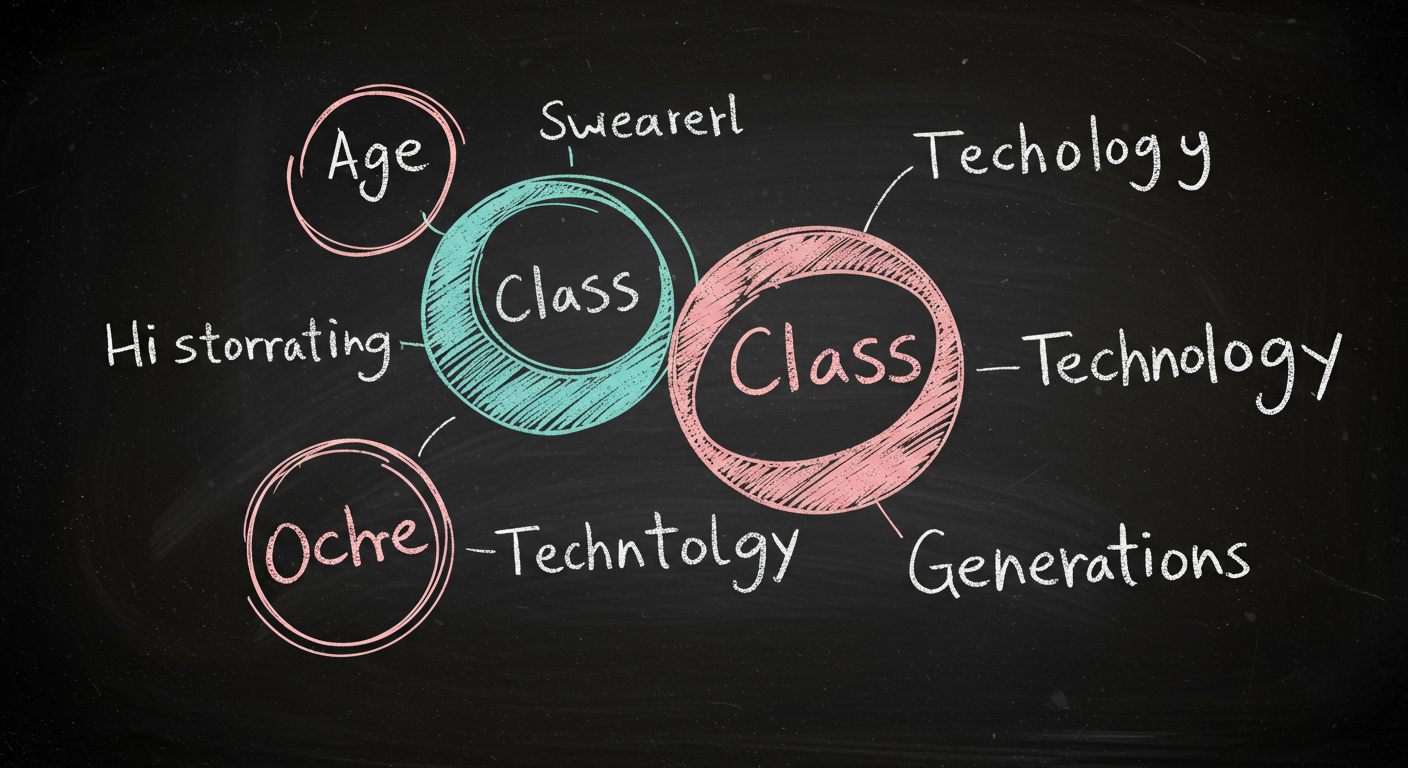
illustration
A classroom whiteboard showing overlapping circles for age, class, technology, and historical events shaping generations
diagram
note

What data can reveal

Good generational analysis asks whether a pattern remains after accounting for other variables.

Examples:

  • Is a communication preference really about age, or about work setting?
  • Is a job change rate about generation, or about wages and housing costs?
  • Is media use about cohort, or about access and platform design?

The answer is often mixed.

equation
True cohort effectdifference after controlling for age, income, education, and location\text{True cohort effect} \approx \text{difference after controlling for age, income, education, and location}

How to think clearly about generations

note

A better framework

Use four layers together:

  • cohort: the historical period of birth
  • age: the life stage someone is in
  • class: money, education, and job security
  • context: country, region, race, gender, and family background

This framework explains more than a single generation label ever can.

diagram
note

Practical takeaways

When you hear a generational claim, ask:

  • What data supports it?
  • What other factors were controlled for?
  • Is this about age, or cohort?
  • Is the claim true in the same way across countries?

That habit turns vague talk into evidence-based thinking.

note

Bottom line

Generations matter because history matters. But they are not destiny. The strongest explanations combine cohort, age, class, and context.

Transcript

Welcome to Slate. Today we're looking at Gen Z vs Millennials vs Boomers: What the Data Says. We'll cover What actually shapes a generation (hint: not birth year alone), Digital nativity and how it rewires communication styles, Workplace expectations across generations, and Why generational stereotypes are mostly wrong — and what is real. Let's get into it.

A generation is not a personality type. It is a cohort shaped by shared historical conditions during childhood and early adulthood. That matters because those years are when habits, expectations, and trust in institutions are forming. The baby boom in the United States ran from 1946 to 1964, after World War Two. Generation X is usually placed from 1965 to 1980. Millennials from 1981 to 1996. Generation Z from 1997 to 2012. Those date ranges are useful, but they are not magic lines. Someone born in 1996 and someone born in 1997 may have had almost identical lives. The real driver is the environment they met at key moments. Here’s the simple picture: think of a generation like a class of plants grown in different weather. The seed is similar, but drought, flood, and sunlight change the shape. That is why birth year alone cannot explain behavior. A teenager in 2008 faced the financial crisis, social media, and smartphones. A teenager in 1988 did not. Those are different worlds. So when people say, “Gen Z is like this,” the better question is, which experiences are actually producing that pattern?

Digital nativity sounds like a clean dividing line, but the reality is messier. People often call Gen Z “digital natives” because many of them grew up with smartphones, social media, and always-on internet. But having devices from childhood does not mean every digital habit is the same. It changes the default setting. For many younger users, communication is asynchronous first. That means they expect time gaps, read receipts, voice notes, emojis, and short bursts of interaction. Think of it like using a shared whiteboard instead of a phone booth. You do not need both people present at the same instant. Millennials are often the bridge cohort. Many remember dial-up internet, flip phones, and then the jump to broadband and smartphones. Boomers and Gen X were more likely to learn digital tools after their basic communication habits were already set. That can make new platforms feel like tools to them, not like the air they breathe. But beware the stereotype. Plenty of Boomers are heavy users of email, Facebook, and video calls. Plenty of Gen Z students still prefer face-to-face conversation for sensitive topics. The real difference is not skill alone. It is the social meaning attached to each channel.

Workplace conflict often comes from mismatched assumptions, not laziness or entitlement. Boomers entered many workplaces when hierarchy was clearer and loyalty was rewarded more visibly. Median household income in the United States rose strongly after World War Two, and long tenure with one employer was more common. Millennials entered adulthood around the 2008 financial crisis. That mattered. Pew Research Center found that in 2019, 32 percent of U.S. adults ages 18 to 29 lived with a parent, a record high at the time. That kind of economic pressure changes what work means. Gen Z entered the labor market with student debt concerns, housing costs, and a pandemic that normalized remote work. So when one group asks for flexibility, another may hear lack of commitment. When one group expects quick feedback, another may hear impatience. The better frame is contract, not character. What does each group think a good job gives them? Stability, autonomy, growth, status, or flexibility. Those priorities are shaped by the economy they met, not by a horoscope-like generation label.

Stereotypes are tempting because they are fast. They compress a messy world into a neat story. But most generational stereotypes fail because they ignore overlap, class, race, education, and life stage. For example, not every Boomer is tech-averse. Not every Millennial is financially fragile. Not every Gen Z worker wants to job-hop. Pew Research Center’s 2019 analysis found that U.S. Millennials were the most educated adult generation at that time, while Gen Z was still very young. Education, income, and location can matter more than cohort label. Here is the key test: if a claim about generations is real, it should show up in data after controlling for age and other factors. If it disappears once you account for income or schooling, the stereotype was mostly a shortcut. Think of it like weather and climate. A single hot day does not prove a climate trend. In the same way, one loud social media post does not prove a generation-wide truth. The right question is not “What are Gen Z people like?” It is “Under what conditions do younger people, on average, behave differently?” That is a much sharper and more honest question.

The best way to talk about generations is to treat them as a starting point, not an explanation. Start with the historical context. Then ask what changed in childhood, adolescence, and early adulthood. For Boomers, postwar expansion mattered. For Gen X, rising divorce rates, dual-income households, and the early personal computer era mattered. For Millennials, the internet, 9/11, and the Great Recession mattered. For Gen Z, smartphones, social platforms, climate anxiety, and the pandemic mattered. Those forces shape habits. But they do not erase individual differences. If you want to understand a person, look at cohort plus class plus culture plus life stage. That is the full picture. One useful analogy is a map. A generation is the region. It tells you the terrain. But it does not tell you the exact path one traveler took. So when someone says, “Boomers are like this,” or “Gen Z is like that,” translate it into a better question: what conditions produced that pattern, and who does it leave out? That is how you get from stereotype to understanding.

XLinkedInWhatsApp

Keep going with Slate

Pick up where this left off in your own voice session.

Built with Slate