1. The prisoner's dilemma: when self-interest beats the group
0:007:17
Math

Game Theory: Why Smart People Make Bad Choices

From the prisoner's dilemma to salary negotiations — the hidden math behind strategy, conflict, and cooperation.

Apr 22, 20267 min listen5 chapters
What you'll learn
  • The prisoner's dilemma and its real-world parallels
  • Nash equilibrium explained with everyday examples
  • How auction theory won Nobel Prizes and shaped tech
  • Using game theory to negotiate better

1. The prisoner's dilemma: when self-interest beats the group

note

Game Theory: Why Smart People Make Bad Choices

From the prisoner's dilemma to salary negotiations — the hidden math behind strategy, conflict, and cooperation.

note

The prisoner's dilemma

The prisoner's dilemma is a two-player game with a conflict between individual incentives and group outcomes.

A standard payoff table uses years in prison, so smaller numbers are better:

Prisoner B silentPrisoner B confess
Prisoner A silent1 year, 1 year3 years, 0 years
Prisoner A confess0 years, 3 years2 years, 2 years

The key fact: confessing is a dominant strategy for both players.

The group-best outcome is mutual silence.

Real-world parallels include price cutting, pollution, and arms races.

diagram
note

Why this matters in real life

A dominant strategy is like wearing a seat belt when you do not know what other drivers will do. It is the safest move for you, even if everyone would be better off in a different world.

The prisoner's dilemma appears in:

  • cartel cheating in markets
  • countries cutting emissions while others do not
  • firms racing to lower prices
  • roommates deciding who cleans first

The lesson is not “people are selfish.” The lesson is that incentives shape behavior, often more strongly than morals do.

equation
If ui(si,si)ui(si,si) for every si, then si is a dominant strategy for player i.\text{If } u_i(s_i, s_{-i}) \ge u_i(s_i', s_{-i}) \text{ for every } s_i', \text{ then } s_i \text{ is a dominant strategy for player } i.

2. Nash equilibrium: stable, not necessarily good

note

Nash equilibrium

A Nash equilibrium is a strategy profile where each player's choice is a best response to the others.

It does not mean:

  • everyone is happy
  • the outcome is efficient
  • cooperation has happened

It does mean:

  • no single player can do better by changing alone
  • the outcome is stable against unilateral deviation

John Nash introduced the idea in 1950 and proved existence for finite games in 1951.

diagram
note

Everyday example: two coffee shops

Imagine two coffee shops in a town.

If one shop is alone downtown and the other is near the train station, customers split by location. If both move near the train station, neither wants to move away unilaterally, because the other shop would capture the foot traffic.

That clustered outcome can be a Nash equilibrium.

It is stable like a marble resting in a shallow bowl. It stays there unless pushed. But the bowl may sit in the wrong place on the table.

equation
A strategy profile s is a Nash equilibrium if ui(si,si)ui(si,si) for every player i and every alternative si.\text{A strategy profile } s^* \text{ is a Nash equilibrium if } u_i(s_i^*, s_{-i}^*) \ge u_i(s_i, s_{-i}^*) \text{ for every player } i \text{ and every alternative } s_i.
note

Common mistake

People often think Nash equilibrium means “the best outcome.” It does not.

It means “no one has a unilateral incentive to move.”

That is why bad equilibria can persist in traffic, pricing, and bargaining.

3. Auctions: where strategy became billion-dollar math

note

Auction theory

Auction theory studies how bidding rules change behavior and outcomes.

Important formats:

  • First-price auction: highest bid wins, winner pays own bid
  • Second-price auction: highest bid wins, winner pays second-highest bid
  • English auction: open ascending bids
  • Dutch auction: price falls until someone accepts

William Vickrey showed the strategic power of second-price auctions. Paul Milgrom and Robert Wilson shaped modern auction design, especially for spectrum sales and related markets.

diagram
chart · bar
Auction formats and bidding incentives
First-priceSecond-priceEnglishDutch
note

Why tech companies care

Search ads are often sold through repeated auctions. The platform needs a rule that is fast, scalable, and hard to game.

If a bidder can hide their true value, prices become noisy. If the mechanism rewards honesty, the platform learns what attention is worth.

That is why auction design is a core part of digital markets, not a niche corner of economics.

equation
In a second-price auction, truthful bidding b=v is a weakly dominant strategy for a risk-neutral bidder.\text{In a second-price auction, truthful bidding } b=v \text{ is a weakly dominant strategy for a risk-neutral bidder.}

4. Repeated games, trust, and better negotiation

note

Repeated games

When players meet again, reputation becomes part of the payoff.

A repeated game can support cooperation because cheating today may be punished tomorrow.

Robert Axelrod's tournaments in 1980 and 1981 made this idea famous.

Tit for Tat:

  • start by cooperating
  • then mirror the opponent's last move

This strategy worked well in many environments because it was clear, forgiving, and retaliatory.
diagram
illustration
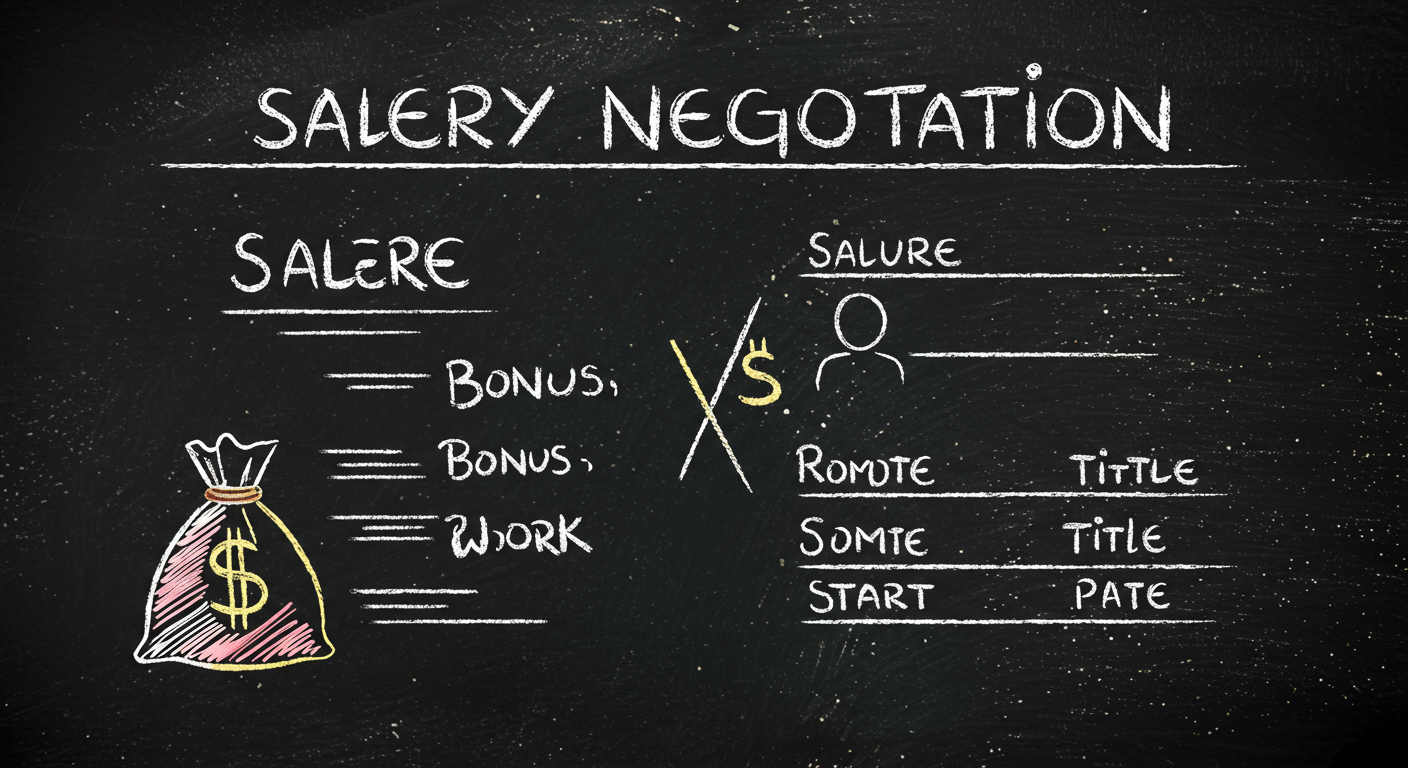
salary negotiation with two people comparing salary, bonus, remote work, title, and start date on a table
note

Negotiating better

Strong negotiation is not about winning every point. It is about improving the whole package.

Useful questions:

  • What is my best alternative if this deal fails?
  • What matters more to them than to me?
  • Which terms can I trade without hurting my goals?

Example: a company may resist a higher salary but be flexible on remote days, learning budget, or bonus timing.

That is game theory in practice: find the variables with different values on each side.

equation
Your bargaining power rises when your outside option improves. If VdealVoutside is large, you can negotiate from strength.\text{Your bargaining power rises when your outside option improves. If } V_{deal} - V_{outside} \text{ is large, you can negotiate from strength.}

5. Using game theory without misusing it

note

A practical checklist

When you face a strategic situation, ask:

  • Is this one-shot or repeated?
  • Are the payoffs aligned or in conflict?
  • Can anyone improve by changing alone?
  • Is the outcome efficient or just stable?
  • Can terms be bundled into a better deal?

These questions help you spot the game before you react to it.

diagram
note

What to remember

Game theory explains why smart people can make choices that look irrational from the outside.

The reason is usually not stupidity. It is incentives.

Once you understand the incentives, you can predict conflict, cooperation, and bargaining much more accurately.

equation
Game theory studies outcomes=f(your choice, others’ choices, rules)\text{Game theory studies } \text{outcomes} = f(\text{your choice},\ \text{others' choices},\ \text{rules})
chart · pie
Where game theory shows up
NegotiationAuctionsPricingPoliticsBiology

Transcript

Welcome to Slate. Today we're looking at Game Theory: Why Smart People Make Bad Choices. We'll cover The prisoner's dilemma and its real-world parallels, Nash equilibrium explained with everyday examples, How auction theory won Nobel Prizes and shaped tech, and Using game theory to negotiate better. Let's get into it.

Two suspects are arrested. Each can stay silent or confess. If both stay silent, they each get one year. If one confesses and the other stays silent, the confessor walks while the silent one gets three years. If both confess, they each get two years. The diagram shows why this is a trap. Confessing is the safer move no matter what the other person does. That makes confession a dominant strategy. But the pair would be better off if both stayed silent. This is the core tension in game theory. Rational choices can produce a worse result for everyone. Think of it like two drivers trying to merge into the same lane. Each driver wants to protect their own bumper. If both hold their ground, both slow down. If both yield, traffic flows. The “best for me” choice is not always the “best for us” choice. That gap matters in arms races, price wars, and climate agreements. The prisoner's dilemma is not just a puzzle. It is a model of trust under pressure. Once you see the payoff table, you start noticing the same structure in real life: when cooperation is fragile, when cheating pays in the short run, and when repeated interactions are the only thing keeping people honest.

Now look at a different idea. A Nash equilibrium is a set of choices where no player can improve by changing only their own move. That sounds almost like peace. But stability is not the same as excellence. The diagram shows the logic: each player is already best-responding to the other. Move alone, and you lose. Stay put, and the outcome persists. John Nash proved this equilibrium concept in his 1950 doctoral dissertation at Princeton University, and his 1951 paper gave the formal existence result for finite games. For that work, he shared the 1994 Nobel Memorial Prize in Economic Sciences with John Harsanyi and Reinhard Selten. A simple everyday example is two gas stations on a highway. Each station wants the most customers. If both are far apart, one can steal traffic by moving closer. But if both are already side by side, neither wants to move alone. That crowded location can be an equilibrium, even if both stations would earn more with better spacing. In other words, equilibrium is a point of mutual best response, not a promise of fairness. Game theory keeps asking the hard question: if everyone is acting rationally, why do we still get outcomes that feel clumsy, congested, or wasteful?

Auctions are where game theory leaves the chalkboard and meets huge money. In 1994, the U.S. Federal Communications Commission used auctions to sell radio spectrum, and the design drew heavily on game theory. That work helped turn auction theory into practical policy. The best-known formats behave very differently. In a first-price auction, the highest bidder wins and pays their own bid. In a second-price auction, also called a Vickrey auction after economist William Vickrey, the highest bidder wins but pays the second-highest bid. That second format has a beautiful property: bidding your true value is optimal. The diagram shows why. If you value an item at 100 dollars and the second-highest bid is 70, bidding 100 wins and pays 70. If you shade your bid down to 80, you still win and still pay 70. If you shade too far, you might lose the item entirely. This incentive design is not abstract. It shapes online ads, where platforms auction search keywords millions of times per second. It also shaped Nobel-recognized work by William Vickrey, who received the 1996 Nobel Prize in Economic Sciences, and by Paul Milgrom and Robert Wilson, who won the 2020 prize for improvements to auction theory and new auction formats. Good auction design is not about squeezing bidders. It is about getting honest information into prices.

Most real conflicts are not one-shot. They repeat. That changes everything. In a repeated prisoner's dilemma, today’s move affects tomorrow’s trust. A one-time cheat can win now, but it can also trigger retaliation, lost business, or a damaged reputation. That is why cooperation can survive even when selfishness looks tempting. Robert Axelrod’s famous tournaments in the early 1980s showed that simple reciprocal strategies could perform remarkably well. The most famous was Tit for Tat: start by cooperating, then copy the other player’s last move. In negotiation, the same logic appears in salary talks. If you anchor too low, you may lock yourself into a weak starting point. If you reveal your reservation value too early, you lose leverage. But if you understand the other side’s payoff, you can create trades. Maybe salary is fixed, but remote work, title, signing bonus, or review timing can move. The image shows the idea: do not treat negotiation as one number. Treat it as a bundle of issues. Game theory helps you ask, “What does the other side value more than I do?” That is where deals get made. The best negotiators are not the loudest. They are the clearest about incentives, alternatives, and the cost of walking away.

Game theory is powerful, but it is not magic. Real people are noisy. They make mistakes. They care about fairness, identity, and emotions, not just payoffs. That is why the clean math is a starting point, not the full story. Still, the core tools are useful. If you see a prisoner's dilemma, ask whether the game repeats. If you see a Nash equilibrium, ask whether it is efficient or merely stable. If you see an auction, ask what rule the seller chose and whether bidders are incentivized to reveal the truth. If you are negotiating, ask what each side values and what happens if no deal is reached. The final diagram ties the lesson together. Game theory is a lens for strategic situations where your outcome depends on other people’s choices. It does not tell you what people should value. It tells you how incentives shape what they do. That is why it shows up in economics, politics, biology, computer science, and everyday bargaining. The real skill is not memorizing names. It is learning to spot the structure of the game before you play it. Once you can do that, you stop being surprised by bad outcomes that were predictable all along.

XLinkedInWhatsApp

Keep going with Slate

Pick up where this left off in your own voice session.

Built with Slate