What the Sapir-Whorf hypothesis really says
0:006:53
Languages

Does Your Language Change How You Think?

Languages without future tense, without color words — the surprising ways language shapes perception and thought.

Apr 22, 20267 min listen5 chapters
What you'll learn
  • The Sapir-Whorf hypothesis: strong vs. weak versions
  • Languages without numbers, without future tense, without color words
  • How language influences time perception and spatial reasoning
  • Modern research: what we know vs. what is still debated

What the Sapir-Whorf hypothesis really says

note

Does Your Language Change How You Think?

Languages without future tense, without color words — the surprising ways language shapes perception and thought.

note

Sapir-Whorf hypothesis and linguistic relativity

The Sapir-Whorf hypothesis is usually split into two versions:

  • Strong version: language determines thought.
  • Weak version: language influences thought.

Edward Sapir wrote in 1929 that no two languages are ever sufficiently similar to be considered as representing the same social reality. Benjamin Lee Whorf developed the idea further in the 1930s.

Modern research rejects strong linguistic determinism. People can learn concepts outside their native language, use tools like maps and math, and reason flexibly.

The weaker idea, often called linguistic relativity, is still studied. It asks whether language changes what people notice first, remember more easily, or classify more quickly.

A useful analogy is a pair of tinted glasses. They do not change the world itself, but they can change which details stand out at a glance.

diagram
note

What counts as evidence?

Researchers look for differences in tasks such as color naming, spatial memory, time reasoning, and number judgments.

Good evidence is not just that two languages have different words. The key question is whether speakers perform differently in carefully controlled experiments.

That is why the strongest claims in popular culture often fail. A language feature may be interesting, but not automatically psychologically powerful.

Color words and how categories shape perception

note

Color terms and perception

Languages vary a lot in color vocabulary.

English has separate basic terms for blue and green. Russian distinguishes light blue and dark blue with separate basic terms. Some languages have fewer conventional color terms overall.

In a famous 2007 study, Jonathan Winawer, Nathan Witthoft, Michael Frank, Lisa Wu, Alex Wade, and Lera Boroditsky found that Russian speakers were faster at discriminating colors across the light blue and dark blue boundary than within one category.

The effect was small and depended on verbal working memory. When participants repeated irrelevant syllables, the advantage weakened.

That points to a practical idea: language can help organize attention, especially when a task requires quick sorting or comparison.

chart · bar
Relative speed in color discrimination
English within categoryEnglish across categoryRussian within categoryRussian across category

Time and future tense: does grammar change planning?

note

Future tense and decision-making

English marks future time explicitly: I will go, she will call.

Some languages do not require a distinct future tense in the same way. Mandarin Chinese often uses context, adverbs, or aspect markers rather than a mandatory future tense form.

Keith Chen’s 2013 study linked future tense marking to savings, retirement planning, smoking, and exercise across countries. The idea was provocative, but the method has been heavily debated because countries differ in many confounding ways.

The safest conclusion is narrow: grammar can affect how people frame time in speech and perhaps in some judgments, but it does not by itself explain national behavior.

diagram
equation
P(behavior)=f(language,culture,institutions,incentives,history)P(behavior) = f(language, culture, institutions, incentives, history)

Numbers, space, and the limits of language

note

Languages without exact number words

A language can support approximate quantity without supporting exact counting in the same way English does.

Research with the Munduruku, reported by Pierre Pica and colleagues in 2004, showed that speakers could estimate quantities roughly, but exact numerical performance was limited without number words and schooling.

That does not mean the people lacked numerical intuition. It means language and education help build exact symbolic number concepts.

Spatial reasoning

Some languages prefer absolute directions such as north, south, east, and west. Others use relative directions such as left and right.

Tzeltal speakers have been studied for their strong use of absolute spatial frames. This can make navigation and memory tasks look very different from English.

A helpful analogy: language is not the map itself. It is the coordinate system you practice using.
diagram
illustration
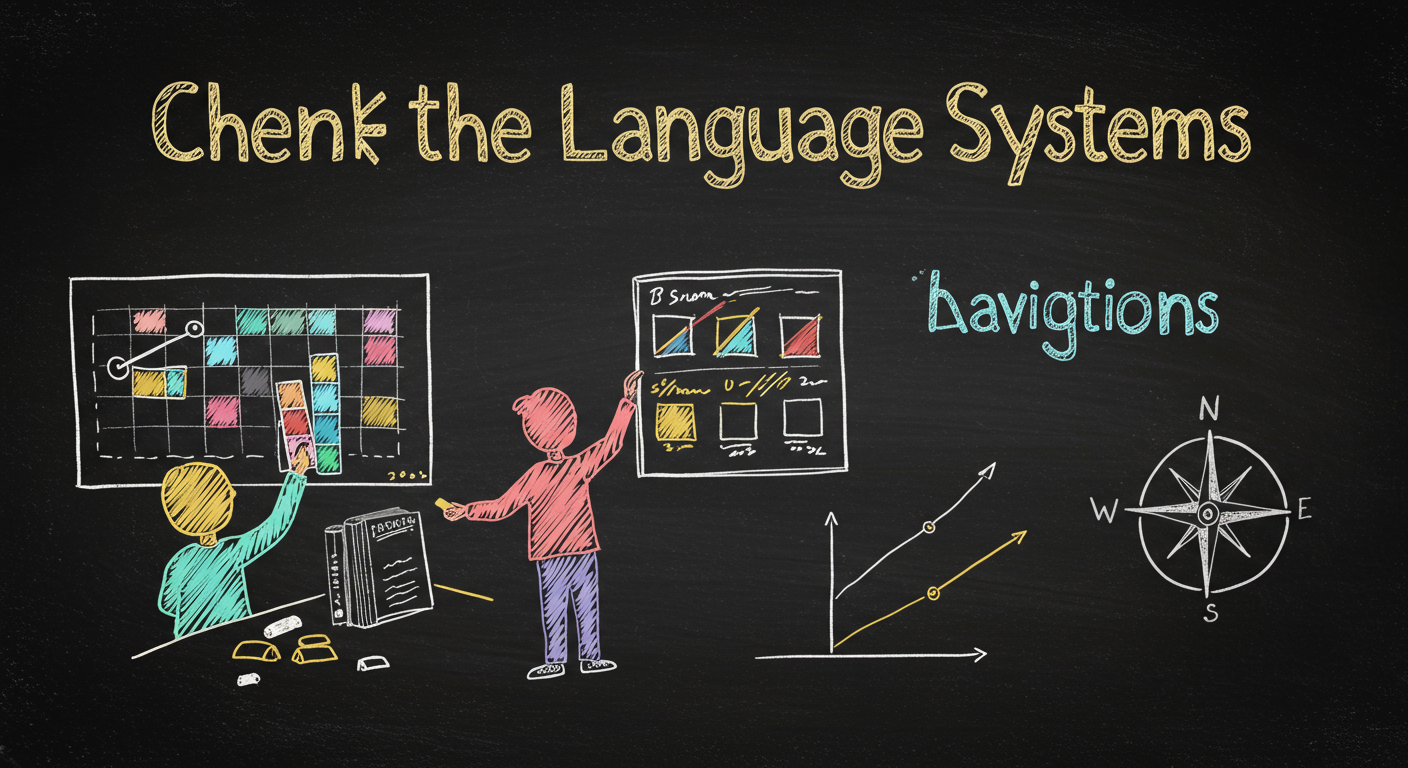
Two people solving the same task with different language systems one sorting color swatches one navigating with compass directions

What we know now and what remains open

note

What modern research supports

Language can influence:

  • fast categorization
  • verbal memory
  • habitual attention
  • some spatial strategies
  • some time judgments

Language does not appear to:

  • trap speakers inside one fixed worldview
  • prevent people from learning new concepts
  • fully determine perception or reasoning

The best summary

The evidence supports linguistic relativity in a limited sense.

That means language can shape thought by making some distinctions easier to notice, easier to remember, or easier to use quickly.

It does not mean that grammar is destiny.

diagram
note

Key takeaways

The Sapir-Whorf hypothesis has a strong version and a weak version.

Color words can shift quick discrimination and memory.

Future tense effects are interesting but heavily debated.

Languages without many number words or with different spatial systems show that human cognition is flexible.

The most accurate conclusion is this: language shapes thought in specific, measurable ways, but it does not determine what people can think.

Transcript

Welcome to Slate. Today we're looking at Does Your Language Change How You Think?. We'll cover The Sapir-Whorf hypothesis: strong vs. weak versions, Languages without numbers, without future tense, without color words, How language influences time perception and spatial reasoning, and Modern research: what we know vs. what is still debated. Let's get into it.

Some languages make different distinctions than English. That fact is real. The big question is whether those differences shape thought, or just give people different ways to talk. The classic name here is the Sapir-Whorf hypothesis, from Edward Sapir and Benjamin Lee Whorf in the 1920s and 1930s. The strong version says language determines thought. If your language lacks a word or grammar pattern, you cannot really have the idea. That claim is too strong. People can learn new concepts, translate between languages, and reason about things their language does not label directly. The weak version is more modest. Language can bias attention, memory, and quick judgments. Think of language like a set of grooves in wet clay. It does not lock your mind in place, but it can guide the shape of your first pass at a problem. Modern cognitive science mostly supports that weaker view. You can see the debate in the diagram: one path claims language controls thought, the other says it nudges it. The evidence has to be specific, because broad claims often collapse under testing. So the right question is not whether language matters at all. It is where it matters, how much, and in which tasks.

Color is one of the cleanest places to test linguistic relativity. English divides the spectrum with words like blue and green. Some languages draw the line differently. Russian has two basic blues, goluboy for light blue and siniy for dark blue. In experiments by Jonathan Winawer and colleagues in 2007, Russian speakers were faster to tell apart shades that crossed that language boundary than shades within the same category. The effect was small, but real. It disappeared when people repeated a verbal task, which suggests language helps by keeping categories active in working memory. Here is the useful lesson: language does not create new colors in the eye. The retina is still doing its job. But language can act like labels on a filing cabinet. When a shade gets a name, it can be easier to sort, compare, and remember. The same pattern has been studied in languages with fewer color terms and in communities where color naming is less standardized. The results are mixed, but the broad theme holds. Color language can shape fast categorization more than basic visual experience. That is a narrower claim than people often expect, and it is the one the evidence actually supports.

Some languages mark the future strongly, like English does with will and going to. Others, such as Mandarin Chinese, often use context or aspect markers instead of a dedicated future tense. That difference led to a bold claim: if your language does not grammatically separate future from present, maybe you treat the future as more connected to the now. The most cited work here is Keith Chen’s 2013 paper, which argued that speakers of so-called weak future tense languages save more, smoke less, and exercise more. But this is not a settled result. Cross-country comparisons are messy. Languages are tied to history, geography, institutions, and wealth, so you cannot cleanly isolate grammar from everything else. Still, the idea is worth testing because it connects language to decision-making. A useful analogy is a calendar app. If the app makes tomorrow look visually separate from today, it may encourage different planning habits. But the app is not the only thing shaping behavior. The real world matters too. Current research suggests that future tense may influence how people talk and think about time in some contexts, but the evidence for big life outcomes is debated and far from conclusive.

Now for the most dramatic examples. Some languages have very limited number words. The Pirahã language of the Amazon has been discussed in this context, though the details are debated. More solidly, researchers studying the Munduruku in Brazil found that people could estimate quantities approximately, but exact number tasks became hard when the required numbers went beyond their number-word system. That does not mean they cannot think about quantity. It means exact symbolic counting is much easier with stable number words and training. Spatial language shows a similar pattern. Tzeltal speakers in Mexico often describe space using uphill, downhill, and across the slope rather than left and right. That can support strong absolute orientation, because the body is constantly tied to the landscape. Think of it like navigating with a compass instead of a street map. Neither is inferior. They just train different habits of attention. In experiments, Tzeltal speakers often outperform English speakers on absolute-direction tasks. These are not magical language effects. They are learned systems for organizing experience. The mind is flexible enough to use either one, but the language you speak can make one system feel more automatic.

The modern view is neither language controls thought nor language does nothing. The evidence points to a middle position. Language can bias attention, help or hinder memory, and shape habitual ways of sorting the world. But it usually works with culture, education, and task demands. That is why studies on color, number, time, and space do not all look the same. Some effects are robust in the lab, especially when the task is fast and the categories are clear. Others fade when you change the method or control for confounds. The strongest lesson is scientific, not philosophical. If you want to know whether language shapes thought, you have to ask which part of thought, in which setting, for which speakers. That is how the field moved beyond the old slogan. So the answer to the title question is yes, but in limited, testable ways. Language is more like a training path than a prison. It makes some mental moves easier to learn and quicker to use. It does not decide everything, and it never works alone. That is the real story the research has built over the last century.

XLinkedInWhatsApp

Keep going with Slate

Pick up where this left off in your own voice session.

Built with Slate