Can You Reverse Aging? The Science of Longevity
Biological age tests, senolytics, and evidence-based protocols — longevity science moved from fringe to mainstream.
- Lifespan vs. healthspan — why the distinction matters
- Biological age testing and what it reveals
- Senolytics, rapamycin, and the science behind them
- Evidence-based lifestyle protocols for longevity
1. Lifespan, healthspan, and what aging actually is
Can You Reverse Aging? The Science of Longevity
Biological age tests, senolytics, and evidence-based protocols — longevity science moved from fringe to mainstream.
Lifespan vs healthspan
Lifespan is total years lived.
Healthspan is years lived with good function, low disease burden, and independence.
A useful rule: medicine has been very good at adding years. Longevity science aims to add years that still feel like life.
Why the distinction matters
- A longer lifespan without better function can mean more frailty and disability.
- A longer healthspan can compress late-life illness into fewer years.
- Public health and personal goals both care about function, not just survival.
The biology behind aging
The 2013 Hallmarks of Aging paper gave researchers a shared map. It did not claim every hallmark is equally important in every tissue. It did show that aging is a network problem, not a single defect.
Examples:
- Telomeres shorten with cell division, especially in high-turnover tissues.
- Mitochondria become less efficient and can generate more reactive byproducts.
- Senescent cells can accumulate in older tissues and promote inflammation.
- Epigenetic changes alter which genes are turned on and off without changing DNA sequence.
Think of it like a city infrastructure system. Roads, power, water, and communications all age together. Fixing one bridge helps, but the whole network determines whether the city functions.
What longevity science can claim today
Strong evidence supports interventions that reduce major disease risk: not smoking, regular exercise, blood pressure control, adequate sleep, and treating metabolic disease.
Much weaker evidence supports any product that can truly reverse human aging. That claim needs biomarkers, randomized trials, and clinical outcomes, not marketing.
2. Biological age tests: what they measure and what they miss
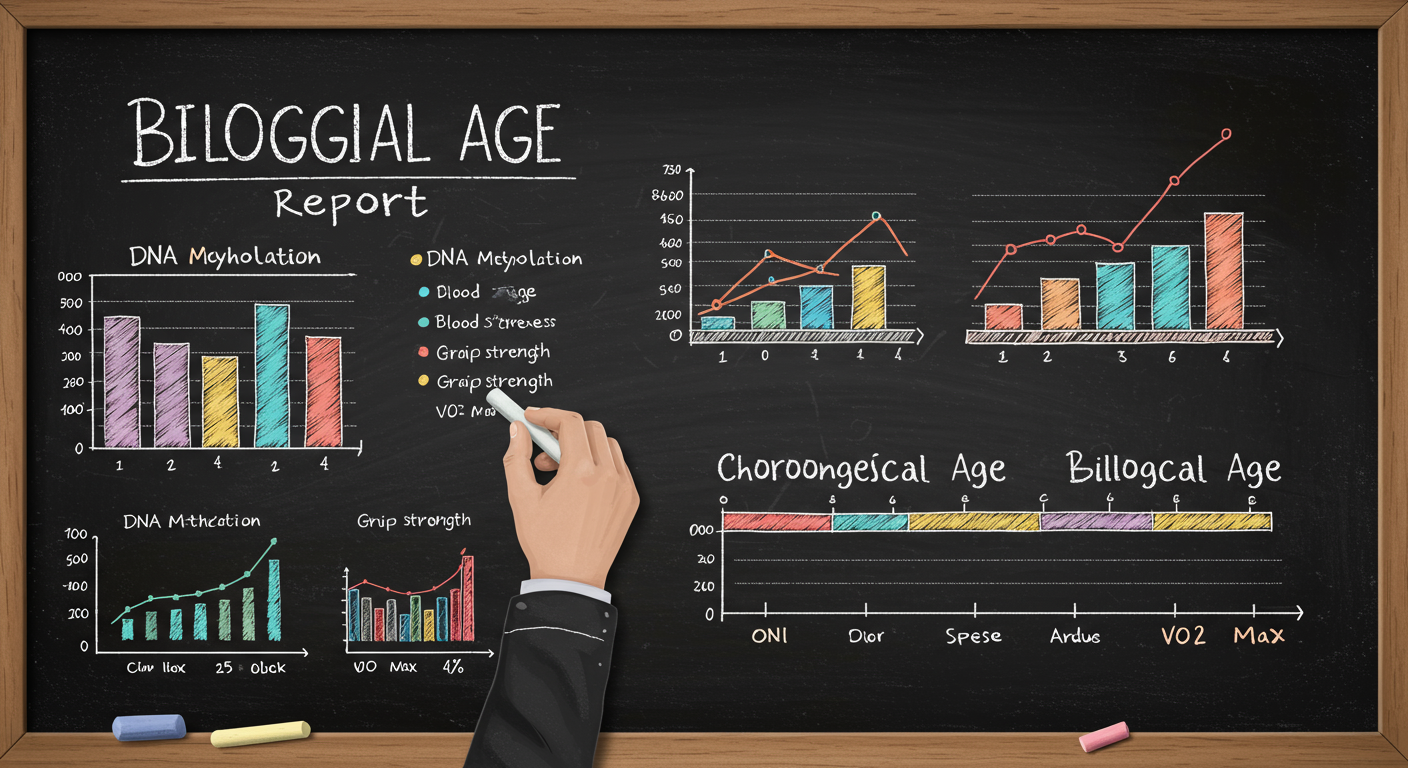
Common biological age tests
Epigenetic clocks
Measure DNA methylation patterns. Examples include Horvath clock, PhenoAge, and GrimAge.
Blood-based panels
May combine inflammation, lipids, glucose, kidney function, and proteins.
Functional measures
Grip strength, gait speed, VO2 max, and body composition often predict outcomes better than a single lab marker.
What they can tell you
- Risk trends over time
- Whether an intervention changes a biomarker
- How your biology compares with population averages
What they cannot tell you
- Your exact future lifespan
- Whether one supplement has truly reversed aging
- A complete picture from one sample
Why epigenetic clocks matter
In 2013, Steve Horvath published a multi-tissue DNA methylation clock in Genome Biology. It was a major step because it suggested that aging leaves a measurable chemical signature.
Later clocks improved prediction of disease and mortality. GrimAge, published in 2019, was especially strong for mortality risk prediction. That does not mean it is a magic aging meter. It means it is a useful proxy.
A proxy is not the thing itself. A weather app is not the sky. It helps you decide whether to carry an umbrella.
3. Senolytics, rapamycin, and the real state of anti-aging drugs
Senolytics
Senolytics aim to remove senescent cells.
Why that matters: senescent cells can secrete inflammatory factors, often called the senescence-associated secretory phenotype, or S-A-S-P.
Potential upside:
- Less tissue inflammation
- Better tissue function in some models
Current limits:
- Human evidence is early
- Optimal dosing is unknown
- Benefits may be tissue-specific
Rapamycin
Rapamycin was first isolated in 1972 from soil bacteria on Easter Island, or Rapa Nui. It inhibits mTOR, a pathway that helps cells decide when to grow and when to conserve resources.
In animal studies, mTOR inhibition can improve lifespan and healthspan. In humans, the evidence is much thinner.
Tradeoffs matter:
- It can affect immune function
- It may alter glucose metabolism
- It is not a proven anti-aging prescription
A good analogy is a thermostat. Lowering growth signaling may help the system spend more on maintenance. But if you turn the knob too far, you can make the house cold and uncomfortable.
What counts as evidence
For a longevity drug, the strongest chain is:
- Human randomized trial
- Clinically meaningful outcome
- Adequate follow-up
- Safety data in the target population
A biomarker shift alone is not enough. If a pill lowers an epigenetic clock by a few months but does not improve function, disease risk, or survival, the clinical value is unclear.
4. Evidence-based longevity protocols that actually move the needle
High-yield longevity actions
Exercise
- 150 to 300 minutes per week of moderate aerobic activity, or 75 to 150 minutes vigorous, plus resistance training on 2 or more days per week, matches major public health guidance.
- Cardiorespiratory fitness is a powerful predictor of mortality.
Nutrition
- Emphasize minimally processed foods, vegetables, legumes, fruit, nuts, fish, and unsaturated fats.
- Match protein and calories to age, activity, and body composition.
Medical risk control
- Blood pressure
- LDL cholesterol and ApoB
- Glucose and HbA1c
- Sleep apnea
- Smoking cessation
A practical protocol
- Track blood pressure, ApoB, HbA1c, waist circumference, and fitness.
- Build strength twice weekly.
- Add aerobic work most days.
- Sleep 7 to 9 hours when possible.
- Use medications for real diseases, not for vague anti-aging promises.
That sequence is not glamorous. It is effective.
5. How to think like a longevity scientist
How to evaluate a longevity claim
- Is it based on human data?
- Does it improve a real outcome?
- Is the effect large enough to matter?
- Are the risks known?
- Is the result reproducible?
Best current takeaway
You cannot buy immortality.
You can often buy more healthspan by doing the fundamentals consistently and by using medicine where the evidence is strongest.
Key names and dates
- 2013: Carlos López-Otín and colleagues published the Hallmarks of Aging.
- 2013: Steve Horvath published the multi-tissue epigenetic clock.
- 2019: GrimAge improved prediction of mortality risk.
- 1972: Rapamycin was isolated from soil bacteria from Rapa Nui.
These dates matter because longevity science has a real history. It is not a trend built on wishful thinking. It is a field built on testable biology.
Final model
Think of aging like a slow leak in a complex machine. The goal is not to pretend the leak does not exist. The goal is to patch the biggest holes first, monitor the system, and replace parts before they fail.
Keep going with Slate
Pick up where this left off in your own voice session.