What AI money tools actually do
0:007:45
Business

Can AI Manage Your Money? Robo-Advisors Explained

Betterment, Wealthfront, AI budgeting apps — what they actually do with your money and when they fall short.

Apr 22, 20268 min listen5 chapters
What you'll learn
  • How AI budgeting tools analyze your spending patterns
  • Robo-advisors: Betterment, Wealthfront, and the competition
  • AI-driven tax optimization and tax-loss harvesting
  • What these tools can and cannot do for you

What AI money tools actually do

note

Can AI Manage Your Money? Robo-Advisors Explained

Betterment, Wealthfront, AI budgeting apps — what they actually do with your money and when they fall short.

note

AI budgeting tools and robo-advisors

AI budgeting apps analyze transaction data from bank and card accounts. They classify merchants, detect subscriptions, and estimate monthly spending by category.

Robo-advisors focus on investing. They usually build diversified portfolios from low-cost index funds or exchange-traded funds, then rebalance them when markets move.

What they are good at

  • Finding recurring charges
  • Summarizing spending by category
  • Keeping an investment portfolio near a target allocation
  • Automating small, repetitive financial tasks

What they are not good at

  • Understanding your full life context
  • Predicting future income shocks
  • Choosing a house, a job, or a retirement age
  • Replacing a licensed human adviser for complex planning
diagram
note

Betterment and Wealthfront in plain English

Betterment and Wealthfront both started in 2008 and became two of the best-known robo-advisors in the United States. Their core promise is simple: answer a questionnaire, deposit money, and let software keep your portfolio aligned with a target mix.

In practice, that means broad diversification, automatic rebalancing, and tax-aware features for taxable accounts. The idea is to remove the two biggest investor mistakes: buying and selling at the wrong time, and drifting away from a sensible allocation.

A useful analogy is a cruise-control system in a car. It can hold speed on a long highway. It cannot tell you whether you should take the trip in the first place.

chart · bar
Typical tasks handled by AI money tools
Categorize spendingDetect subscriptionsRebalance portfolioPick individual stocksLong-term life planning

How robo-advisors build portfolios

note

Portfolio construction basics

Robo-advisors usually start with a questionnaire and then map you to a model portfolio.

Common building blocks include:

  • U.S. stock index funds
  • International stock index funds
  • U.S. bond funds
  • Sometimes municipal bonds, cash, or factor tilts

Why diversification matters

Diversification reduces the damage from any single company, sector, or country doing badly. It does not remove market risk. It spreads it out.

Why automation helps

Humans tend to chase performance and ignore drift. Software can rebalance without emotion.

diagram
equation
wi=Vij=1nVjw_i = \frac{V_i}{\sum_{j=1}^{n} V_j}
note

Rebalancing example

If your portfolio is worth $50,000 and you want 20 percent bonds, the bond target is $10,000. If bonds grow to $13,000, you are overweight by $3,000. A robo-advisor may sell $3,000 of bonds or route new contributions elsewhere.

That is not magical. It is disciplined bookkeeping at machine speed.

Tax-loss harvesting and tax-aware automation

note

Tax-loss harvesting explained

Tax-loss harvesting means selling an investment at a loss in a taxable account, then using that loss to reduce taxes owed on gains or, in some cases, ordinary income.

The key U.S. rule is the wash-sale rule. You generally cannot claim the loss if you buy a substantially identical security within 30 days before or after the sale.

Where it helps most

  • Taxable brokerage accounts
  • Investors with realized gains
  • Investors in higher tax brackets
  • Portfolios with frequent market moves

Where it helps less

  • Retirement accounts such as 401(k)s and IRAs
  • Accounts with very small balances
  • Years when markets rise steadily
diagram
note

A real tax tradeoff

A harvested loss is not free money. It is a timing advantage. You may lower this year’s tax bill, but the replacement fund can have a different cost basis, which affects future taxes.

That is why tax-aware software is helpful but not magical. It improves execution. It does not erase taxes.

chart · line
Illustrative tax-loss harvesting opportunity over a year
JanMarMayJulSepNov

Where AI budgeting apps help and where they fail

note

What budgeting AI can detect

  • Merchant categories
  • Recurring subscriptions
  • Spending spikes
  • Cash flow patterns
  • Duplicate or unusual charges

Common failure modes

  • Shared accounts with mixed spending
  • Cash transactions that never enter the system
  • Transfers mistaken for expenses
  • Merchant names that are hard to classify
  • One-time expenses that look like a trend

Privacy and data access

Most budgeting apps rely on linked account data. The more data they can read, the better the categorization. That also means you should pay attention to permissions, security practices, and how the company handles your data.
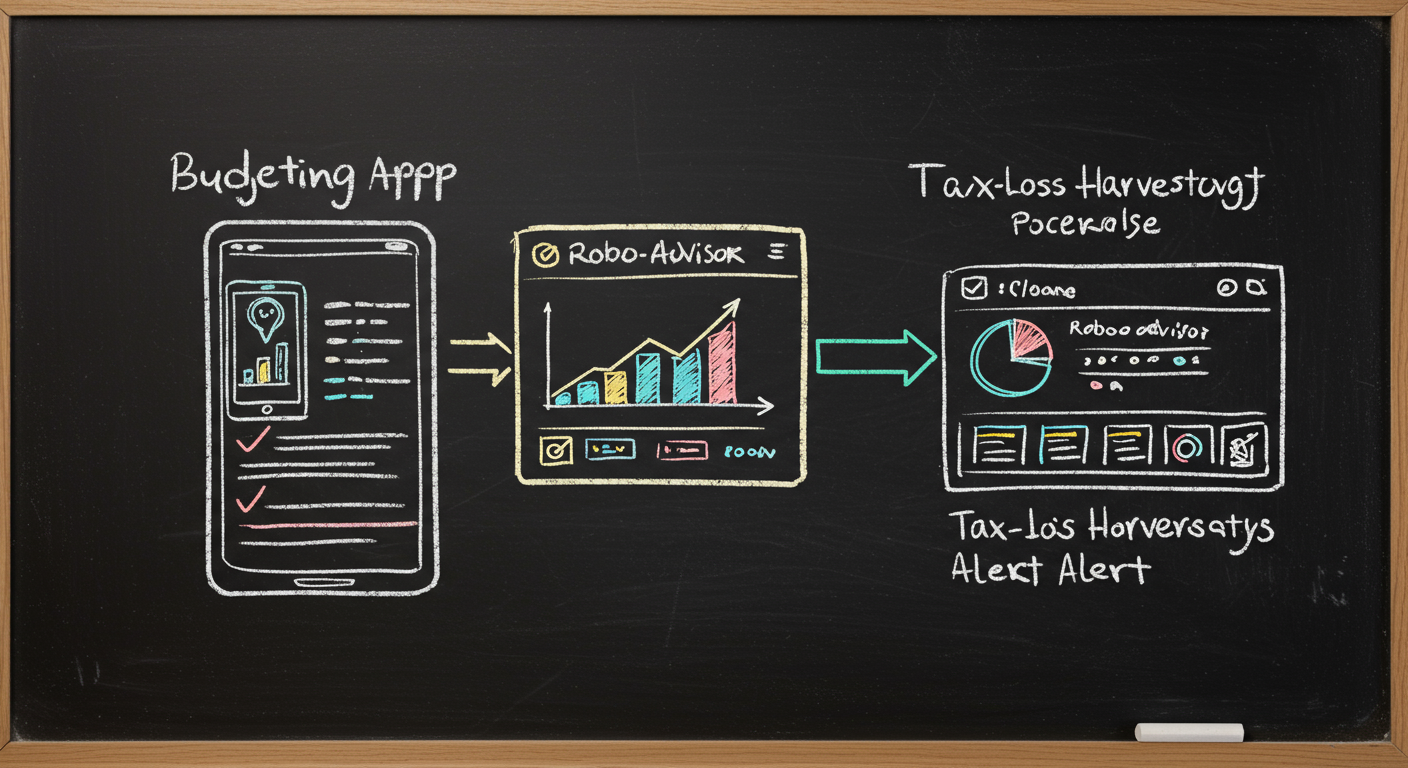
illustration
A clear diagram of a person comparing a budgeting app screen, a robo-advisor portfolio screen, and a tax-loss harvesting alert
diagram
note

When the app is wrong

If you split rent with roommates, the app may classify reimbursements badly. If you move money between checking and savings, it may briefly show a false expense. Good users review the categories, correct mistakes, and teach the system over time.

How to choose the right tool for your money

note

Best use cases by tool

Budgeting app

Use it when you need:

  • Spending visibility
  • Subscription cleanup
  • Cash flow alerts
  • Habit change

Robo-advisor

Use it when you need:

  • Automatic investing
  • Rebalancing
  • Tax-aware management in taxable accounts
  • Simple, diversified portfolios

Human adviser

Use it when you need:

  • Estate planning
  • Stock options or concentrated positions
  • Business ownership issues
  • Multi-country taxes
  • Complex retirement planning
diagram
note

Quick decision rule

If the problem is repetitive, software can probably help.

If the problem depends on values, tradeoffs, or legal complexity, software should support the decision, not make it for you.

That is the boundary between automation and advice.

chart · pie
Where AI finance tools add value
Spending visibilityRebalancingTax-loss harvestingSubscription cleanupComplex planning

Transcript

Welcome to Slate. Today we're looking at Can AI Manage Your Money? Robo-Advisors Explained. We'll cover How AI budgeting tools analyze your spending patterns, Robo-advisors: Betterment, Wealthfront, and the competition, AI-driven tax optimization and tax-loss harvesting, and What these tools can and cannot do for you. Let's get into it.

AI money tools do not think about your finances the way a human adviser does. They look for patterns. A budgeting app might scan hundreds of card transactions and group them into rent, groceries, rideshares, and subscriptions. A robo-advisor does something similar with your investments. It asks about your goal, your time horizon, and your risk tolerance, then places you into a portfolio built from low-cost exchange-traded funds, or E-T-Fs. Think of it like a thermostat with a few settings, not a personal chef. It can keep the room near the target temperature. It cannot decide what meal you actually want. The first big difference is scope. Budgeting apps try to help with cash flow. Robo-advisors try to help with long-term investing. Some apps, like Monarch Money and Rocket Money, use machine learning to categorize transactions and detect recurring charges. That is useful when your spending is messy. But the app only knows what it can see in your linked accounts. Cash purchases, shared bills, and transfers between your own accounts can confuse the picture. Robo-advisors are narrower and more disciplined. Betterment launched in 2008. Wealthfront launched in 2008 as well. They automate portfolio construction, rebalancing, and sometimes tax-loss harvesting. That is not the same as stock picking. It is rules-based investing with software doing the bookkeeping at scale.

Here is the basic workflow. You answer a questionnaire. The platform estimates your risk tolerance, your time horizon, and sometimes your tax situation. Then it places you into a model portfolio. Most model portfolios use broad index funds, because broad funds are cheap and diversified. That matters. A portfolio is like a toolbox. You want a few reliable tools, not a drawer full of duplicates. Betterment and Wealthfront both use Modern Portfolio Theory ideas in the background. Harry Markowitz published the core work in 1952. The main lesson is that mixing assets can reduce risk without necessarily reducing expected return as much as holding one asset alone. In normal language, you do not want all your eggs in one basket, and you also want the baskets to behave differently. Rebalancing is one of the most valuable automation features. Suppose your target is 80 percent stocks and 20 percent bonds. After a strong stock market run, you might drift to 88 percent stocks. The robo-advisor can sell some stocks or direct new deposits into bonds to pull you back. That keeps your risk closer to the level you chose. But the model is only as good as the inputs. If you say you can tolerate volatility but panic during a 20 percent drop, the software cannot fix that by itself.

Tax-loss harvesting is one of the most concrete ways robo-advisors try to add value. The idea is simple. If an investment in a taxable account falls below what you paid for it, you can sell it, realize the loss, and use that loss to offset capital gains. In the United States, if losses are larger than gains, up to 3,000 dollars of net capital losses can offset ordinary income each year, with extra losses carried forward. That rule comes from the Internal Revenue Code. Wealthfront made tax-loss harvesting a headline feature early on, and Betterment also offers tax-loss harvesting for taxable accounts. The software watches for losses across a portfolio and can swap into a similar, but not identical, fund to keep market exposure while respecting the wash-sale rules. The wash-sale rule generally disallows a loss deduction if you buy a substantially identical security within 30 days before or after the sale. Think of tax-loss harvesting like cleaning a whiteboard after a messy brainstorming session. You keep the ideas, but you wipe away the smudges so the next round starts cleaner. The catch is that the benefit depends on your tax bracket, your gains, and how long you hold the assets. In a retirement account, the strategy has no immediate tax value because those accounts are already tax-advantaged. This is where automation is genuinely useful. The software can scan thousands of holdings and notice tiny opportunities a human might miss. But it cannot promise extra return every year. Sometimes the market is up, and there are simply fewer losses to harvest.

Budgeting apps are strongest at pattern recognition. If your grocery spending jumps from 600 dollars a month to 950 dollars, the app can flag the change. If Netflix, Spotify, and an old storage plan keep charging every month, the app can surface those subscriptions. That is useful because humans are bad at noticing small leaks. A 15 dollar charge is easy to ignore once. Over a year, it becomes 180 dollars. The weakness is context. A transaction labeled travel might be a plane ticket, a hotel, or a reimbursement from your employer. A transfer to a savings account may look like spending when it is really progress. Joint accounts are even harder, because the app cannot always know whose purchase is whose. There is also a privacy tradeoff. To categorize spending, these tools often need access to linked financial accounts through account aggregators such as Plaid. That means convenience comes with data sharing. The more accounts you connect, the better the picture, and the bigger the trust question. A good budgeting app is like a flashlight in a dark garage. It helps you see what is there. It does not tell you what project you should build next. For that, you still need judgment, priorities, and a plan that fits your real life.

The right tool depends on the job. If you want to stop overspending and understand where your paycheck goes, a budgeting app can help quickly. If you want automated investing with low fees and steady rebalancing, a robo-advisor can do that well. If you want a full financial plan with stock options, business income, multiple properties, or a complicated tax situation, software alone is usually not enough. Fee structure matters. Many robo-advisors charge around 0.25 percent of assets under management, though pricing changes by provider and account size. That fee may be worth it if the automation keeps you invested and disciplined. But if you have a simple portfolio and the confidence to manage it yourself, a low-cost brokerage account and a target-date fund may be cheaper. The best use of AI in personal finance is not surrendering control. It is reducing busywork. Let software categorize transactions, rebalance drift, and scan for tax lots. Then spend your attention on the human decisions: how much to save, what risks you can truly تحمل, and when to ask for a licensed adviser or tax professional. That is the real limit. These tools are excellent at execution. They are much weaker at wisdom.

XLinkedInWhatsApp

Keep going with Slate

Pick up where this left off in your own voice session.

Built with Slate