1. Where AI bias comes from
0:007:34
Computer Science

Can AI Be Ethical? The Bias Problem

AI now decides who gets hired, who gets loans, and who gets parole. Explore how bias enters these systems and what we can do.

Apr 22, 20268 min listen5 chapters
What you'll learn
  • How bias enters AI systems and why it is hard to remove
  • Frameworks for responsible AI development
  • Case studies: hiring algorithms, predictive policing, healthcare triage
  • The global landscape of AI regulation in 2026

1. Where AI bias comes from

note

Can AI Be Ethical? The Bias Problem

AI now decides who gets hired, who gets loans, and who gets parole. Explore how bias enters these systems and what we can do.

note

How bias enters machine learning systems

Bias can enter at three main stages:

  • Data collection: the training set is incomplete or unrepresentative
  • Labeling: people encode subjective judgment into the target variable
  • Deployment: the model is used in a setting different from the one it was trained on

A useful analogy: training data is like a classroom textbook. If the textbook leaves out whole chapters of history, the student who learns from it will be confident and still wrong.

Common sources of bias include:

  • Historical bias: past discrimination appears in records
  • Sampling bias: some groups are underrepresented
  • Measurement bias: the thing being measured is not the thing we really care about
  • Proxy bias: a harmless-looking variable stands in for a sensitive trait
  • Feedback loops: model decisions change the world, and the new data reinforces the same pattern
diagram
note

Why bias is hard to remove

Removing one source of bias can expose another. If you rebalance data, you may increase noise. If you remove a sensitive feature like race or gender, the model can still infer it from ZIP code, school, or employment history. In fairness research, this is called proxy discrimination.

There is also a tradeoff between different fairness goals. A model can satisfy one fairness metric and violate another. For example, equal false positive rates and equal calibration are often impossible to satisfy at the same time when base rates differ across groups. That result was formalized in the fairness literature by researchers including Jon Kleinberg, Sendhil Mullainathan, and Manish Raghavan in 2016.

So the real question is not, “Can we make AI perfectly neutral?” It is, “Which harms are we trying to prevent, for whom, and under what context?”

equation
Bias=systematic error that favors some outcomes or groups over others\text{Bias} = \text{systematic error that favors some outcomes or groups over others}
note

A simple worked example

Suppose a hiring model is trained on 10,000 past applications. If 80 percent of the historical hires were men, the model may learn that male-coded signals correlate with success. Even if gender is removed, the model may still use signals like certain extracurriculars, career gaps, or school networks as proxies.

That is why fairness work starts with problem definition, not just model tuning.

2. The fairness toolbox

note

Core fairness metrics in AI

Demographic parity

  • The model selects people at similar rates across groups
  • Useful when selection itself is the concern
  • Can be misleading if groups differ in underlying risk or eligibility

Equalized odds

  • False positive rates and false negative rates are similar across groups
  • Useful when mistakes have unequal costs
  • Often harder to satisfy in practice

Calibration

  • A predicted score means the same thing across groups
  • Important for risk scores and triage systems

Individual fairness

  • Similar people should receive similar predictions
  • Hard to define because “similar” depends on the task

Analogy: demographic parity is like making sure every classroom gets the same number of gold stars. Equalized odds is like making sure the grading mistakes are equally common in every classroom.

diagram
chart · bar
Example fairness comparison
Group A selection rateGroup B selection rateGroup A false positive rateGroup B false positive rate

3. Three high-stakes case studies

note

Case study 1: hiring algorithms

What can go wrong:

  • Historical hiring data reflects old discrimination
  • Resume features can act as proxies for gender, age, or class
  • Automated ranking can hide the reason a candidate was rejected

What helps:

  • Use job-relevant features only
  • Audit outcomes by subgroup
  • Keep humans accountable for final decisions

Case study 2: predictive policing

What can go wrong:

  • Arrest data is not the same as crime data
  • Patrol intensity changes what gets recorded
  • Feedback loops amplify existing surveillance patterns

Case study 3: healthcare triage

What can go wrong:

  • Spending is used as a proxy for need
  • Under-treated patients look healthier than they are
  • Risk scores can worsen inequities if they ignore access differences
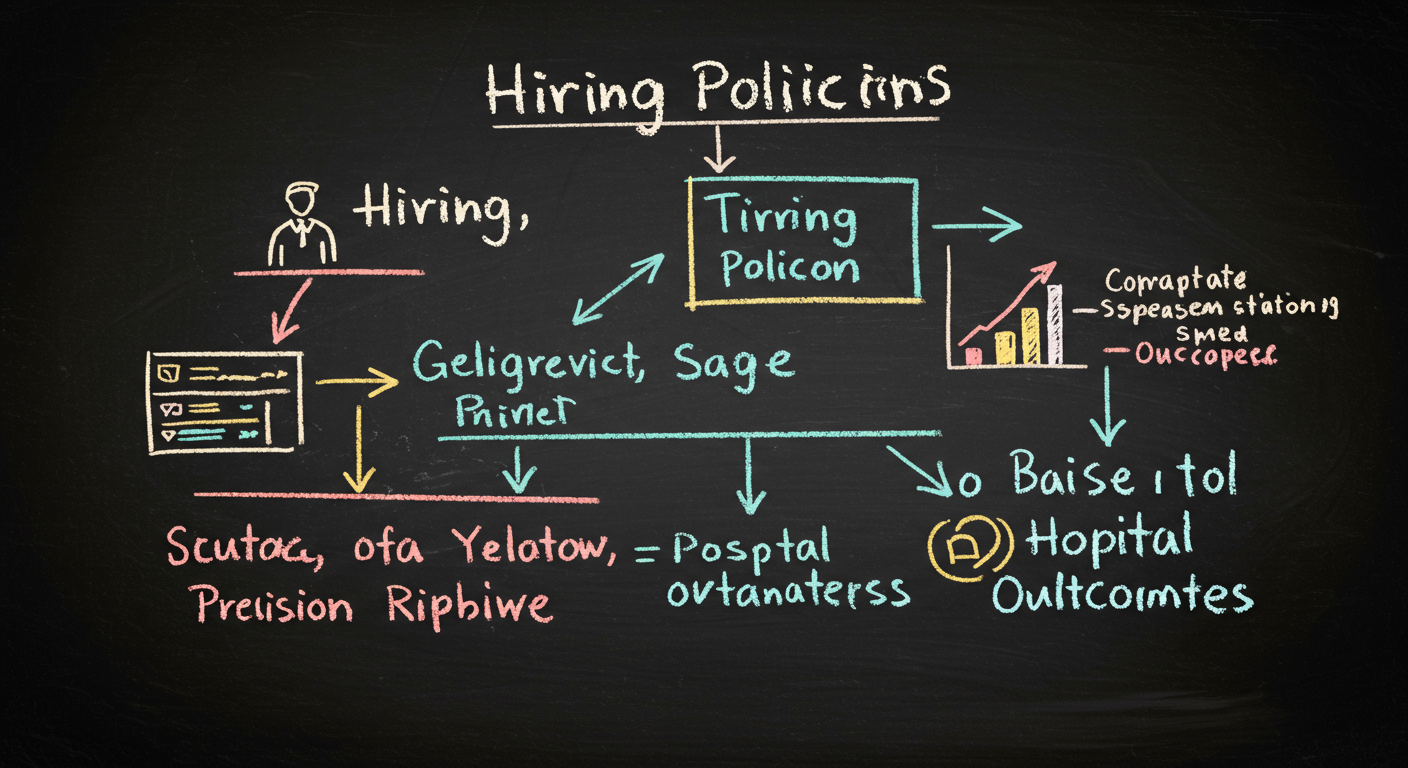
illustration
A hiring, policing, and hospital triage decision pipeline with arrows showing how biased data can shape outcomes
diagram
note

What these cases teach

The hardest part is not detecting bias after the fact. It is noticing which variable is acting as a proxy before harm spreads. That takes domain experts, not just machine learning engineers.

4. Responsible AI in practice

note

Responsible AI development framework

  1. Problem framing

    • What decision is being automated?
    • Who can be harmed?
    • Is automation necessary?
  2. Data review

    • Who is represented?
    • What is missing?
    • Are labels reliable?
  3. Model evaluation

    • Test accuracy and fairness together
    • Compare error rates across groups
    • Stress-test edge cases
  4. Human oversight

    • Set escalation rules
    • Require review for high-impact cases
    • Make overrides visible
  5. Post-deployment monitoring

    • Track drift
    • Re-audit regularly
    • Log complaints and appeals
diagram
note

Practical safeguards

  • Use representative test sets, not only average accuracy
  • Set thresholds separately when justified by the use case and law
  • Keep an appeal path for people affected by automated decisions
  • Log model inputs, outputs, and overrides
  • Reassess the system when the population or policy changes

A useful analogy: responsible AI is less like a single exam and more like a flight checklist. The plane can be technically capable and still unsafe if one step is skipped.

equation
Risk=Impact×Likelihood\text{Risk} = \text{Impact} \times \text{Likelihood}
note

Documentation matters

Model cards and datasheets help teams answer three questions:

  • What was this system built for?
  • What data shaped it?
  • When should it not be used?

That last question is often the most honest one.

5. Regulation and the road ahead in 2026

note

Global AI regulation snapshot in 2026

European Union

  • AI Act in force since 1 August 2024
  • Phased obligations for banned uses, general-purpose AI, and high-risk systems
  • Strong emphasis on documentation, risk management, and human oversight

United States

  • Sector-by-sector rules and enforcement
  • Executive Order 14110 issued on 30 October 2023
  • Local rules such as New York City Local Law 144 for hiring tools

United Kingdom

  • Regulator-led approach across sectors
  • Guidance from bodies such as the Information Commissioner's Office and the Financial Conduct Authority

China

  • Rules for recommendation systems, deep synthesis, and generative AI services
  • Strong content and platform governance

International

  • Council of Europe AI Convention adopted in 2024
  • OECD AI Principles remain a widely used policy reference
chart · pie
Illustrative regulatory approaches
EU prescriptiveUS sectoralUK regulator ledChina platform rulesOther regions
diagram
note

What good teams do now

  • Build compliance into product design
  • Keep audit trails and model documentation
  • Test for bias before launch and after updates
  • Include legal, policy, engineering, and domain experts
  • Give users a way to contest automated decisions

The goal is not to make AI perfectly innocent. The goal is to make it accountable, testable, and reversible when it causes harm.

Transcript

Welcome to Slate. Today we're looking at Can AI Be Ethical? The Bias Problem. We'll cover How bias enters AI systems and why it is hard to remove, Frameworks for responsible AI development, Case studies: hiring algorithms, predictive policing, healthcare triage, and The global landscape of AI regulation in 2026. Let's get into it.

AI systems do not start neutral. They learn patterns from human data, and human data carries history. Here is the key idea: a model is like a mirror made of math. It reflects what was in the training set, including gaps, stereotypes, and old decisions. If past hiring favored men for engineering jobs, a model trained on those records can learn that pattern and repeat it. Bias enters at several points. The data may be unbalanced. The labels may encode human judgment, and human judgment is noisy. The goal itself may be the problem. If a hospital uses past spending as a proxy for medical need, the model can underestimate care for patients who had less access in the first place. That happened in a widely cited 2019 study by Ziad Obermeyer and colleagues in Science, where a commercial health-risk algorithm used cost as a stand-in for illness and reduced the share of Black patients flagged for extra care. Notice the pipeline on the screen. Bias can enter before training, during training, and after deployment. A model can also look fair in the lab and fail in the real world when the population changes. That is why bias is not a single bug. It is a system problem.

When people say an AI system should be fair, they often mean different things. Here is the practical move: define the harm first, then pick a metric that matches it. If a loan model rejects too many qualified applicants from one group, you may care about false negatives. If a policing model sends officers too often to one neighborhood, you may care about false positives and over-policing. The diagram shows the main fairness metrics. They do not all agree. That is not a failure of math. It is a sign that fairness is a value judgment, translated into equations. For example, demographic parity asks for equal selection rates across groups. Equalized odds asks for equal error rates, conditional on the true label. Calibration asks that a score of 0.8 means roughly an 80 percent chance of the outcome in every group. These can conflict. In a 2016 paper, Kleinberg, Mullainathan, and Raghavan showed that when base rates differ, you usually cannot satisfy calibration and certain error-rate parity conditions at once. So teams must choose. That choice should be documented, reviewed, and tied to the use case. A good rule: do not use a fairness metric as a slogan. Use it as a design constraint, then test what breaks.

High-stakes AI is where fairness becomes concrete. In hiring, the danger is not only discrimination. It is also hidden filtering. A model trained on resumes from one company may reward a narrow career path and punish people with nontraditional backgrounds. Amazon famously scrapped an experimental hiring system in 2018 after it learned patterns that downgraded resumes associated with women. The lesson is not that all automation is bad. The lesson is that past hiring data is a record of past hiring choices, not pure job performance. In predictive policing, the feedback loop is the story. If police are sent more often to one neighborhood, they find more recorded crime there, which makes the model send them back again. The algorithm is not just predicting crime. It is predicting where enforcement has already been concentrated. In healthcare triage, the stakes are life and time. A triage system that uses cost or prior spending can miss patients who needed care but received less of it. The 2019 Science study found that the algorithm would have more than doubled the number of Black patients receiving extra care if it had used illness burden instead of cost-based proxies. These cases share one pattern. The model is only one part of the system. The policy around it matters just as much.

Responsible AI is not a certificate you hang on a wall. It is a set of habits built into the product cycle. Here is the practical sequence. First, define the decision and the harm. Second, check whether you even need automation. Third, test the data for representation gaps. Fourth, evaluate the model across groups. Fifth, add human review where the cost of error is high. Sixth, monitor after launch, because drift can make yesterday’s safe model unsafe tomorrow. The flowchart on screen shows this loop. Notice that monitoring is not the end. It is the beginning of real accountability. A model can pass a fairness audit in January and fail in July if the applicant pool changes or if the organization changes how it uses the score. A strong governance process also needs documentation. Model cards, introduced by Margaret Mitchell and colleagues in 2019, summarize intended use, limitations, and evaluation results. Datasheets for datasets, proposed by Timnit Gebru, Jamie Morgenstern, Briana Vecchione, and others in 2021, do the same for training data. These documents do not make a system fair by themselves. They make it harder to hide uncertainty. Think of responsible AI like building a bridge. You do not inspect it once and walk away. You inspect it before opening, during heavy use, and after storms.

AI regulation is no longer theoretical. In the European Union, the AI Act entered into force on 1 August 2024. Its obligations phase in over time, with the first bans on certain unacceptable-risk practices applying after six months, rules for general-purpose AI after 12 months, and many high-risk obligations after 24 months. By 2026, organizations serving the EU must already be treating compliance as an operational task, not a legal memo. The United States uses a patchwork approach. The White House issued Executive Order 14110 on 30 October 2023, then federal agencies moved on procurement, safety testing, and civil-rights enforcement. States also act on their own. New York City Local Law 144, effective in 2023, requires bias audits for certain automated employment decision tools. The United Kingdom has favored sector-specific guidance through regulators rather than one single AI law. China has already issued rules for recommendation systems, deep synthesis, and generative AI services. Brazil has been debating a national AI framework, while the Council of Europe adopted the Framework Convention on Artificial Intelligence, Human Rights, Democracy and the Rule of Law in 2024. The global picture is not one rulebook. It is a map of different risk thresholds, disclosure duties, and enforcement styles. For teams building AI in 2026, the safest strategy is to design for the strictest credible standard, keep detailed records, and assume scrutiny from regulators, customers, and the public.

XLinkedInWhatsApp

Keep going with Slate

Pick up where this left off in your own voice session.

Built with Slate