What blockchain actually is
0:006:56
Business

Bitcoin, Ethereum, DeFi: Crypto Explained Simply

Beyond the hype — what blockchain is, how DeFi works, and whether crypto belongs in your portfolio in 2026.

Apr 22, 20267 min listen5 chapters
What you'll learn
  • How blockchain technology actually works
  • Bitcoin vs. Ethereum vs. stablecoins — different purposes
  • DeFi explained: lending, staking, yield farming
  • Whether crypto deserves a place in your portfolio

What blockchain actually is

note

Bitcoin, Ethereum, DeFi: Crypto Explained Simply

Beyond the hype — what blockchain is, how DeFi works, and whether crypto belongs in your portfolio in 2026.

note

Blockchain basics

A blockchain is a distributed database built from linked blocks of transactions.

Each block usually contains:

  • a batch of transactions
  • a timestamp
  • the previous block’s hash
  • a new hash for the current block

Why the hash matters: it acts like a tamper-evident seal. Change one transaction and the block’s hash changes. Then every later block that points to it becomes suspicious too.

What a blockchain is good at

  • shared records without one central owner
  • audit trails that are hard to rewrite
  • assets that can move directly between users

What a blockchain is bad at

  • high-speed transaction processing
  • cheap storage for large files
  • privacy by default

Bitcoin’s design goal was simple: a payment system with no central bank. Ethereum, launched in 2015, expanded the idea by letting developers run smart contracts, which are programs stored on the blockchain.

diagram
equation
Hn=h(Hn1Bn)H_n = h(H_{n-1} \parallel B_n)

Bitcoin, Ethereum, and stablecoins

note

Bitcoin vs Ethereum vs stablecoins

AssetMain purposeSupply designTypical use
BitcoinStore of value and paymentsCapped at 21 millionLong-term holding, settlement
EthereumSmart contract platformNo fixed cap, fee burn affects supplyDeFi, NFTs, apps
StablecoinsPrice stabilityBacked by reserves or algorithmsTrading, payments, cash parking

Why the differences matter

Bitcoin’s scarcity is the point. Ethereum’s flexibility is the point. Stablecoins’ stability is the point.

A common mistake is to judge all three with the same yardstick. That is like comparing a vault, a computer, and a dollar bill as if they were the same tool.

Ethereum’s proof-of-stake system replaced energy-intensive mining with validators who lock up ETH. If a validator acts dishonestly, part of the stake can be slashed. That gives the network economic security instead of electricity-based security.

diagram
chart · bar
Crypto asset roles
BitcoinEthereumStablecoins

How DeFi works

note

DeFi explained simply

DeFi is a set of financial services built with smart contracts instead of traditional intermediaries.

Common DeFi building blocks

  • lending and borrowing
  • decentralized exchanges
  • staking and liquid staking
  • liquidity pools
  • bridges between blockchains

Why people use DeFi

  • open access for anyone with a wallet
  • 24/7 markets
  • programmable rules
  • fast settlement on-chain

Main risks

  • smart contract bugs
  • price oracle manipulation
  • liquidation risk
  • bridge hacks
  • governance attacks

A protocol can be transparent and still be unsafe. Open code helps users inspect the rules, but it does not guarantee the code is correct.

diagram
python
# Simple collateral ratio example
collateral_value = 1500
loan_value = 900
collateral_ratio = collateral_value / loan_value
print(round(collateral_ratio, 2))

# If the protocol requires 150%, this position is safe for now.
required_ratio = 1.5
print(collateral_ratio >= required_ratio)

Should crypto belong in a portfolio in 2026

note

Crypto portfolio framework

Good reasons to own crypto

  • you understand the asset’s role
  • you can tolerate large drawdowns
  • you want a small speculative allocation
  • you use stablecoins or DeFi for a specific purpose

Bad reasons to own crypto

  • fear of missing out
  • expecting steady income with no risk
  • borrowing money to buy volatile assets
  • assuming every token is the same

Practical 2026 checklist

  • Know your custody method: exchange, self-custody wallet, or ETF where available.
  • Know your tax rules in your country.
  • Know whether the token is a currency, a utility token, or a speculative asset.
  • Size the position so a 50 percent drop does not force a sale.

The best portfolio decision is often less dramatic than social media suggests. Small, intentional, and understood beats large and vague.

chart · line
Illustrative crypto drawdown risk
Start-20%-40%-60%-70%
diagram

What to remember

note

Key takeaways

  • Blockchain is a distributed ledger secured by hashes and consensus.
  • Bitcoin, Ethereum, and stablecoins serve different jobs.
  • DeFi uses smart contracts to automate lending, trading, and staking.
  • Crypto can fit a portfolio, but usually as a small, intentional allocation.

Final test

If you cannot explain an asset in one sentence, you probably do not understand its role well enough to buy it.
illustration
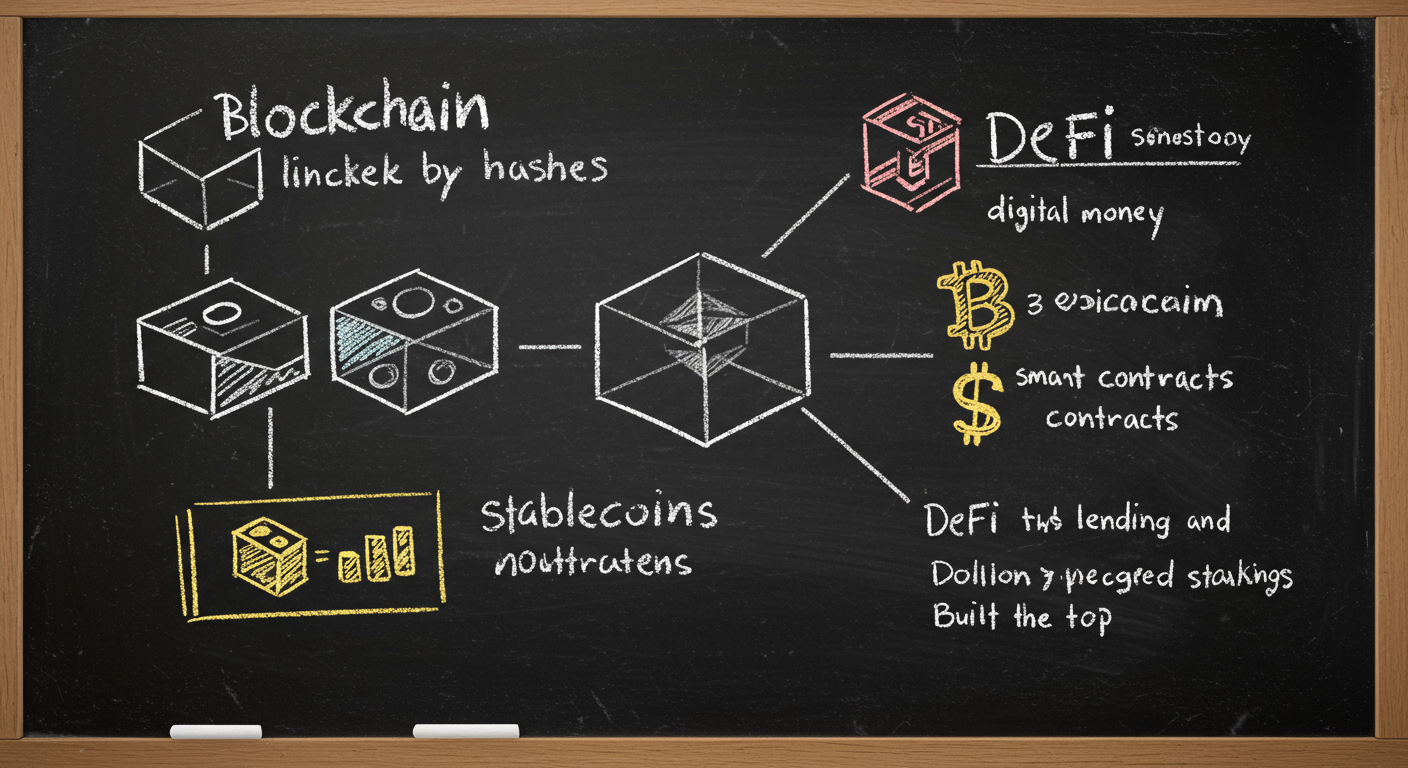
A clear educational diagram showing blockchain blocks linked by hashes, Bitcoin as digital money, Ethereum as smart contracts, stablecoins as dollar-pegged tokens, and DeFi as lending and staking apps built on top

Transcript

Welcome to Slate. Today we're looking at Bitcoin, Ethereum, DeFi: Crypto Explained Simply. We'll cover How blockchain technology actually works, Bitcoin vs. Ethereum vs. stablecoins — different purposes, DeFi explained: lending, staking, yield farming, and Whether crypto deserves a place in your portfolio. Let's get into it.

A blockchain is a shared ledger. Think of it like a notebook that many computers keep in sync. Each page is a block. Each new page points to the page before it with a cryptographic fingerprint called a hash. If someone changes an old page, the fingerprint changes, and the chain no longer matches. Here’s the key idea: the network does not trust one central bookkeeper. It checks the same record across many nodes, which are just computers running the software. The first block in Bitcoin was mined on January 3, 2009. That was the genesis block. Bitcoin used proof of work, where miners spend electricity to solve a puzzle. The puzzle is hard to solve but easy for everyone else to verify. That asymmetry is what keeps the ledger honest. A good analogy is a receipt with carbon copies. If one copy is altered, the mismatch is obvious. Blockchain does the same thing digitally, but with hashes and consensus instead of paper. Not every blockchain is the same. Public chains like Bitcoin and Ethereum let anyone read and join. Private chains restrict access. Public chains are slower than a normal database because thousands of nodes must agree. That tradeoff buys openness and resistance to tampering.

Bitcoin, Ethereum, and stablecoins solve different problems. Bitcoin is mainly digital money with a fixed supply cap of 21 million coins. That scarcity is why many people treat it like digital gold. But Bitcoin is not built for complex applications. Its scripting language is intentionally limited. Ethereum, by contrast, is a programmable platform. It supports smart contracts, so developers can build lending apps, exchanges, games, and token systems. Ether, or ETH, is used to pay for computation on the network. That fee is called gas. The network moved from proof of work to proof of stake in September 2022, in an event called the Merge. Stablecoins are different again. They are designed to track a stable asset, usually the U.S. dollar. Tether’s USDT and Circle’s USDC are the best-known examples. They are useful when traders want to move in and out of crypto without the price swings of Bitcoin or Ether. Here’s the clean mental model. Bitcoin stores value. Ethereum runs programs. Stablecoins try to keep a steady price. If you mix those up, you end up asking the wrong question about the wrong asset.

DeFi means decentralized finance. It is finance built on blockchains, mostly Ethereum and its layer 2 networks. Instead of a bank matching borrowers and lenders, smart contracts do the job. The code holds collateral, calculates rates, and moves funds according to rules everyone can inspect. A lending protocol is the easiest place to start. Suppose you deposit USDC into Aave. The protocol pools your deposit and lends it to borrowers who post collateral. If the collateral value falls too far, the position can be liquidated. That protects lenders. The tradeoff is that you do not get the same guarantees as a bank deposit insured by the FDIC in the United States. Staking is different from lending. When you stake ETH, you help secure proof-of-stake networks and earn rewards. It is closer to earning interest for helping run infrastructure, though the reward rate changes with network conditions. Yield farming means moving assets across DeFi protocols to chase the highest return. The yield can come from trading fees, token incentives, or both. It can also vanish quickly when incentives change. A useful analogy is coupon hunting across grocery stores. The discount is real, but it can disappear tomorrow. DeFi can be powerful. It can also fail through bugs, oracle errors, and smart contract exploits. In 2022, the Ronin bridge hack drained about 625 million dollars. Code is not the same as safety.

The right answer depends on your goals, time horizon, and risk tolerance. Crypto is volatile. Bitcoin has had multiple drawdowns greater than 70 percent. Ether has also seen severe drops. That means position sizing matters more than conviction. For many investors, crypto belongs in the speculative slice of a portfolio, not the money you need for rent, tuition, or a house down payment. A small allocation can give you exposure without letting one asset dominate your future. Some advisers use a range like 1 to 5 percent for high-risk assets, but there is no universal rule. The point is to keep the downside survivable. You also need to separate price from utility. Bitcoin may act like a macro asset for some investors. Ethereum may benefit if on-chain applications keep growing. Stablecoins are not really an investment; they are a transaction tool and a parking place for cash on-chain. Before buying, ask three questions. What problem does this asset solve? How much can I lose without changing my life? And do I understand the custody risk, tax treatment, and platform risk? If the answer to any of those is no, wait. A portfolio should fit your life, not your fear of missing out.

Here is the short version. Blockchain is a way for many computers to agree on a record without one central owner. Bitcoin uses that structure mainly for money. Ethereum uses it for programmable applications. Stablecoins try to keep a steady value. DeFi takes the old financial toolbox and rebuilds it with smart contracts. The promise is access, transparency, and automation. The cost is complexity, technical risk, and price volatility. That is why the same asset can be useful to one person and inappropriate for another. If you remember one analogy, make it this one: blockchain is a shared notebook, Bitcoin is the scarce asset inside it, Ethereum is the computer that runs apps on it, and DeFi is the financial software built on top. The notebook matters, but the rules written inside it matter just as much. For 2026, the smartest approach is not guessing which coin will be loudest. It is understanding what each asset does, what can go wrong, and how much risk your portfolio can truly absorb.

XLinkedInWhatsApp

Keep going with Slate

Pick up where this left off in your own voice session.

Built with Slate