1. Why lithium-ion is running into limits
0:006:58
Science

Beyond Lithium-Ion: The Next Battery Breakthrough

Solid-state and sodium batteries are here. They charge faster, last longer, and could finally make renewables reliable.

Apr 22, 20267 min listen5 chapters
What you'll learn
  • Why lithium-ion is hitting its ceiling
  • Solid-state and sodium-ion breakthroughs in 2026
  • Impact on EV range, charging speed, and cost
  • Grid-scale storage and the renewable energy unlock

1. Why lithium-ion is running into limits

note

Beyond Lithium-Ion: The Next Battery Breakthrough

Solid-state and sodium batteries are here. They charge faster, last longer, and could finally make renewables reliable.

note

Lithium-ion battery limits

Lithium-ion is mature, but not limitless.

A modern cell is balanced around four constraints:

  • Energy density: how much energy fits in a kilogram or liter
  • Power: how fast the battery can deliver or absorb energy
  • Safety: how it behaves under heat, damage, or abuse
  • Cost: materials, manufacturing, and pack-level hardware

The hard part is that improving one often stresses the others.

A useful analogy is a crowded highway. You can move more cars by narrowing the lanes and speeding everyone up, but congestion and accidents rise quickly. Battery engineers face the same tension between speed, capacity, and safety.

diagram
equation
E=VQE = VQ
note

Why the ceiling matters

Battery energy is voltage times charge. If chemistry cannot safely raise voltage or store more charge, gains slow down.

At the pack level, the extra hardware needed for cooling and protection also eats into usable energy density. That is why a cell that looks excellent on paper can shrink once it becomes a real vehicle battery.

chart · bar
Typical EV battery energy density
Cell levelPack levelOlder packs
note

What this means in practice

Lithium-ion will not disappear. It is too cheap, too scalable, and too well understood. But incremental gains are getting smaller. That opens the door for chemistries that solve different problems instead of trying to squeeze more from the same liquid-electrolyte design.

2. Solid-state batteries: what changes when the liquid is gone

note

Solid-state battery basics

A solid-state battery swaps the liquid electrolyte for a solid one.

That can bring three advantages:

  • Higher energy density, especially with lithium-metal anodes
  • Better safety, because there is less flammable solvent
  • Potentially faster charging, if ion transport and interfaces are engineered well

The challenge is not the idea. The challenge is the interface. Solid materials do not self-wet the way liquids do. Every microscopic gap adds resistance.

diagram
note

Why interfaces are the bottleneck

In a liquid battery, the electrolyte flows into tiny pores and keeps contact everywhere. In a solid battery, contact depends on pressure, surface quality, and mechanical stability.

That means engineers must solve three problems at once:

  • Conductivity through the solid
  • Stable contact over time
  • Manufacturing at automotive scale

A battery that works in a coin cell is not automatically a battery that works in a 1,000-pound pack.
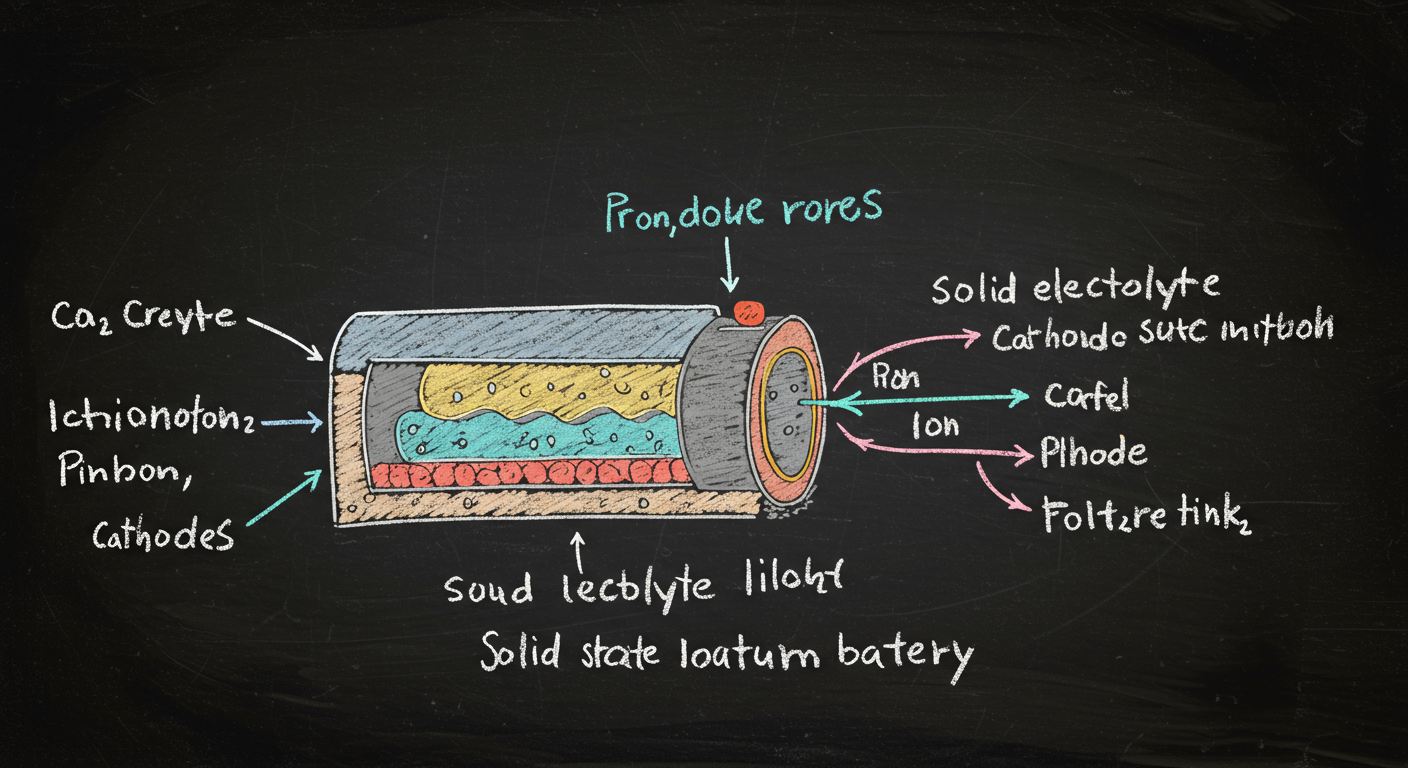
illustration
cross section of a solid-state battery showing solid electrolyte lithium metal anode cathode and ion flow
note

What solid-state can change for EVs

If mass production succeeds, solid-state batteries could improve range because the pack carries more energy for the same weight. They could also support faster charging if the chemistry tolerates high current without plating or cracking.

But these gains are not free. Early products may cost more than today’s lithium-ion packs. The first winners are likely premium vehicles, where higher price can absorb the manufacturing complexity.

chart · line
Solid-state development path
Lab cellsPilot lineAutomotive validationMass production

3. Sodium-ion batteries: the cheaper chemistry for abundant storage

note

Sodium-ion battery chemistry

Sodium-ion batteries replace lithium with sodium in the charge carrier.

That brings real advantages:

  • Lower material cost pressure
  • Better supply chain resilience
  • Good performance in cold conditions for some designs
  • Attractive economics for stationary storage

The main drawback is lower energy density than lithium-ion. Sodium is heavier and larger, so fewer watt-hours fit into the same space.

equation
Energy densitycharge storedmass or volume\text{Energy density} \propto \frac{\text{charge stored}}{\text{mass or volume}}
diagram
chart · bar
Chemistry tradeoffs
Lithium ionSolid stateSodium ion
note

Where sodium-ion wins

Sodium-ion is a strong fit when volume and weight are less important than cost per kilowatt-hour.

That includes:

  • Utility-scale storage for solar and wind
  • Backup power for data centers and telecom sites
  • Low-cost urban vehicles
  • Microgrids and remote communities

For a grid battery, the goal is not maximum range. The goal is to move electricity from noon to evening, or from a windy night to a calm afternoon.

4. What these batteries change for EVs, charging, and the grid

note

EV impact: range, charging, cost

Solid-state batteries could raise range by improving energy density. That matters most in premium EVs, where every kilogram counts.

Sodium-ion batteries are less likely to set range records, but they can reduce pack cost for smaller cars.

Fast charging depends on three things working together:

  • Cell chemistry
  • Thermal management
  • Charger power

Even a very good cell cannot charge quickly if the pack overheats.

diagram
chart · line
Charging time example
10 to 80 percentImproved cellBest case target

5. The real bottleneck: manufacturing at scale

note

Scale determines success

A battery technology must survive four gates:

  • Lab proof of concept
  • Pilot production
  • Automotive or grid validation
  • High-volume manufacturing

Many chemistries clear the first gate. Far fewer clear the last one.

The winning chemistry is often the one that is good enough, manufacturable, and cheap enough.

diagram
note

Big picture

Lithium-ion is approaching a practical ceiling.

Solid-state aims for more energy and better safety.

Sodium-ion aims for lower cost and better supply resilience.

Together, they make batteries more matched to the job. That is the real breakthrough.

chart · pie
Best fit by application
Long range EVsCity EVsGrid storageBackup power

Transcript

Welcome to Slate. Today we're looking at Beyond Lithium-Ion: The Next Battery Breakthrough. We'll cover Why lithium-ion is hitting its ceiling, Solid-state and sodium-ion breakthroughs in 2026, Impact on EV range, charging speed, and cost, and Grid-scale storage and the renewable energy unlock. Let's get into it.

Lithium-ion batteries still power most phones, laptops, and electric cars. But the chemistry is close to its practical ceiling. A typical lithium-ion cell uses a graphite anode, a liquid electrolyte, and a metal-oxide cathode. That liquid helps ions move fast, but it also adds safety risk. If a cell overheats, the separator can fail and the battery can go into thermal runaway. That is the chain reaction engineers try to prevent. Here is the key tradeoff. To store more energy, you want a higher-voltage cathode and a denser anode. But pushing harder often means more heat, faster aging, and more cost. Today’s best lithium-ion packs for electric vehicles usually deliver about 250 to 300 watt-hours per kilogram at the pack level, not the cell level. The pack is heavier because of cooling, wiring, casing, and safety hardware. Charging is limited too. Fast charging works by forcing lithium ions into the graphite quickly. Do that too hard, especially in the cold, and metallic lithium can plate on the anode. That lowers capacity and can create safety problems. So the battery acts like a narrow bridge. More traffic sounds good, until the bridge starts to buckle. This is why the next battery wave matters. Researchers are trying to replace the liquid, change the ion chemistry, or both.

Solid-state batteries replace the flammable liquid electrolyte with a solid material. That sounds simple, but it changes almost everything. The solid can be ceramic, polymer, or a hybrid. The goal is to let lithium ions move through a stable solid while using a lithium-metal anode or another high-capacity design. Why does that matter? Lithium metal stores far more charge than graphite. In theory, that can raise energy density and shrink battery weight. It also can improve safety because there is no liquid solvent to leak or ignite. But the interface between solid layers is the hard part. Ions must cross tiny contact points, and if the layers do not stay pressed together, resistance rises. Think of it like trying to pass water between two pieces of dry sponge. If the surfaces touch perfectly, flow is fine. If gaps form, movement slows fast. That is why many solid-state prototypes work well in the lab but struggle in a car, where vibration, temperature swings, and thousands of charge cycles are unforgiving. By 2026, the progress is real, but it is still uneven. Toyota has said it aims for solid-state batteries in the second half of the 2020s. QuantumScape has reported multi-layer solid-state cell development, but commercial scale is still the test.

Sodium-ion batteries use sodium instead of lithium. That one swap changes the economics. Sodium is far more abundant in the Earth’s crust and can be sourced from common industrial feedstocks. That lowers material pressure and reduces dependence on lithium supply chains. The tradeoff is energy density. Sodium ions are larger and heavier than lithium ions, so sodium-ion batteries usually store less energy per kilogram. That makes them less attractive for long-range electric cars. But for city EVs, scooters, backup power, and grid storage, lower cost can matter more than maximum range. In 2026, sodium-ion is moving from theory into products. CATL announced its sodium-ion battery in 2021 and has continued development toward commercial use. Several Chinese and European companies are targeting stationary storage and short-range vehicles. For the grid, that is a big deal. A battery farm does not need to be light. It needs to be cheap, durable, and safe. Here is the simple picture. Lithium-ion is the sprinter. Sodium-ion is the utility player. It may not win the 400-meter race, but it can fill the roster where cost and supply chain resilience matter most.

Battery chemistry becomes real when it changes a vehicle or a power plant. For EVs, the headline numbers are range, charging time, and price. A higher-energy battery can extend range without making the car heavier. A faster-charging battery can cut a 10 to 80 percent session from about 30 minutes closer to 10 to 15 minutes, if the charging hardware and thermal system can keep up. But faster charging is not just about the cell. The charger, cable, cooling, and battery management system all have to cooperate. It is like trying to pour from a fire hose into a bottle. The bottle shape matters as much as the hose. For the grid, the value is different. Solar and wind are variable. In 2023, roughly 21 percent of U.S. utility-scale electricity generation came from wind and solar combined, according to the U.S. Energy Information Administration. More storage helps shift that power to when people actually need it. That is where sodium-ion can shine. It can be cheaper for multi-hour storage. Solid-state could help high-performance EVs. Different tools for different jobs. The future battery market is not one winner. It is a portfolio.

The final test is not the lab. It is the factory. Battery breakthroughs fail when they cannot be made repeatably, cheaply, and in huge volumes. A chemistry that works in a few hundred cells may collapse when it has to survive humidity, vibration, contamination, and tight cost targets. This is why manufacturing details matter so much. Yield, cycle life, and supply chain stability decide whether a battery becomes a product or a press release. If a solid-state cell needs extreme pressure to keep its layers in contact, the pack design gets heavier and more complex. If a sodium-ion cell gives up some range but can use cheaper materials and existing factory equipment, it may scale faster. The likely future is mixed. High-end EVs may adopt solid-state first if durability and cost improve enough. Grid storage may move faster toward sodium-ion because energy density matters less there. Conventional lithium-ion will remain dominant for years because factories already exist and the ecosystem is enormous. So the breakthrough is not one chemistry replacing another overnight. It is a split market. Each battery finds the job it does best, and that is how the energy transition gets cheaper and more reliable.

XLinkedInWhatsApp

Keep going with Slate

Pick up where this left off in your own voice session.

Built with Slate