Which side hustles actually pay
0:007:56
Business

Best Side Hustles That Actually Pay in 2026

Freelancing, content creation, micro-SaaS — which side hustles generate real income and which are noise.

Apr 22, 20268 min listen5 chapters
What you'll learn
  • Which side hustles actually generate sustainable income
  • The creator economy in 2026: platforms, monetization, burnout
  • Building a micro-SaaS with no-code and AI tools
  • Tax and legal basics for side income

Which side hustles actually pay

note

Best Side Hustles That Actually Pay in 2026

Freelancing, content creation, micro-SaaS — which side hustles generate real income and which are noise.

note

Side hustles that reliably generate income

Fastest path to cash

  • Freelancing: writing, design, editing, coding, bookkeeping, virtual assistance
  • Local services: cleaning, tutoring, photography, pet care, handyman work
  • High-trust consulting: marketing audits, analytics, resume review, sales coaching

Slower but scalable

  • Micro-SaaS and automation tools
  • Paid newsletters with a niche audience
  • Digital products tied to a real workflow
  • Content creation with a clear monetization path

Usually noisy or overstated

  • Generic affiliate sites with no audience
  • Dropshipping with no brand or service edge
  • Low-value print-on-demand stores
  • “Passive income” systems that depend on hype instead of demand
diagram
chart · bar
Typical time to first dollar
FreelancingLocal servicesContent creationMicro SaaSAffiliate site
note

What buyers actually pay for

  • Speed: they need it this week
  • Specificity: they want one narrow outcome
  • Reliability: they want fewer mistakes
  • Revenue impact: they want more sales, more leads, or less churn

A good side hustle is not “make money online.” It is “save a business 10 hours a week” or “help a creator publish twice as fast.”

Freelancing in 2026: the clearest path to income

equation
Weekly income=Hourly rate×Billable hoursWeekly\ income = Hourly\ rate \times Billable\ hours
python
hourly_rate = 75
billable_hours = 10
weekly_income = hourly_rate * billable_hours
monthly_income = weekly_income * 4.33
print(weekly_income)
print(round(monthly_income, 2))
diagram
note

What makes a freelance offer sell

Strong offers

  • Clear deliverable
  • Clear deadline
  • Clear business outcome
  • Easy before and after proof

Weak offers

  • Broad generalist services
  • Custom work with no scope
  • No examples
  • No price anchor

Good first niches

  • Short-form video editing
  • Podcast clipping
  • Bookkeeping cleanup
  • Email marketing setup
  • No-code automation
  • Resume and LinkedIn optimization

Creator economy: real money, real burnout

illustration
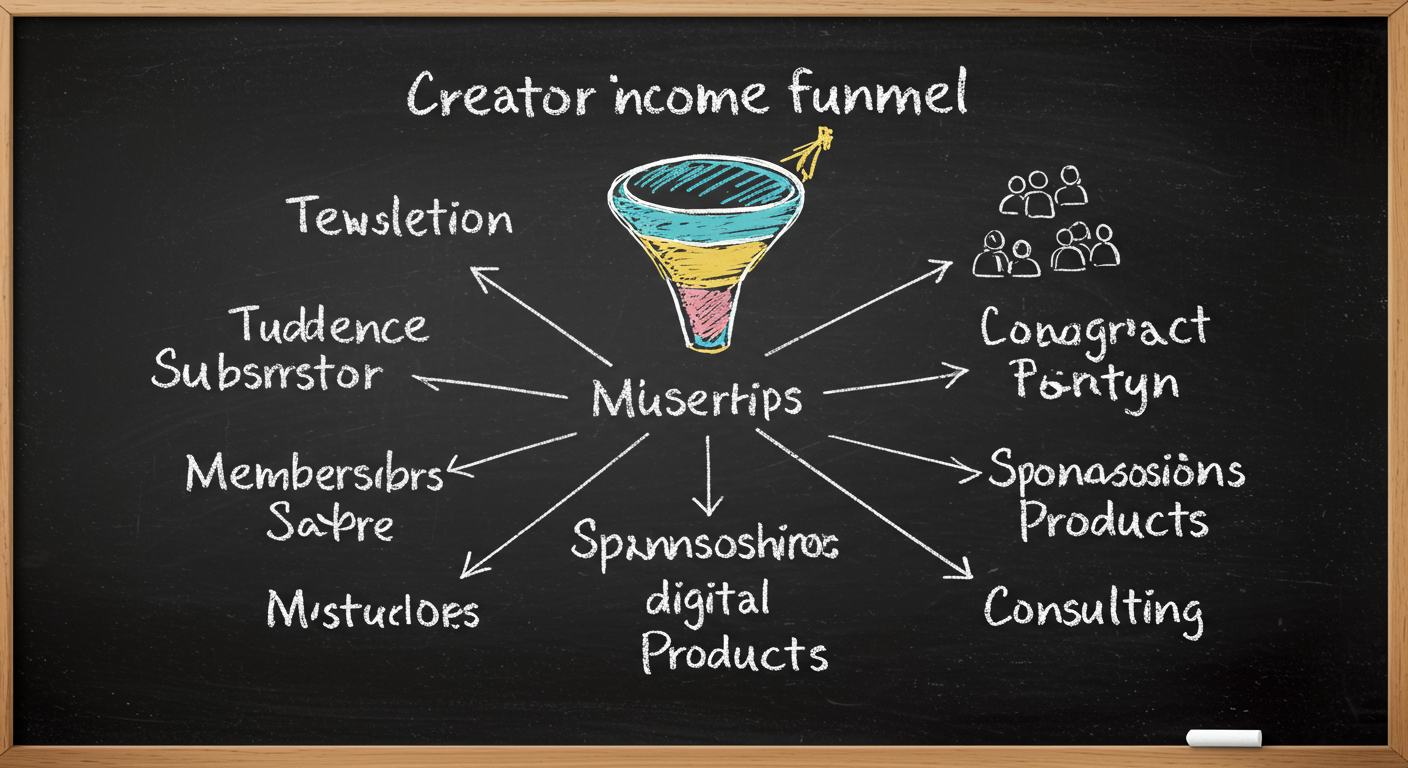
A creator income funnel showing audience attention turning into newsletter subscribers, memberships, sponsorships, digital products, and consulting
diagram
note

Creator economy realities

  • Audience growth is not the same as income
  • One niche audience beats broad attention
  • Platform risk is real
  • Reusing ideas across formats reduces burnout
  • Products and services stabilize cash flow

A creator business works best when the content answers a problem people already search for, fear, or need to solve.

Micro-SaaS with no-code and AI

javascript
const customers = 50;
const monthlyPrice = 39;
const monthlyRevenue = customers * monthlyPrice;
console.log(monthlyRevenue);
diagram
note

Micro-SaaS examples that can work

  • Invoice reminders for freelancers
  • Reporting dashboards for agencies
  • Appointment follow-up tools for clinics
  • Listing description generators for real estate teams
  • Compliance checklists for small firms

What usually fails

  • Too many features
  • No clear buyer
  • No recurring pain
  • Building before talking to users
equation
Monthly revenue=Customers×Price per monthMonthly\ revenue = Customers \times Price\ per\ month

Taxes, legality, and what to track

note

Tax and legal basics for side income

  • Report all income, even if no form arrives
  • Set aside money for taxes as you earn
  • Keep receipts for deductible expenses
  • Use contracts for freelance work
  • Separate business and personal accounts
  • Check local rules for sales tax, VAT, and business registration

Common deductible expense categories

  • Software and subscriptions
  • Internet and phone used for business
  • Equipment and peripherals
  • Advertising and website costs
  • Professional services and education
chart · bar
Example side hustle expense categories
SoftwareEquipmentAdvertisingEducationInternet share
diagram
note

Best practical rule

If a side hustle makes money but cannot survive basic bookkeeping, contracts, and tax planning, it is not a business yet. It is a cash stream with leaks.

Transcript

Welcome to Slate. Today we're looking at Best Side Hustles That Actually Pay in 2026. We'll cover Which side hustles actually generate sustainable income, The creator economy in 2026: platforms, monetization, burnout, Building a micro-SaaS with no-code and AI tools, and Tax and legal basics for side income. Let's get into it.

A side hustle is only useful if it earns more than it costs in time, tools, and stress. Here’s the first filter: ask whether the work has direct demand. Freelance writing, design, bookkeeping, video editing, and software support do. They solve a problem a buyer already has. That is why they pay faster than most “passive income” ideas. Think of side hustles like a vending machine versus a factory. A vending machine can make money while you sleep, but only after you stock it, place it well, and keep it working. A factory takes more setup, but it can scale. Freelancing is the vending machine of income: you can start fast, get paid in days or weeks, and learn what people will pay for. A micro-SaaS is closer to the factory: slower to build, but more scalable if it solves one narrow problem. The biggest mistake is chasing audience size instead of buyer intent. Ten clients paying 500 dollars a month beats 50,000 followers who never buy. In 2024, Upwork’s Freelance Forward report said 64 million Americans freelanced, showing how large the market already is. The question is not whether freelance work exists. The question is whether you can package a skill into something specific, repeatable, and sellable. Notice the pattern in the strongest side hustles: they reduce friction for a business, save time, or increase revenue. That is the real test.

Freelancing still wins when you want income fast, because you are selling a result, not a hope. The strongest offers are narrow. “I do marketing” is vague. “I write five SEO pages for local dentists” is easy to buy. Specificity lowers risk for the client, and that makes the sale easier. Here’s the math. If you charge 75 dollars an hour and work 10 billable hours a week, that is 750 dollars weekly before tax. At 20 hours, it is 1,500 dollars. The catch is billable time is never 100 percent of your work. Outreach, revisions, invoicing, and admin eat hours. Many new freelancers only bill 30 to 50 percent of their total working time. So a 20-hour week can feel like 35 hours of effort. That is why productized services matter. A productized service is like a menu item at a restaurant. Instead of custom work every time, you sell a fixed package. For example, “four short-form videos edited per week for 600 dollars” is easier to deliver and price than “video help.” The best freelance niches in 2026 are still tied to business outcomes: short-form video editing, ad creative, bookkeeping, CRM setup, no-code automation, and technical writing. AI can speed up the work, but it does not remove the need for judgment. Clients pay for accuracy, taste, and deadline safety.

Content creation can pay, but the income model matters more than the follower count. A creator with 8,000 loyal subscribers can earn more than someone with 200,000 casual viewers. Why? Because monetization comes from trust. Trust turns attention into memberships, courses, sponsorships, affiliate sales, and consulting. The platform mix in 2026 still rewards different behaviors. YouTube is strong for long-form search and ad revenue. TikTok and Instagram are better for discovery. Newsletter platforms work when the audience wants depth. But every platform has a hidden cost: you are building on rented land. Algorithm shifts can cut reach overnight. Burnout is the real tax. Constant posting creates a treadmill. If every week demands a new idea, a new hook, and a new format, the work becomes fragile. The healthier model is a content system. One idea becomes a video, a post, a newsletter, and a clip. That is like cutting one log into multiple boards instead of chopping a new tree every day. The best creator businesses in 2026 are usually niche and service-adjacent. A designer who teaches design systems. A marketer who sells templates. A nurse who explains exam prep. The content is the trust engine. The product is the income engine. If you separate those two, the business gets much easier to manage.

Micro-SaaS means a very small software product that solves one narrow problem for one type of user. Think of it as a pocket tool, not a giant machine. A good micro-SaaS does one job well enough that people keep paying for it. The no-code stack makes this possible for solo builders. Tools like Bubble, Glide, Softr, Airtable, Zapier, and Make can handle the database, interface, and automation. AI helps with code generation, support drafts, and content inside the product. But the hard part is still the same: finding a painful workflow. Here is the best path. Start with a problem you have seen up close. Maybe agencies need client reporting. Maybe realtors need listing descriptions. Maybe recruiters need resume screening. Build the smallest version that saves time or makes money. Then charge early. If no one pays, the problem is probably not sharp enough. A useful test is this: would someone pay 20 to 100 dollars a month to stop doing this manually? If yes, you may have a real product. If the answer is no, the idea is probably a feature, not a business. The advantage of micro-SaaS is recurring revenue. The risk is support and churn. A small product with 50 paying customers at 39 dollars a month earns 1,950 dollars monthly. That is meaningful, but only if churn stays low and acquisition stays manageable. Small software is still a business, not magic.

Income is only real if you keep enough of it. Side hustle taxes can surprise people because platforms do not pay them for you. In the United States, self-employment tax is 15.3 percent on net earnings, made up of 12.4 percent for Social Security and 2.9 percent for Medicare. On top of that, you may owe federal and state income tax. In 2025, the IRS still uses Form 1099-NEC for nonemployee compensation of 600 dollars or more, and Form 1099-K rules can apply depending on payment thresholds and platform reporting. The simplest habit is clean bookkeeping from day one. Track income, expenses, mileage if it applies, software subscriptions, equipment, and home office use when it qualifies. A spreadsheet works at the start. Accounting software helps once the volume grows. Here’s the legal mindset: separate business and personal money, use written agreements, and understand local rules before you scale. If you are freelancing, a contract protects scope and payment terms. If you are selling digital products or software, you may need to handle sales tax or value-added tax depending on where customers live. Think of taxes like the guardrails on a road. They do not tell you where to drive, but they keep the business from tipping over. A side hustle with strong income and sloppy records can still become a liability. The goal is not just to earn. It is to keep the profit.

XLinkedInWhatsApp

Keep going with Slate

Pick up where this left off in your own voice session.

Built with Slate