AI in Science: From AlphaFold to Drug Discovery
AI is no longer just analyzing papers — it designs molecules, runs experiments, and collaborates with scientists.
- How AI is accelerating drug discovery and materials science
- The AlphaFold moment and what came after
- Collaborative human-AI research workflows
- Ethical questions around AI-generated knowledge
1. AI moved from reading science to making it
AI in Science: From AlphaFold to Drug Discovery
AI is no longer just analyzing papers — it designs molecules, runs experiments, and collaborates with scientists.
From literature mining to scientific design
Early scientific AI systems were strongest at finding patterns in text and data. They could classify papers, extract named entities, and support systematic reviews. But modern AI in science goes further: it predicts protein structure, suggests molecules, and helps plan experiments.
Why this matters
Scientific discovery often means searching a huge space:
- Protein folding: one amino-acid sequence can produce many possible shapes
- Drug discovery: millions to billions of candidate molecules
- Materials science: vast combinations of elements, crystal structures, and processing conditions
AI reduces the search space. It does not replace experiments. It makes experiments more targeted.
A useful analogy
Think of AI as a metal detector on a beach. It does not dig for you, and it does not prove treasure is there. But it helps you avoid digging every square meter of sand.
2. The AlphaFold moment
What AlphaFold actually did
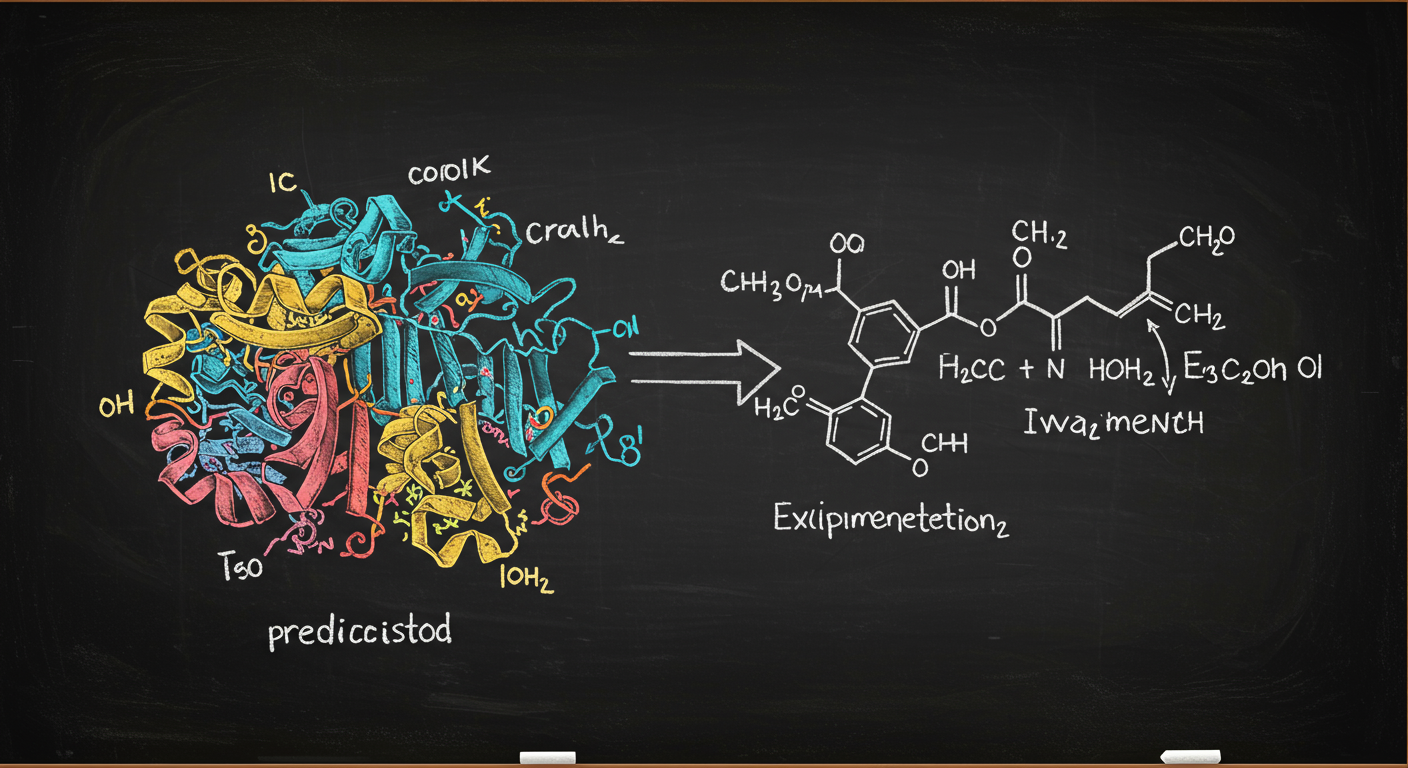
AlphaFold2, released by DeepMind in 2020, predicts protein structure from sequence. Its success at CASP14 marked a major milestone in computational biology.
Why the result mattered
A protein’s function depends on its shape. If you know the shape, you can often infer:
- where a ligand may bind
- which residues are likely active
- how a mutation may change function
- whether a protein complex is plausible
Important limits
AlphaFold is powerful, but not omniscient:
- it is less certain for flexible loops and disordered regions
- it does not fully solve protein complexes or dynamics by itself
- it predicts a likely structure, not a guarantee of biological behavior
The real breakthrough
The breakthrough was not only accuracy. It was scale. A structure that once took specialized effort could now be estimated for millions of proteins. That changed what questions scientists could ask on Monday morning.
3. AI is now designing molecules and materials
Drug discovery pipeline and where AI fits
AI is used across multiple stages of drug discovery:
- target identification
- hit finding
- lead optimization
- property prediction
- synthesis planning
- toxicity screening
Why this is hard
A good drug must satisfy many constraints at once:
- strong and selective binding
- acceptable absorption, distribution, metabolism, and excretion, or ADME
- low toxicity
- chemical stability
- feasible synthesis
That is why a single promising molecule is not enough. The model must help balance tradeoffs.
4. Human-AI collaboration in the lab
A typical human-AI research loop
- Define a biological or materials question
- Use AI to generate or rank hypotheses
- Run simulations or wet-lab experiments
- Compare predictions with results
- Update the model or the hypothesis
Why collaboration beats automation
AI is strongest when the task is well specified. Science often starts with vague goals and ambiguous evidence. Humans are still essential for:
- choosing the right objective
- interpreting surprising results
- rejecting spurious correlations
- deciding what is worth validating
Common failure modes
- Training data bias
- Confusing correlation with mechanism
- Overconfident predictions outside the training domain
- Missing rare but important edge cases
5. Ethics, trust, and what counts as knowledge
Ethical questions in AI science
Reliability
Can the prediction be reproduced by independent experiments?
Accountability
Who is responsible when a model-guided decision fails?
Data provenance
Was the training data collected and used appropriately?
Fair access
Will the benefits reach more than a few well-funded labs?
What good practice looks like
- independent validation
- uncertainty estimates
- documented training data
- clear separation between prediction and proof
The standard for scientific knowledge
A model output is a hypothesis. A validated experiment is evidence. Science needs both, but they are not the same thing.
Final takeaway
AI is becoming a collaborator in science because it can search, propose, and prioritize at a scale humans cannot. The scientific method stays the same. The tools around it are getting much smarter.
Keep going with Slate
Pick up where this left off in your own voice session.